
The Apple Box Belles
Published: December 1, 2025
Authors: Donna Sacuta, BCLHC Executive Director
For over 100 years, fruit from the orchards of BC’s Okanagan Valley has fed families across Canada and the hard-working women in the fruit packing plants became known as the “Apple Box Belles”. While much has been written about Okanagan fruit-growing, the early union history has barely been mentioned.
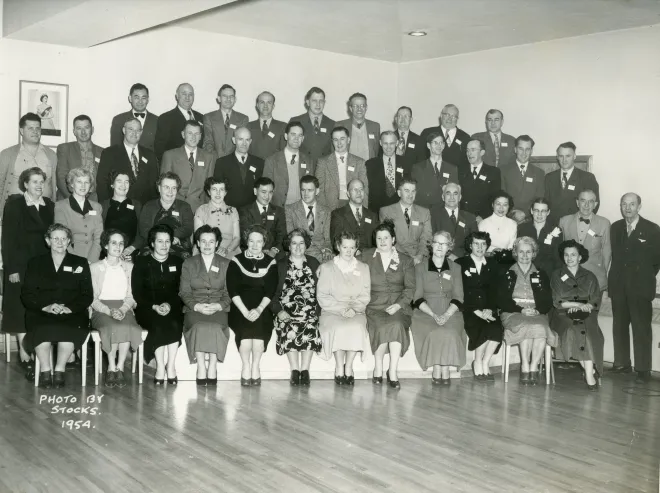
Meeting of the Federation of Fruit and Vegetable Workers Union, Penticton, British Columbia, January 22, 1954. Alma Faulds Scrapbook, SD_01_01_0119_01.
When Alma Faulds (1915-1999) first started working at an Oliver packing house she made 46 cents an hour. Lydia Bastian, who started in 1939, was making 25 cents an hour. Like in most industries, the men they worked alongside were paid more than the women, supposedly because the men’s jobs required more muscle, such as loading crates. But, with automation came forklifts and that argument was lost, though the wage difference remained. It wasn’t that common for women to work outside their homes in the early days, but the packing plants offered seasonal jobs and there was rent to pay and families to feed. It wasn’t a choice. “We just had to work,” said Bastian. But it took until the 1970s to win an eight-hour day and pay equity.
When the plants unionized, Faulds took a leadership role, becoming a member of the union executive and then a business agent. She was one of a small number of women employed by unions in BC. Inside the packing plant, workers took pride in their speed and dexterity but long hours, occupational disease and accidents were constantly present. Carbon monoxide poisoning, falls, rashes and severed fingers were some of the hazards that were generally dismissed. “The women would get headaches and they would complain, and management would say, ‘It’s all in your imagination’, Faulds recalled. Faulds and Bastian chuckled over some moments of hilarity. Bastian’s breast was squashed between two apple boxes, and the young first aid man was too shy to examine the injury. “He wouldn’t do it. He just said, ‘Well, you better go up to the doctor!’, Was he ever shy!” they laughed.
Being in a union was a new experience for the packing plant women. “We weren’t that sophisticated,” recalled Faulds. “We didn’t know how much rights we had. We didn’t know how to be good complainers. We didn’t know where to go for help.”
-
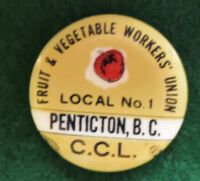
- Fruit & Vegetable Workers’ Union (CCL), c. 1942
-
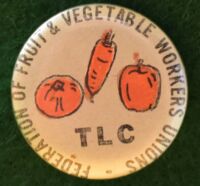
- Federation of Fruit & Vegetable Workers Unions, c. 1946
-
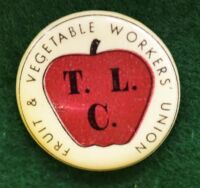
- Fruit & Vegetable Workers’ Union, c. 1946
-
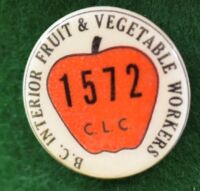
- BC Interior Fruit & Vegetable Workers Local 1572, CLC charter, 1958
In 1942, the Canadian Congress of Labour (CCL) organized a number of locals of the Fruit and Vegetable Workers’ Union in the Okanagan valley, which then formed a Federation (FFVWU) and obtained an initial contract in 1943. But in late 1945, the CCL told the unions that it no longer had the resources to support them, and urged them to join the United Packinghouse Workers (UPWA). Faulds says even though the UPWA was seen as the radical choice, there was a lot of resentment that the organizing was done in the wintertime when only a few men were working. “When spring came, suddenly we were having $2 union dues deducted because two of the men in the packinghouse had agreed that we should be organized,” Faulds recalled. In late 1946 the FFVWU transferred its affiliation to the Trades and Labor Congress (TLC). In 1952 FFVWU was granted poly-party certification for all packing plants in the Okanagan, arguably a first in BC.
An all-out strike in 1955 was fought over wages and pay equity at the height of the fruit season. Men were making $1.05 an hour, women 80 cents. Some jobs were piecework. “The business agent hadn’t bothered to tell us anything about how you act on a strike. My brother-in-law had some experience in the IWA, but I’d seen pictures of people carrying sandwich boards, and so I bought a whole bunch of cardboard, and I got some black felt pens. We got some string and we tied them together,” laughed Faulds. He also gave her some other good advice. ‘If I were you, I would make sure they get at least the equivalent of unemployment insurance as strike pay. Because the first time somebody is 50 cents short of going to the grocery store, they will start thinking about crossing the picket line.’
When management got wind of the strike they called everyone into the lunchroom for “a talk” about loyalty. “We’re all standing around and then the manager gives us this tremendous pep talk, and he talks about loyalty and how the packing house has to keep operating and ‘you know what’s going to happen to the fruit’ and ‘what’s going to happen to the farmers.’ Faulds looked around the room and the union president looked away. The chief shop steward looked away. “It appeared that nobody was going to say anything. I looked at all these undecided faces and I thought, ‘someone’s got to say something’.”
“By this time, I’m yelling. I’ve lost my head anyway, so what the hell.” ‘I want to tell you we’re very loyal,’ she began. ‘We’re also very desperate. At eight o’clock on Monday morning, we’re going to be on the picket line.’ “With that I walked out the door and I’m bawling. And that was it. We walked out.”
The strikers held firm for 16 days, winning modest wage increases and leaving just enough time for that year’s bountiful peach harvest. It was a difficult strike, during which the Teamsters’ Union offered financial support to set the stage for an attempted raid on the Federation of Fruit and Vegetable Workers Union (FFVWU). The Teamster raid ultimately failed but further divided the membership. In late 1958 the Canadian Labour Congress (CLC) intervened and created a directly chartered BC Interior Fruit and Vegetable Workers’ Union, Local 1572. The union merged into the United Food and Commercial Workers Union (UFCW) in 1982.
Sources:
Nikki Moir. (1973 February 5). “She’s proved she’s equal.” The Province.
Lydia Bastion & Alma Faulds, Interview by Sara Diamond, 1979. https://archive.vivomediaarts.com/lydia-bastion/
Rod Mickleburgh (host), Patricia Wejr (author). (2025-11-27) The Applebox Belles (Episode 33). On the Line: Stories of BC Workers.
David Yorke Labour History Collection, Simon Fraser University Library.
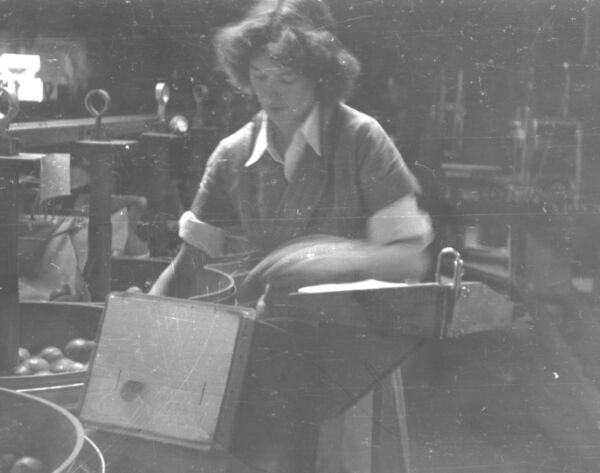
Aldredge, Ed. (n.d.) [Worker packing apples at fruit packing plant]. Doug and Joyce Cox Research Collection, UBC Okanagan Special Collections and Archives, Kelowna, B.C. Item no. OSC ARC 1.3-2/P00204.