Solidarity City: The Mac-Paps Come Home
Published: March 12, 2026
Authors: Kayden Russell Black
In the late hours of February 10, 1939, a crowd of around 9,000 Vancouverites gathered at the train station on Cordova Street, eagerly anticipating the return of 31 “Mac-Paps” – Canadian volunteers who fought against fascism as part of the XV International Brigade in the Spanish Civil War (1936-1939).
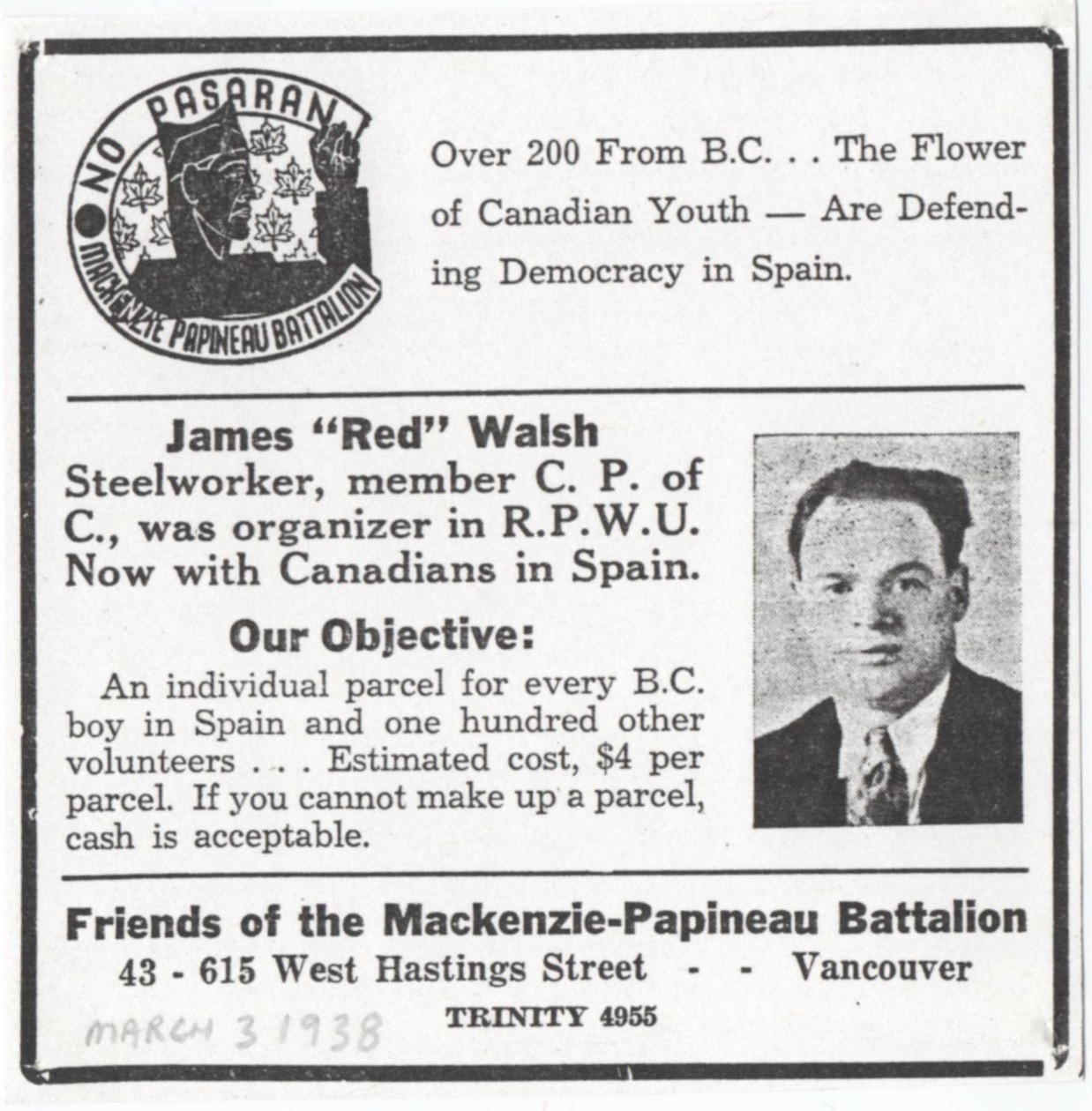
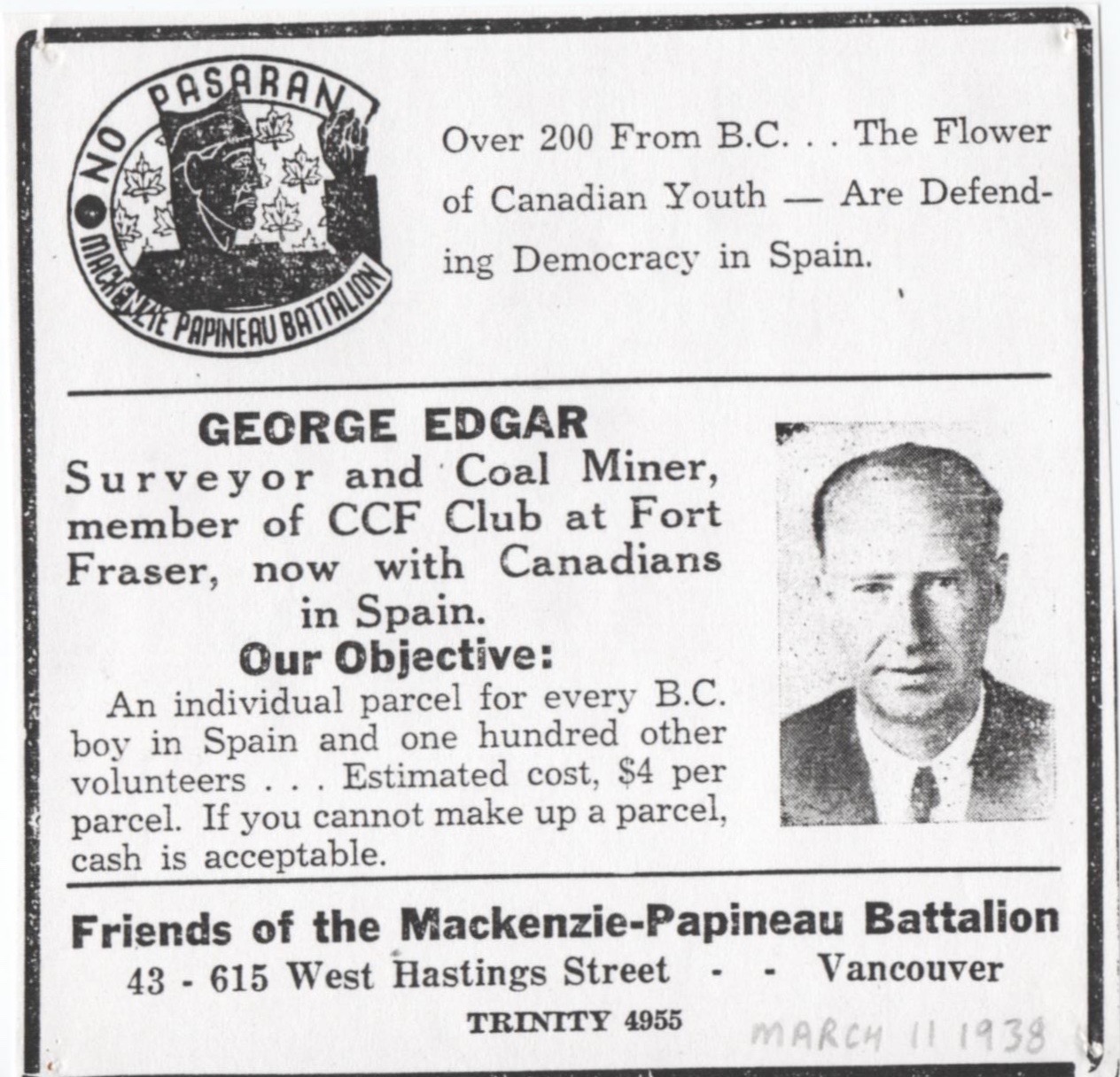
Mac-Paps were overwhelmingly working-class, and were motivated to oppose fascism by their experiences during the Great Depression. According to the Friends of the Mackenzie-Papineau Battalion (FMPB), an organisation that raised funds to support the Mac-Paps during and after the war, Vancouver had produced more volunteers proportional to its population than any other city in the world – nearly 300 for a city of approximately 275,000.
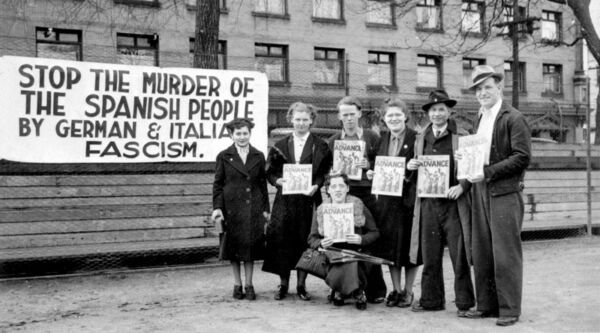
Men and women selling copies of “The New Advance” magazine at Oppenheimer Park | Michael Newman photo, 1938. Vancouver Public Library 9442
“A cry from near 10,000 throats rang out to the high ceiling of the rotunda of Canadian Pacific station, Friday night. A strange cry in an unaccustomed tongue—’Viva Republica Espagnol!'[sic]”
Vancouver Sun. February 11, 1939.
Shortly after 11:00 at night, as snow fell on the streets of Vancouver, the Mac-Paps completed the final leg of their long journey home.
The left-wing People’s Advocate newspaper described the night as “the winter’s only real snowstorm,”1 but the harsh weather does not appear to have deterred the crowd. The rotunda of the station was packed so tightly that members of the Relief Project Workers Union, one of the primary groups responsible for organising the On-to-Ottawa Trek, had to physically clear a path for the procession of “Fighting Canucks” carrying their battalion flag. The Vancouver News Herald wrote of “blue-bereted veterans, some scarred and limping, but all smiling.”2
The Vancouver Sun proclaimed that the Mac-Paps had “made history in Spain.”3
In addition to the immense crowd, delegates from the Vancouver Trades and Labour Council, professors from the University of British Columbia, and the Spanish Republic’s consul were in attendance.
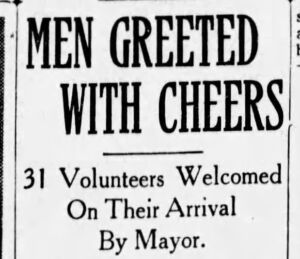
Men Greeted with Cheers | The Province newspaper, February 11, 1939
After Jean Cameron of the FMPB quieted the excited crowd, Vancouver mayor Lyle Telford was the first to speak. While the Mac-Paps were considered criminals under the 1937 Foreign Enlistment Act, and the presence of an elected official was not typical of other Canadian welcoming ceremonies, Mayor Telford took the opportunity to express support on behalf of the entire city:
“The spirit that animated your sacrifices to make democracy safe are appreciated by the people of Vancouver… these people here tonight know that you have fought for them as well as for the Spanish people.”
Mayor Lyle Telford, quoted in the Vancouver Sun, February 11, 1939
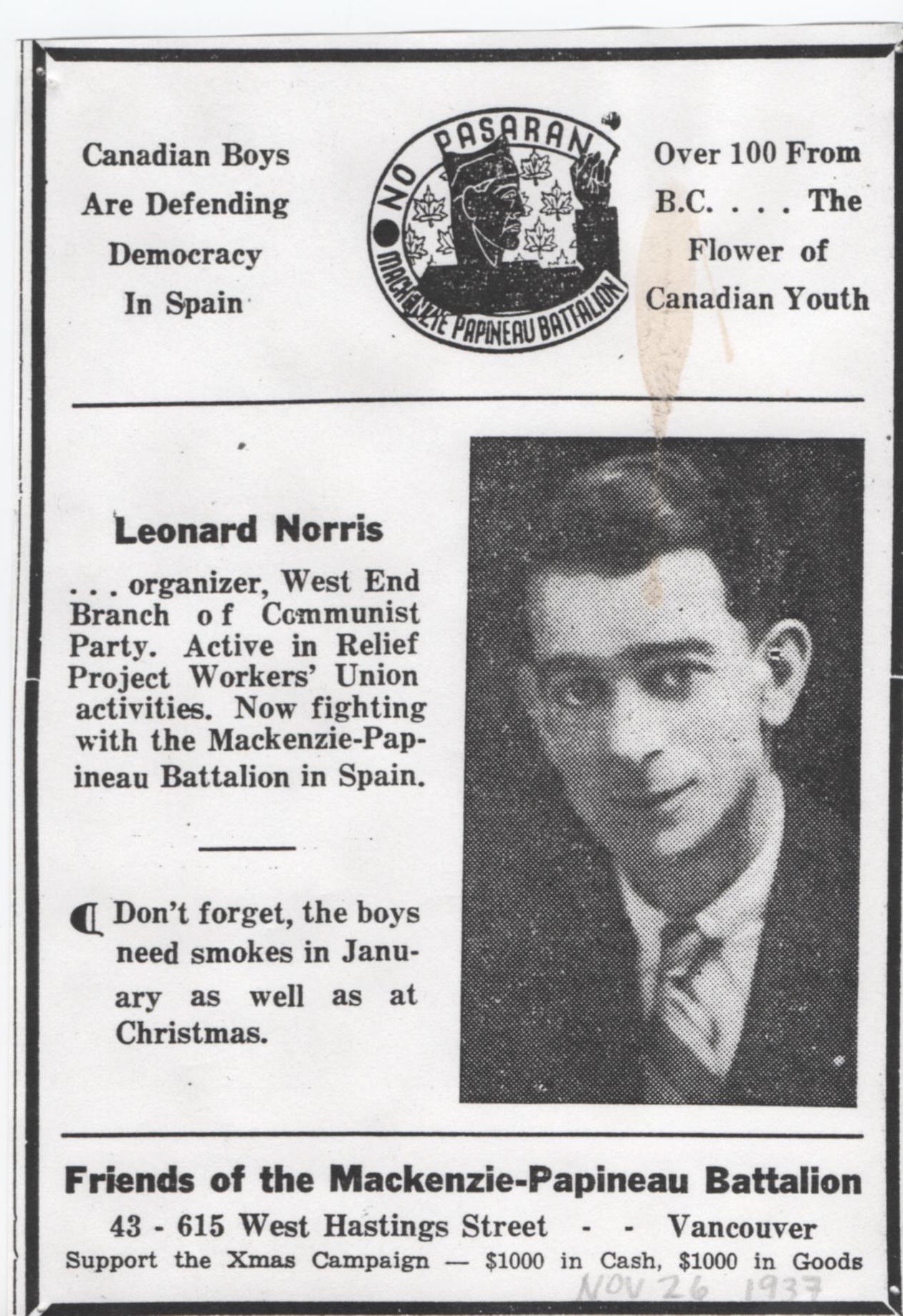
Every paper reporting on the event highlighted the touching story of Mac-Pap Leonard Norris being reunited with his mother.
” ‘My boy, my boy’ she cried. He ran forward. Utterly oblivious to the packed humanity around them, they clung to each other, reunited after years of fear and dread.”
Vancouver News-Herald. February 11, 1939.
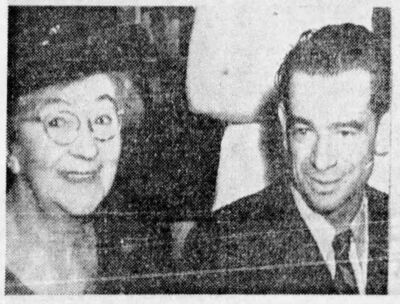
Len Norris being reunited with his mother | The Province newspaper, 11 Feb 1939
The veterans did not depart the station until some time after midnight, when the crowd was still so dense that organizers had to form a “flying wedge” to get the Mac-Paps through. The men first marched out of the station, up Seymour St. and down Pender St. to the Olympic Café, where they enjoyed a meal of beef stew.
The Vancouver press was overwhelmingly positive in their discussion of the Mac-Paps, using emotive language to present the welcome event sympathetically. Previously, researcher Mary Biggar Peck found that most pan-Canadian publications produced coverage of the war that favoured the fascist Nationalist faction, backed by Hitler and Mussolini.4 It is significant that the Vancouver press diverged from this trend.
Vancouver, as a hub of radical working-class organization, had concentrated the kind of people who would volunteer to fight in the Spanish Civil War, as well as the kind of people who would gather in the freezing night to welcome them home.
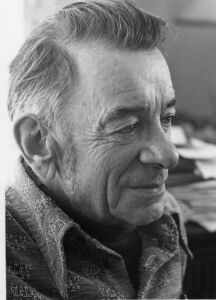
Len Norris, later in life | Pacific Tribune
Our thanks to guest author Kayden Russell Black, whose original analysis of Vancouver news coverage of the Mackenzie-Papineau Batallion brought us this story. ~BCLHC
- Wilson, J. D. “31 Returned Men Get Civil Welcome; 9000 Crowd Depot.” People’s Advocate (Vancouver), February 17, 1939. BC Labour Heritage Centre. [↩]
- Vancouver News-Herald. “2500 Crowd Into Depot To Welcome Home Volunteers From Spanish Civil War.” February 11, 1939. Microforms. University of Victoria Special Collections and University Archives. [↩]
- Vancouver Sun. “10,000 Cheer Vancouver Homecoming of Spanish War Veterans.” February 11, 1939. ProQuest Historical Newspapers. [↩]
- Peck, Mary. Red Moon over Spain: Canadian Media Reaction to the Spanish Civil War, 1936-1939. Steel Rail, 1988. [↩]