
Jon Bartlett & Rika Ruebsaat Interview: Singing Labour History
Jon Bartlett and Rika Ruebsaat spent decades teaching BC labour history through song, as music educators, BC Teachers’ Federation activists, Solidarity organizers and festival founders in Princeton.
This interview was conducted Patricia Wejr on April 7, 2026 in Burnaby, BC. It is part of our Oral History Collection.
Interview: Jon Bartlett (JB) and Rika Ruebsaat (RR)
Interviewer: Patricia Wejr (PR), Natasha Fairweather (NF)
Date: April 7, 2026
Location: Burnaby, B.C.
Transcription: Natasha Piccolo, Jett Bogart, Ryan Shachtay
[00:00:05.14] – PW
Okay, so today is April 7th, 2026, and I’m here for the BC Labour Heritage Centre Oral History Project with Jon Bartlett and Rika Ruebsaat. So, we’re going to talk about their long career in focusing mainly on music, but also their social activism. So, to start off, I’m going to do it alpha. So to start off with Jon B-Bartlett, could you just tell me where you were born and maybe a little bit about your family background, if it gives any hint as to why you became an activist?
[00:00:39.06] – JB
I was born in London, in West London. My father was on the Cardiff Hunger March in the ’30s, came to London, got a job as a porter on the Underground, and then rose very rapidly because he was a very sharp man. Conversation at home was social and political. There was 4 of us, 4 kids, and Mother and Father. It wasn’t unfamiliar. I can recall my father had been the speaker of the Hammersmith Borough Council at a very young age, like 22. When he was head of the Council, and he was parliamentary candidate later on for a seat as a Labour candidate in, I think, Eton and Slough before the war. Spoke on behalf of various people, knew various people in the Labour Party, and looking back on him and looking back on his record, he was a right-winger. And ended up being a right-wing kind of Stalinist. His notion of negotiation with people was a brick wall and a rifle. That was a way I wasn’t going to go. I found my own way into politics through the campaign for nuclear disarmament. I was on the Aldermaston March in 1963 and ’64, I think.
[00:02:13.08] – JB
With my sister, and that’s where I first connected with song. I’d been a choirboy, so I could sing, but the singing on the march was inspiring, and they were all Scots. They had come down from Holy Loch, where the Americans had a nuclear base, and they were making up songs like, [singing] Och, och, there’s a monster in the loch. A monster in the loch, a monster in the loch, och, och, there’s a monster in the loch, there’s the hated Ship Polaris. So that was—I associated song immediately politically and also with Scotland. It’s kind of intriguing. There were jazz bands on the march too, there was a whole bunch of them. So that was my parents’ stint in the sing. So that was really my insertion into song and politics together.
[00:03:12.25] – PW
Maybe at this point, I’ll just jump back and forth between the two. So, Rika, where were you born? And same question, what in your background, family background, might have influenced your activism?
[00:03:25.25] – RR
I was born in Germany, in Western Germany. Emigrated to Canada in 1952. My father’s family were staunch supporters of the Nazi regime, and my mother’s family less so, but they grew up in the same village and married, and in my household growing up, we didn’t talk politics. And in fact, when my father voted, he wouldn’t tell us how he voted. Whether that was because in Germany you didn’t get to vote or whatever, or whether he said the ballot is secret so I don’t tell anyone. Politics was not part of my upbringing at all. In fact, I suspect my parents not only eschewed it but also were frightened of it because they were completely unfamiliar with democratic process or anything like that. Our house was artsy rather than political, but we sang. We sang when I was growing up in German, of course. My father learned a lot of songs from his father, who was also a singer, and my mother’s family was also.
[00:04:39.22] – JB
And a collector.
[00:04:41.04] – RR
And a collector of songs. My grandfather, my paternal grandfather, worked in the agricultural department and went around to different farmers and worked with them and then collected songs. So he had a vast repertoire of songs, as did my father. So we sang as a family. So I came to politics largely through song. There was a little time I lived in England for a while and got involved with a fellow who was involved in the Wages for Housework movement. At the time, this was in 1974. And that was kind of my first time hanging out with political people and hearing political language. I mean, I remember going to a party and there was a poster of Marx on the wall, and somebody made a joke about it being Brahms, and I couldn’t—didn’t understand why it was a joke, because Marx looks a lot like Brahms. The composer. So that’s how completely out of it I was politically. And when I came back to Vancouver in 1975 and got involved with the Vancouver Folk Song Society, with which I had been involved as a teenager in the folk boom, and started becoming aware of the Canadian repertoire and particularly the BC repertoire through Phil Thomas, who collected.
[00:06:09.29] – RR
And through the songs and the landscape, I was very connected to the BC landscape because we used to camp in the bush when I was a kid, and very—BC was home to me and the landscape was home to me. So I connected with the songs on a kind of a visceral level. But a seminal experience for me was in 1975 I was invited—I did a lot of work. This is before Jon and I were together. I worked in schools, so I was making a living singing Canadian songs in schools and connecting the songs to the history and the landscape and people’s working lives. So I spent two weeks in Fernie singing in the schools, and then in the evening I sang in the bar at the Northern Hotel in Fernie. Now Fernie at that time was a logging and coal mining town. So here I was singing all these songs from Phil’s collection to these loggers and coal miners, and it was kind of like, ‘Oh, right, these songs are about—’ I mean, I knew intellectually that these songs were about the people and the work they did, but here I was singing the songs of these people and the work they did to people who did the work that I was singing about.
[00:07:27.11] – RR
It was very moving because I would be—people in the audience nodding their heads and saying, ‘Yeah, right, right,’ and feeling like I was a vehicle for something that was bigger than me. And it kind of went, ‘Kachung!’ And that’s kind of when the political link was made. And again, it wasn’t initially overtly political, it was working lives. But then you can’t disconnect the notion of working lives from the politics. So that was my entrance into politics. And Jon and I were friends for a few years, and we were both involved in the Folk Society, and he was suspicious of me because I was too artsy, and I was suspicious of him because he was too arrogantly political.
[00:08:19.07] – JB
Which of course now entirely changed. [laughs]
[00:08:26.19] – RR
So I wrote an article for a magazine that he was running at the time about my experience in Fernie, and so he then realized that I wasn’t the artsy dumb blonde that I maybe appeared to be. So that was kind of how we connected our musical and our political lives into a a lifelong partnership.
[00:08:46.08] – JB
But it was a struggle. We both knew that this was going to be permanent and it was going to be very important, so we had to —
[00:08:56.21] – RR
So we had to find the right—
[00:08:59.25] – PW
So just jumping back, what led you to come to Canada, Jon?
[00:09:06.20] – JB
It’s a long story and a very funny story, but it’s not really relevant. I was offered a job here as a law clerk with H.A.D. Oliver, and there were no such things as law clerks in Canada at that time. In Britain, we were called legal executives. We were essentially NCOs [non-commissioned officers] in the legal system. We weren’t officers, we weren’t barristers or solicitors. On the other hand, we were organized in the law, we had theory, we had practice. And when I came to Canada, I tried to do the things that I was doing in London, like making bail applications or doing High Court stuff, and there was no problem. Whereas when I came here, the judge said, ‘Mr. Bartlett has no right of attendance in my court.’ So that was the end of the story, and at that point I decided to become a lawyer. And then I ended up, as soon as I got through, I did my first year at City College at Oak and 12th, and within 3 weeks of going there, I abandoned the idea of going into law and became, what did I become? I just became a layabout, I think.
[00:10:23.13] – JB
There was a lot of LIP [Local Initiative Program] projects and OFY [Opportunities for Youth] projects at that time, and I involved myself in a bit of this and a bit of that. I was singing. I became a minstrel in Gastown, in the Medieval Inn among other places, and so sang around various clubs, and I suppose that’s what kept me alive. And then when I met Rika and we got together, then we began to think through the school process much more thoroughly, I think, than you had done. You were just doing gigs, but we thought about what’s the best way of doing gigs? And we came to the idea of, well, we put two classes together in one classroom, so it’s—you’ve got a nice density, and then we tie the songs to the social experience of the people who made the songs. And that was to come back to that question of Fernie. It wasn’t merely a question that Rika was singing mining and logging songs to miners and loggers. It was the songs themselves were made by miners and loggers, not by Gordon Lightfoot or by some singer-songwriter who was imagining what their lives were like. This is made—these songs were made by people who actually lived the experiences, which made them so—that’s where the nodding comes from.
[00:11:40.10] – RR
That’s right.
[00:11:40.28] – JB
When we sang in New Westminster at the—at the—Quay. At the Quay. And we were singing songs of salmon packing, made by Linda Chobotuk and the front row was women who had worked—
[00:11:56.11] – RR
In a cannery—
[00:11:57.23] – JB
Sitting there laughing. You know you’re on to something, something very significant, because the songs are going straight back to the people from whom they came.
[00:12:11.11] – RR
I think the important thing at that moment is that you as a singer are not the important thing. The song is the vehicle, and you are merely a mediator between the song and the people to whom you are singing, and that you are humble and take this responsibility very seriously to communicate their lives to them.
[00:12:38.13] – JB
Yeah, you’re the postie, you know, you don’t own the letter, right?
[00:12:42.11] – RR
Yeah, so that was kind of the stance that we took and the stance that I had learned in the experience in Fernie, which is why it was so seminal.
[00:12:53.03] – PW
So you both then decided that you would become teachers?
[00:12:56.09] – JB
No.
[00:12:57.13] – RR
Not initially.
[00:12:58.12] – JB
Not initially, no. Initially we would look for contracts with school boards to go and do a day or a week in a school board covering certain areas. We did it in French, we did it in socials and we did it in English.
[00:13:15.29] – RR
Yeah, so we basically were music—we were song educators and so we toured. So we’d spend a week in Quesnel and a week in Prince George and a week in Saskatoon and, you know, Sudbury. We did Sudbury. So we’d spend a week in a school district and go from school to school and do workshops with the kids and tying the history and the social life and the working life to the songs and engage the kids in the stories and in the singing itself.
[00:13:46.12] – PW
And how did the kids receive that?
[00:13:48.24] – RR
They loved it.
[00:13:49.11] – JB
Yeah, very well, very well.
[00:13:50.29] – RR
Yeah, I mean, you know, you talk about people, you know, the prairies in the ’30s and you talk about clouds of grasshoppers and things, you know, I mean, it’s visceral and sensual experience that you’re singing about and that you’re telling them about and they love it. And then later when I became a teacher, I very much did that in my classroom as well. So it speaks directly to kids’ sensuality and physicality.
[00:14:19.15] – JB
And then the money dried up. I mean, the grants dried up because I think many of the school boards did a contract with the musicians’ union who would offer to pay half the cost of performers who would appear and they’d put the whole school into the gym and they would go out for a smoke while the—
[00:14:39.09] – RR
Which was not our—that’s not what we were doing. We weren’t doing concerts.
[00:14:45.07] – JB
So then we became teachers, yes. Rika more than me. I did 7 years subbing in Vancouver, New Westminster, and Rika did 20? How many years did you do that?
[00:14:57.09] – RR
25 years. Well, two of those were teaching at Simon Fraser. Yeah.
[00:15:02.13] – PW
And did you do elementary?
[00:15:04.01] – RR
Yeah.
[00:15:04.20] – JB
Yeah, both of us. Yeah. Yeah, intermediates.
[00:15:07.29] – PW
What school did you teach at?
[00:15:09.12] – RR
I taught in Surrey, different schools in Surrey. Yeah, so grade 4, 5, 6, 7, that age group.
[00:15:18.05] – PW
And did you become active in the BCTF [British Columbia Teachers’ Federation]?
[00:15:23.06] – RR
Yes, yes, I was staff rep. I was on the Status of Women Committee. I was on the Political Action—PAPR—Political Action Public Relations Committee. I was delegate to the BC Teachers’ Federation annual convention numerous times. I was the picket captain for the times we went on strike. I was very involved.
[00:15:54.10] – JB
I was on VESTA Executive.
[00:15:59.20] – RR
Vancouver Elementary Teachers’ Association.
[00:16:03.18] – JB
I was chair of a committee, a BCTF committee, looking after the newsletter. At that point. What else did I do? A lot of driving, a lot of volunteering for other aspects, PAPR committee. I edited the paper a couple of times.
[00:16:32.01] – RR
He was with a group of 3 other guys and they were called the Four Horsemen of the Apocaleft [laughing].
[00:16:43.02] – JB
Yes, I was also a member of Viewpoint, which was the progressive—
[00:16:47.23] – RR
Caucus, the lefty caucus within the BC Teachers’ Federation.
[00:16:54.26] – JB
So that was—and I subbed. When I subbed, I subbed for many of the members of the executive when they had executive meetings, so I knew ahead of time. Because at that point I was also a house husband and I had two kids, so I would then sub off my duties with the kids to a friend and I would go and sub in the schools for Maureen MacDonald or Larry Kuehn or—
[00:17:23.07] – RR
Kitty O’Callaghan.
[00:17:24.04] – JB
Larry’s kids were babysitters for our kids. So I knew all these guys and we went on retreats with them. Oh, we also, at every convention, when we won, which we won every year, at the top floor of the Hotel Vancouver we would sing. Jeff Peters, us, um—
[00:17:46.07] – RR
Maureen MacDonald, Bob Rosen, Jim Edmondson.
[00:17:50.27] – JB
Who’s the guy who died? Big guy.
[00:17:53.18] – RR
Bob Rosen.
[00:17:54.05] – JB
Bob Rosen, yes. Yeah. Yeah.
[00:17:59.02] – PW
As well as all of that, you also were active in the NDP?
[00:18:05.03] – JB
Marginally. I think I joined maybe 7 times and burnt my card 8 times. Just frustration at the way which the party worked. I was involved in the Berger campaign when Berger succeeded Strachan. It must have been Strachan. It must have been ’68 with the Cockes. I was involved with the Cockes because the Cocke Machine, that’s when the Cocke Machine I think was born. I worked for Hilda Thomas ’75 and ’79. I was canvass director in Point Gray. That was wonderful because it was a principled campaign, and we had a very small chance of winning, but nonetheless we felt every year we jacked up the percentage. I had a lot of fun there. I met a lot of people. What else did I do? Oh, the Day of Protest. When was that? October?
[00:19:13.13] – RR
Well, we did in 1976 when there was the October 14th, the Day of Protest, there was a big rally down town in front of the—
[00:19:22.08] – JB
We were the secret picketers. That’s right. We were on TV with, who was that guy? We told him we were the secret picketers and he was [shocked inhale] like this. Some mainstream guy, I don’t remember who it was.
[00:19:40.17] – PW
That was a big day for Co-op Radio.
[00:19:42.21] – JB
Yes, indeed it was. Indeed it was, yes.
[00:19:44.23] – RR
Well, I would say for me, Co-op Radio was an important part of my political evolution as well. Because I was in an organization and with a group of people who thought along those lines and lived what they spoke. And for me, that was very—a really important model.
[00:20:07.16] – JB
And the word also was agency, that Co-op Radio could actually do things. And the things that we did, we were proud of doing, and with very small, very few resources, but nonetheless the team, the collective which generated Co-op Radio was a model of organizational democracy and a model of production of truth which is just fabulous. We used to do, we had a show called Folk Circle that Rika and I set up and we did a—We used to have an open line and we had 4 or 5 singers and we said, ‘You can call in and you can ask us to sing a song and we’ll sing it.’ That went on for a few hours. Remember that?
[00:20:59.06] – RR
Yeah, it was one of the marathons, I think. Yeah, and some of the people we met through that we’re still friends with.
[00:21:07.14] – JB
Yeah, like yourself [to PW].
[00:21:10.25] – PW
So then you made the big decision to move up to Princeton, right?
[00:21:18.23] – RR
Yeah, well, that wasn’t—
[00:21:19.29] – PW
I mean, is that when you retired? Is that when you decided to do that?
[00:21:23.26] – RR
Yeah, no, there was a lot of stuff that happened in between there. There was the whole Solidarity thing, which was huge. I think the Solidarity experience was a social and political milestone or turning point.
[00:21:44.07] – JB
Watershed.
[00:21:44.29] – RR
Watershed, that’s the word I’m looking for. Watershed for us. Because I was involved in my union at my school in terms of the pickets that went up during Solidarity. We were involved with Cultural Workers Against the Budget, CWAB.
[00:22:00.17] – JB
We invented it.
[00:22:01.29] – RR
That’s right. Well, what happened was that the first—there was the Solidarity, Operation Solidarity, and there was Solidarity Coalition, and we were part of the coalition, and we were slated to perform at the rally at the stadium, the first one. And it was the same thing that happened at the October 14th thing in 1976, was again that you had the speeches, which were the important part, And then you had the singers who were the sort of the filler. And it was very unsatisfying. So when the second big rally happened at the QE [Queen Elizabeth Theatre], we were the organizers of the rally. And I remember—
[00:22:48.16] – JB
And she was the chair.
[00:22:49.17] – RR
Well, I remember I was pregnant with Morgan at the time, and I was the MC, and, you know, telling Art Kube when he was allowed to come up on stage.
[00:23:01.16] – JB
[laugh] No, it was Jack. It was Jack Munro.
[00:23:04.20] – RR
Well, no, Kube was there too, but anyway, yeah, that’s right.
[00:23:07.27] – JB
Kube is on the cover of the historical magazine. That picture was taken at the, on the occasion. And Hal is there and all kinds of—
[00:23:17.27] – RR
Bob Rosen’s there, Jeff Peters.
[00:23:19.28] – JB
Yeah, and Hal Steeves is there and Hiller in front. Yeah, yeah, that was an occasion. So that was—
[00:23:27.29] – RR
So that rally was really one of the high points of—well, speaking just for me—of my political engagement and awareness. And we were able to program that event in a way that worked so that the songs were as important a form of communication as the speeches, so that there was a kind of a seamless integration of the culture and the message, as it were, into one communication, which was very gratifying. So we went through all that and all the permutations of solidarity. And I remember sitting in front of my TV on the Sunday night of the Kelowna Accord and sitting there with tears streaming down my face not knowing, was I going to go to work the next morning, and what was it all for? And until that point, because we were sort of children of the ’60s with all the, the optimism and impetus and motivation that, that many of us of that generation brought to the table, you, you worked under the conscious or unconscious awareness, quote unquote, that the revolution was just around the corner and we were going to be part of it. And after Solidarity, that notion kind of washed away, and many of us haven’t recovered from that, or have recovered in, you know, that we’ve lost that—that sense of hope and optimism.
[00:25:14.24] – RR
Not that we’re pessimists, and not that we gave up and said, ‘Oh, fuck the whole thing,’ and, you know, ‘Goodbye,’ and, you know, ‘I’m gonna go and crawl in the sand,’ or something. But it was definitely a watershed in terms of what we thought was possible and how it was possible. And in retrospect, I realized that we were naive in a lot of ways in terms of how pervasive and overwhelming the whole system was, and how difficult it would be to even not, not even touch the hands of power, never mind try to influence them or turn them over. So it was, it was very sobering in that respect, and I think a lot of people went through huge changes during that time.
[00:26:03.23] – JB
I think it was Bennett who said when asked, had there been an election at that time, they would have won every seat. And I think they were probably correct, that we were in a bubble. We were a bubble of progressive people who found joy in each other and understanding, and we didn’t live in the big world. In the big world, the people who did not do politics could have told us, we could have gone into any café, and asked somebody if they were involved in politics. No. What’s going to happen if there’s an election? Oh, it’ll be a sweep. They didn’t understand what solidarity was. In fact, I just saw a clip last night of All the President’s Men with Jason Robards as editor of the Washington Post telling Redford and Dustin Hoffman in the middle of all this stuff, he said twenty— he says the latest poll says 25% of the American people never even heard of Watergate. You’re up against something, you don’t know how big this thing is. So I was Secretary of the Lower Mainland Solidarity Coalition when Art Blakey—Art Blakey? Art Blakey was—
[00:27:22.02] – RR
Al Blakey.
[00:27:23.15] – JB
Al Blakey. I think of the drummer. Al Blakey, who was one of my heroes, was a president. Ed LeBell was also there. It was a wonderful collection of people. But as I say, I think it was a bubble. We really didn’t understand how much of a bubble it was.
[00:27:49.28] – PW
Do you think though that that basically with that foundation you then adjusted your outlook and then you actually thought, I’m only going to focus on something that I actually can have an impact with?
[00:28:07.05] – JB
I think we grew up, yes, I think we grew up in terms of recognizing that we are working in a small area, all we could do was the best we what we could do in that area. That’s where we began to focus, I think, a little bit more. We began writing a variety of books. Soviet Princeton was one, based on what we had discovered in the archives, mostly through the songs. Phil had done some work finding songs in the papers, and because he couldn’t find the old boys anymore who had the songs—they were all long dead We thought we’d follow this paper route, and that led us to the archives, and the archives led us to—
[00:28:52.04] – RR
Princeton Museum Archives.
[00:28:54.09] – JB
We were both on the board of the museum there, and so we went through every copy of the paper up until 1945 and found the story. Then that led on to Triumph and Solidarity, and that led on to a book about Haywire Mack McClintock. I mean, it just—
[00:29:14.11] – PW
Do you want to say a little bit more about that? Which one? Because people won’t know about Haywire.
[00:29:19.09] – JB
Oh, that hasn’t come out yet. I’ve written it and I’ve got his stories that he wrote for Railroad Magazine. Wonderful stories. And the guy had the story of his agency starting off as a kid who ran away from home at the age of 14 and joined the circus and ended up in New Orleans, goes into a pub where there’s a bunch of British sailors and they’re singing. And he says, ‘Can I—’ ‘Yeah, come on, sit down, kid.’ And so he joins them and they sing some songs. He says, ‘When I got back to where I was sleeping,’ and I don’t know where he was sleeping, he emptied his pockets and there was dimes and quarters and half dollars and He said, ‘I knew then, I would never go hungry.’ This was 1890, probably, something like that. He becomes a hobo as a kid. He rambles around the Southwest singing in bars and whatever else. He learned the guitar, he learned the banjo, I think, and he picked up songs, as one does, vernacular songs. Big Rock Candy Mountain, was a very rude song about a hobo who has got a young kid as a bed partner and a beggar, begging partner.
[00:30:42.25] – JB
And he straightened it out to make it acceptable. And with that, later on, he won a contest in 1925 in San Francisco, and they gave him a show. So he became Haywire Mack and his Haywire Orchestree, and put out a bunch of songs. He wrote or rewrote Big Rock Candy Mountain, also the Bum Song, also Hallelujah I’m a Bum. All these songs came from him. He knew Joe Hill, he longshored with Joe Hill in San Pedro and also in Hawai’i. He was in a strike in Utah. And then he stops politics, bang. I think he stops politics after Joe Hill is shot. He may have said, ‘This is getting too hairy.’ He had learned to be a railroad man in the—must have been the turn of the century because he was in South Africa and Rhodesia, and I think he learned to be a switchman there. And then he went back being a boomer switchman all over the States. Because there was a lot of jobs available. You could just walk into a job and show you had the skills.
[00:31:57.10] – PW
So how did you come across him?
[00:31:59.16] – JB
Well, because two or three of his songs had been collected by Phil from a couple of old boys up in New Denver. They knew 50 Years from Now and they knew Hallelujah, I’m a Bum and they knew The Bum Song. So I sort of investigated this and I began I began to do some research on him, tracking down whatever I could. It all came together, and I found out he had written 20 or 30 articles for Railroad Magazine. Found some of them, because many of them—the magazine is a pulp magazine, and the stories are fabulous. So, I sent everything off to Charles H. Kerr in Chicago, who are the publishers of left-wing stuff, and they thought it was a possibility, but I haven’t heard back from them, so—
[00:32:54.06] – RR
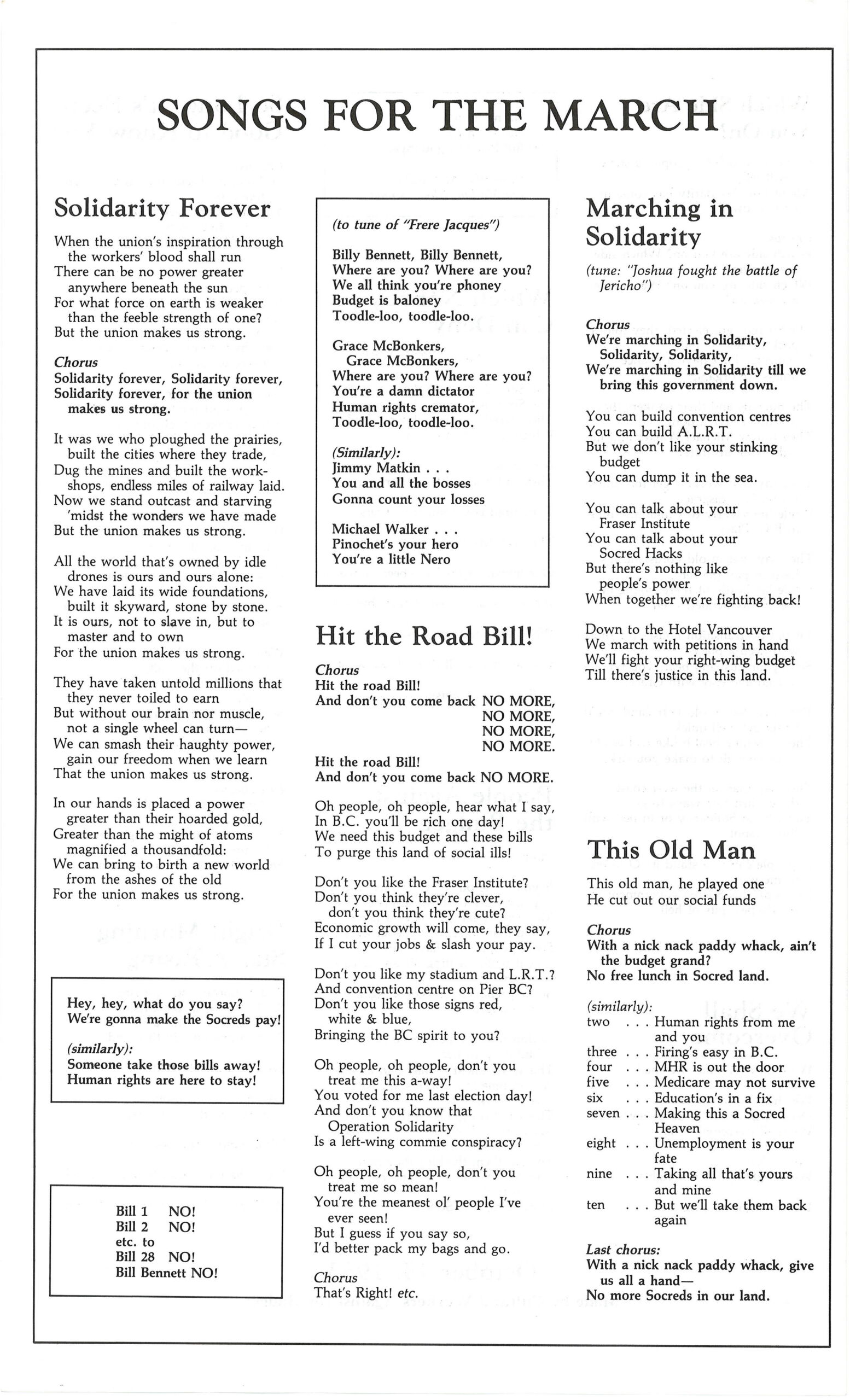
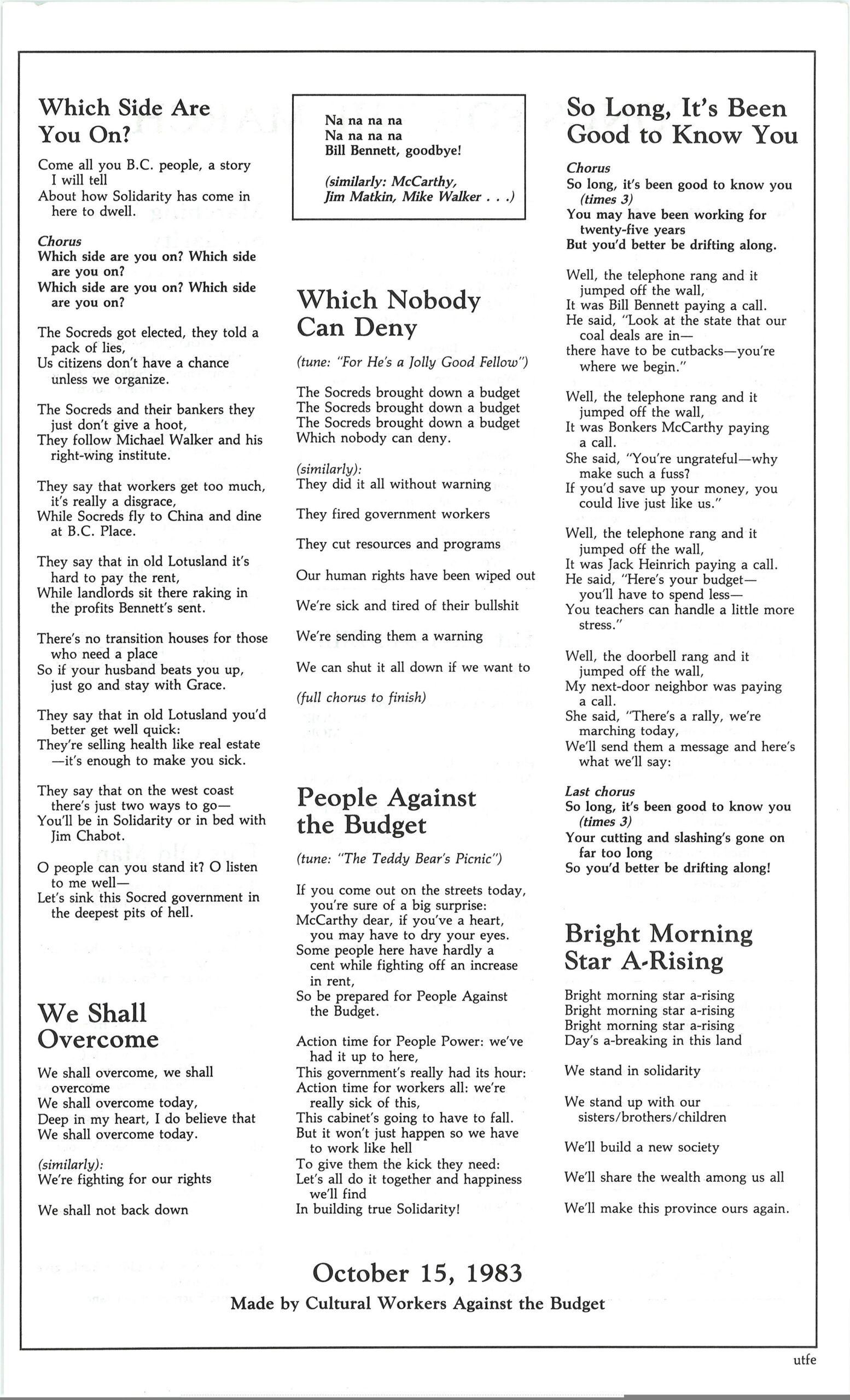
I think the importance of someone like Haywire Mack, and before him Joe Hill, was the notion of zipper songs, was the notion that you could take songs and make new songs out of them, which is what we did when we did the 1976 Labour protest thing in October and also during the peace marches and also for Solidarity, where we made new songs out of old songs that people knew. So you would take a song and just put new words to it. And do you have the song sheets here? Did you bring the—yeah. So, we put out—the Vancouver Folk Song Society and also the BC Teachers’ Federation printed this for us.
[00:33:48.29] – JB
So—And we handed them out in the march. Here’s the song sheet.
[00:33:52.17] – RR
Yeah, so that big—the marches during Solidarity, we had the Vancouver Folk Song Society had a banner and we had people walking backwards playing guitar, singing, while everybody was singing these songs. So, you know, this is one, you know, [sings] Hit the road, Bill, and don’t you come back no more, no more, no more, no more. Hit the road, Bill, and don’t you come back no more. Oh people, oh people, hear what I say. In BC you’re gonna be rich one day. We need the—we need this budget and these bills to purge this land of social ills. Hit the road, Bill and so on and so forth. You take songs that people know, or This Old Man, you know.
[00:34:34.13] – JB
Oh, the best one is the other side of the page. It’s the picnic.
[00:34:41.14] – RR
Oh yes, People Against the Budget.
[00:34:43.28] – JB
Can I sing that one?
[00:34:44.28] – RR
Yes, please. We had a demonstration in front of Grace McCarthy’s house.
[00:34:50.06] – JB
[sings] If you come out on the streets today, you’re sure of a big surprise. McCarthy dear, if you’ve a heart, you may have to dry your eyes. Some people here have hardly a cent while fighting off an increase in rent, so be prepared for people against the budget. Action time for people power, we’ve had it up to here, this government’s really had its hour. Action time for workers all, We’re really sick of this, this government’s going to have to fall. But it won’t just happen so, we have to work like hell to give them the kick they need. Let’s all do it together and happiness will find in building true solidarity. Yes, that was a lot of fun making those songs. That’s what CWAB did.
[00:35:47.10] – PW
I have a very specific music question though, because when I was reading this, what is the difference between a shanty and a four-bitter? Is that what you call it?
[00:35:55.27] – JB
Yeah, a four-bitter is a song you sing on the four bits at the front of the—when you’re off watch. A shanty is a work song. The work songs are—
[00:36:05.10] – RR
You sing it while you’re working, so it might be a capstan shanty, a slow song while you’re turning the capstan to wind up the anchor, or a short one when you’re hauling on the ropes. Or whatever, or a bunting shanty when you’re pulling in the sails and tying them up. So, specific songs for specific jobs, and you would have a leader of the song.
[00:36:23.26] – JB
A shantyman.
[00:36:24.11] – RR
A shantyman who would lead the song, and the chorus would be sung by the crew.
[00:36:28.14] – JB
[sings] I thought I heard the old man say, John Kanaka-naka too-ri-yay, today, today is a holiday, John Kanaka-naka too-ri-yay. Now, we taught these kids and then we got them to make up verses. So they did, I went to sea and I saw a shark. No, I saw a squid. John Kanaka-naka too-ri-yay. He was chewing on the bones of a grade 2 kid. And they were just [unclear].
[00:37:05.07] – RR
When I was classroom teaching, we sang every day and my kids used to to sing while they were doing their math work. And we did John Kanaka one day, and it went on for half an hour as the kids were ad-libbing verses. And the boys started making verses about the girls, and so the girls started making verses about the boys. And because they had internalized the tune and the cadence of the song, that they could just do it on the fly.
[00:37:32.26] – JB
That’s great. Yeah, it’s—I think one of their—
[00:37:34.28] – PW
I think it’s like the quartermaster’s store, right?
[00:37:37.03] – RR
Exactly. Exactly. You can make endless verses about that too.
[00:37:44.05] – PW
So, moving on, what on earth made you choose Princeton to move to eventually?
[00:37:49.23] – RR
Well, we used to go camping every summer, and we loved the interior because of just the difference in landscape and the dry air and all of that. And we thought, well, we’d like somewhere to go when we’re not—where we can go in the winter too, because you can’t camp in the winter. So we thought, well, we’d buy a place in Princeton that we can go to on weekends and stuff, and it’s only 3 hours away. And we did that, and we spent one Christmas holiday there. We said, well,
[00:38:15.17] – JB
We bought a trailer. We bought a trailer.
[00:38:17.14] – RR
Mobile home. Yeah. So, so we said, well, why don’t we retire here? Having decided to do that, we said, well, why don’t we retire early? So we did. So we sold our house in New Westminster and bought a house in Princeton. In the meantime, we were there on holidays and weekends, but we got involved with the museum and with the naturalists as well. Looking through the archives in the museum, there’s a lot of history there, a lot of labour history, railway history, mining history, ranching history.
[00:38:46.03] – JB
We started that before we moved, didn’t we?
[00:38:48.28] – RR
That’s right. We hadn’t intended to move there. We were getting tired of the rain and the traffic and all the rest of it. By this time, our kids had left home already.
[00:39:02.22] – PW
So they don’t live in Princeton?
[00:39:04.27] – RR
No.
[00:39:05.26] – JB
No, no, no. Never have.
[00:39:07.27] – RR
No, no, they were both away by the time we moved.
[00:39:12.04] – JB
We were also organizing a festival to go with somebody else’s festival. You were looking after one of the stages.
[00:39:20.11] – RR
Well, we were looking after the musical aspect of a festival that was happening there. And then we—it was so much fun, we said, well, let’s have our own festival on a different weekend. So we ran a music festival there for 12 years.
[00:39:32.02] – JB
We had a gig in New York, and we had a gig in Washington 2 weeks later. So we—
[00:39:41.08] – RR
I was still working at the time, part-time.
[00:39:43.05] – JB
We drove out, whatever it was.
[00:39:44.21] – RR
You drove out, and I flew both ways. Anyway, that’s a side story.
[00:39:49.08] – JB
Yes, it was—we did the gig. I went to Library of Congress to do some research. Rika went home.
[00:39:59.14] – RR
Did my report cards, went to a retirement party, sold our house.
[00:40:02.28] – JB
Sold the house and came back. And then we came back.
[00:40:08.29] – RR
I had a nervous breakdown in the summer.
[00:40:11.05] – JB
And immediately had the festival. So it was crazy. And that was a transitional point because then the festival, I think, became the key of what we were doing. And we began to think about what kind of—we had written about festivals, we had been to festivals, we had performed at festivals, and the question was, what didn’t we like about festivals? Because oftentimes we’d find ourselves walking down a road somewhere saying, why are we not enjoying what we’re doing? And so we had to think it through and we did. We made a festival for what we wanted.
[00:40:46.25] – RR
Music as conversation rather than as performance.
[00:40:50.19] – JB
And it was going to be a free festival and we were going to feed the performers and we were going to give them some travel money and we got grants, a federal grant and a provincial grant and then a town grant and a regional district grant, and we passed a bucket and we sold ads in the program guide. And we ran for 12, well, 15 years, of which 3 were disasters because they were COVID or fires or floods or all of that stuff.
[00:41:21.09] – PW
Pestilence. .
[00:41:23.00] – RR
The wrath of God.
[00:41:24.13] – JB
Yes, yes. But it was a very enjoyable experience and introduced us to a whole bunch of new singers. That was something.
[00:41:36.02] – PW
You know, I was thinking about this and what are your thoughts on—when I was in the labour movement, I worked for a union for 25 years, and we never would have thought of having any gathering if we didn’t have live music. Just part of what you did. I worry that that tradition has been lost. I don’t know.
[00:42:00.15] – RR
Well, what’s happening now is that our son has begun—he and a friend of his have begun a singing session in the basement of the Wise Hall. And what’s happening is all these young people are coming. I mean, it used to be when we had singing gatherings, it was mostly people our age and then one or two young people. Now we’re the sort of token oldsters. And part of the problem is that we are so inundated with music and music as a commodity rather than as something that people share with one another, that people are hungry. So what’s happening now is we’re having to turn people away at the door because there’s a lineup. Because people are hungry.
[00:42:48.05] – JB
Yeah, there’s hundreds, hundreds, hundreds of singers. In the basement of the Wise Club in Victoria once a month. Powerfully successful, huge numbers of singers, people astounded at how much they enjoy singing because they’d never sung before, and it’s wonderful. There’s a new generation coming in and we’re so glad that we just caught the—in our lives, at the end of our lives, we’ve caught the beginning of something which we hope will continue.
[00:43:22.13] – PW
Yeah, and I hope they’ll start singing at union events.
[00:43:25.22] – JB
Well, if the unions can think it through, you know, I mean, we are prepared, and I think Bevan and Dylan are prepared to present, you know, and to teach songs and to get people singing.
[00:43:39.23] – RR
It’s tricky, it’s a delicate flower in this culture, and it’s so easily steamrollered by the mainstream culture, which is based on commodification and making money. And it’s very hard for people to shift their paradigms to singing being something that isn’t something that you—that only special people can do and something that you buy, you know, either a CD or an MP3 or whatever form you buy it in, that it’s something that you do. That people are frightened to sing because only people who are gifted and professional can sing.
[00:44:16.27] – JB
Yes, yeah, that’s a sad thing.
[00:44:19.05] – RR
So you’re—it’s like Sisyphus pushing the boulder up the mountain, you know, if you’d stop pushing it’ll roll back down and squash you. So we’re hoping that, you know, again coming back to the question of what can one do in the face of, you know, post-solidarity, discouragement, and all that. So these are our small efforts to shift the ground, if it can be shifted, or however far it can be shifted.
[00:44:51.03] – PW
Is there anything that you would like to ask?
[00:44:57.07] – NF
Oh, this has been great. I’ve just been following along. I don’t have any specific questions, I don’t think.
[00:45:02.24] – PW
We’ve actually covered—I’ve heard so many good clips [laughs]. I know.
[00:45:11.14] – RR
I’m doing an oral history project right now, too, and you’re always saying, ‘Ah, yeah, that’ll be good, yeah, yeah.’
[00:45:23.04] – JB
We are open to being invited to do all kinds of stuff, and it doesn’t cost anything. We’ll do it for for free. So, but all the resources we have at our disposal, we’re anxious to spread them around before we pop our clogs, so, as the Lancashire people say.
[00:45:41.14] – NF
What does it mean to have BC-specific songs? Like, what’s the importance of songs tied to place and songs tied to BC?
[00:45:51.05] – JB
Places you’ve been, the places you’ve been to.
[00:45:54.17] – RR
I think it’s a question, it’s a question of being grounded in where you are and having a sense of connection to the landscape. And you could tie it into environmentalism of having a love of the landscape and the sense of connectedness to it. And also planting your feet on the ground on which you stand and also having people’s working lives reflected in a song is very life-affirming and very strengthening, as I experienced in the bar in Fernie, that people—this was the first time that these people had heard songs about their lives, and it was—it enlarged their sense of themselves.
[00:46:46.19] – JB
Yeah, yeah. Or, [sings] Are you from Bevan? I said, from Bevan, where those fields of stumps, they beckon to me. I’m glad to see you. Tell me, how be you and those friends I’m longing to see? If you’re from Union Bay or Courtenay or Cumberland, any place below that Bevan second dam, [both sing] are you from Bevan? I said, from Bevan. ‘Cause I’m from Bevan too. If you come from Cumberland, a song with your town’s name in it, it’s—the word I would use is enheartening. It makes you—it builds you up and it connects you, and I think that’s such a valuable—and it gives you agency. That’s the word we’ve—we haven’t used the word—we didn’t use the word until about 10 years ago, and suddenly the word agency is absolutely central to how we think and what we do.
[00:47:47.11] – RR
Because people feel so powerless these days, and it’s the opposite of powerlessness.
[00:47:55.09] – JB
They have to buy authenticity. They have to buy artisan bread rather than being an artisan making your own bloody bread.
[00:48:04.18] – RR
Anyway, I hope that answers your question.
[00:48:08.18] – PW
Is there anything else that you would like to share? I think we’ve got a great interview here.
[00:48:16.25] – JB
I would like to say that I really enjoy my life. I really enjoy doing what I’m doing, and I hope it’s useful. It may not be useful to this generation. Generation or indeed the next generation, but I hope when I write or when I sing, I do it for the ages, as it were, in the sense that this is a useful human product that can be appreciated, if not now, maybe later. But I’m happy doing it. I feel it’s a worthwhile job.
[00:48:54.03] – NF
What is the job like? Because it’s also work, right? Being an educator, being a musician.
[00:48:58.24] – JB
No, we don’t make—I don’t make that distinction.
[00:49:01.15] – NF
No, but exactly. So what is it like as labour?
[00:49:04.22] – RR
It’s immensely—it’s hard work, but it’s also immensely gratifying because—and it’s selfish too, because you wake up in the morning with a sense of purpose, a sense of agency, and you look forward to getting down to it. And so in that sense, the degree to which it makes the world a better place is—you could say it’s an act of faith, or it’s an act of hope, or whatever. But you’re not doing it with that, ‘okay, I want to make the world a better place, what can I do to make the world a bet’—like, it’s not like that. It’s like, I really enjoy doing this because it’s grounding for me, and one hopes that it is grounding for other people too.
[00:49:52.25] – JB
I’m transcribing the diary of J.C. Goodfellow, who was the United Church minister in Princeton, 1927 to 1958, who kept a diary. And he was involved in the strike, in the strike with Slim Evans in ’33-’34. And it’s It’s tedium after tedium. It’s, oh God, it’s an enormous haystack with one or two diamonds as I’m transcribing this stuff. That’s work. Occasionally I’ll find some little nub, some reference here and some—oh, great.
[00:50:41.08] – NF
Is there anything else that you’d like to say?
[00:50:43.15] – RR
I don’t know whether it’s relevant, but I’m working on a book right now of German immigrant stories. Oral histories.
[00:50:50.23] – NF
Tell us about that project.
[00:50:54.01] – RR
Well, it started off as a piece that I was working on an autobiography just, you know, just for sort of family consumption, not, you know, with any notion of publishing it. But I had a chapter emerged called ‘The Problematics of Being German.’ And I was telling some—I was actually telling Harley and Eleanor and also Tom Morton about it, and they said, ‘We would like to read it.’ So I said, ‘Sure.’ So I sent it to them, and then Tom said, ‘Can I send it to my German friend?’ And I said, ‘Sure.’ So he sent it to his German friend. I got an email back from the German friend, pages and pages of his family history. And I said, this is a topic that needs public discussion. So I had already done a book on summer camp stories, oral histories of people who went to summer camp. So I thought, well, I’ll do one about German immigration, because the layers of social and political ramifications are huge, particularly in these troubled times. So that’s what I’ve been working on, so I’ve been interviewing immigrants from Germany and had someone interview me rather than me interviewing myself. And so I’m in the middle of doing that now. I’ve interviewed about 50 people and I’m beginning to conceptualize the structure of the book. I didn’t want to impose a structure on it. I wanted it to emerge out of the oral histories. So that’s what I’m working on. You know, it’s a long process, as you say, the transcribing of the interviews and deciding what to use and what not to use and how to tie it together and that sort of thing. But again, I wake up in the morning and say, ‘Yes, I’m going to get to work.’
[00:52:41.04] – JB
We should say also we’ve just finished a book called Our Singing Lives [noun, rhymes with hives], or Our Singing Lives [verb, rhymes with gives], I’m not quite sure. It’s going to be about 100,000 words of our history essentially, and what we’ve learned and what we’ve learned was wrong, and also a collection of papers and articles we’ve written over the years. I’m looking for a publisher for that, so we don’t know quite what will happen with that. Some young people said, ‘Oh, the young’uns will need to read this.’ Okay.
[00:53:31.04] – PW
Great.
[00:53:32.11] – PW
So you’re obviously extremely busy.
[00:53:35.29] – JB
Yes, I love it. I love it, yes.
[00:53:39.22] – PW
Yeah. Okay, so I think we can—thank you so much for coming out and doing this.
[00:53:44.12] – JB
Thank you. It was lovely.
Jon Bartlett was born in West London, England, where his father, a veteran of the Cardiff Hunger March, rose from working as porter to being an elected official. Jon’s own activism began with nuclear disarmament marches in the 1960s, where he first connected music to political action. After moving to Canada to work as a law clerk, he became a Gastown minstrel and school performer, and later a substitute teacher in Vancouver and New Westminster.
Rika Ruebsaat was born in West Germany and emigrated to Canada in 1952. In 1975, she found herself singing songs from folklorist Phil Thomas’ collection to loggers and coal miners in a Fernie bar, and she saw how songs made by working people carried their working lives back to them. She joined the Vancouver Folk Song Society and later taught elementary school in Surrey for 25 years.
Together, Jon and Rika toured school districts as “song educators,” linking BC songs to labour and social history. Both were active in the British Columbia Teachers’ Federation (BCTF). Rika served as a staff representative, picket captain and member of the Status of Women and Political Action committees, while Jon sat on the Vancouver Elementary Teachers’ Association (VESTA) executive and belonged to the Viewpoint caucus. Jon was canvass director for Hilda Thomas’ NDP campaigns in Point Grey in 1975 and 1979, and both were involved with Co-op Radio and the 1976 Day of Protest.
The Solidarity movement was a watershed. Jon was secretary of the Lower Mainland Solidarity Coalition, and the couple helped found Cultural Workers Against the Budget (CWAB), writing new words to familiar tunes for marches and rallies. Rika was MC of the Queen Elizabeth Theatre rally.
After retiring early to Princeton, they ran a free music festival for 15 years, served on the museum board and wrote books drawn from local archives, including Soviet Princeton, When Heroes Become Villains, and Triumph and Solidarity.
Related Resources
Vi Cordoni Interview: Singing for Labour and Justice
In this interview conducted by Sean Griffin, Vi (Violet) Cordoni describes her history of singing for her community. Vi was born in 1938 in Drumheller, Alberta to Hungarian-Canadian parents. She descr...
Timeline: BCTF Past Presidents Interviews
The BCTF History Project interviewed past presidents and other leaders of the BC Teachers’ Federation, with most of the interviews recorded in 2015–2016. In 2024, the collection was given to the...
Lesson Plan: Operation Solidarity, English/French
In 1983, Operation Solidarity and the Solidarity Coalition came together in response to a series of proposed bills by the Social Credit government to stage the largest protest in the province’s histor...
George Hewison Interview: Music for Social Change
George Hewison grew up in Campbell River where he learned his unionism and politics at “the kitchen table” during the Cold War years. He was an organizer and executive member of the United Fishermen a...
BCTF History Interviews Collection
Beginning in 2014, a working group of BC Teachers’ Federation staff and volunteers conducted interviews with past presidents of the BCTF. These interviews cover most presidencies from 1963-2022,...
Allan Seager Interview: Chronicling BC's Labour Past
Labour historian Allen Seager spent decades documenting British Columbia’s working-class past, from coal mining communities to the On-to-Ottawa Trek, while helping build Simon Fraser University&...