
Joy Langan Interview: Union trailblazer, NDP politician
Joy Langan (1943-2009) trained as the first woman apprentice compositor at Pacific Press in Vancouver. As a member of the International Typographical Union (ITU), Joy was elected in 1972 to the union’s Executive Board and began a career in the labour movement that would span over 35 years. In 1988, she was elected as a Member of Parliament in the federal riding of Mission-Coquitlam, one of 19 NDP MP’s from BC.
mcgrath_fonds_82_12_Langan.mp3
Recorded May 16, 1989
Transcribed by Donna Sacuta, September 2025
Tom McGrath [00:00:02] This is an interview with Joy Langan, May 16, 1989, in the House of Commons. Joy, back in 1983, Solidarity, the movement began in July. How did you first get involved with the Solidarity movement? Was it through OpSol (Operation Solidarity), or had you started to participate through the Unemployed Action Centres?
Joy Langan [00:00:49] Well, the Unemployment Action Centres were in place, and as Director of Labour Participation at United Way I had a contract with the Federation to administer those Action Centres through my office. So that started, they obviously were a natural part of the Coalition. But the Operation Solidarity, I was immediately involved in as Vice President of the BC Fed (BC Federation of Labour). So being a Vice President when the whole plan hatched, if you like, I was really active in both sides. Part as a decision maker of the Operation Solidarity, but also part as a participant in the Coalition.
Tom McGrath [00:01:44] Now, were you working, for instance, along with George, on the Unemployed Action Centres? Or were you working—
Joy Langan [00:01:55] George?
Tom McGrath [00:01:55] He’s now the general secretary of the CP (Communist Party), he’d been the secretary of Fish (United Fishermen and Allied Workers Union).
Joy Langan [00:02:08] Okay, George Hewison. Well, the Action Centres were— George was active in the Vancouver and District Labour Council. So the Action Centres were each — there was an Action Centre for each Labour Council region, and in fact some regions ended up having two and I think a couple of the Labour Councils had three Action Centres in their geographic region. Now, they had started doing some work with the unemployed prior to the Federation’s Action Centres starting, and they became part of that. There was some autonomy struggles, if you like, over the years, but certainly I didn’t work that closely or that directly with George. He was Co-ordinator and the Labour Council executive worked with him directly. They had a different agenda. [laughter]
Tom McGrath [00:03:16] That’s very true. Had you, had you not been that Vice President of the Fed, would you have gotten yourself involved in the Solidarity movement?
Joy Langan [00:03:33] Oh, absolutely. Absolutely. I think, first of all, because I was Director of Labour Participation at United Way, and United Way being an umbrella organization for a number of mainstream establishment community groups, there was a need to educate those agencies about A. How the numerous pieces of legislation would affect them, B. Why they should be part of what they saw to be a political movement, very difficult because those agencies depended a great deal on provincial government funding. So they’re kind of nervous about doing anything that they see, that maybe seen to be partisan. They also have boards that in many cases, don’t reflect the average Canadian’s community, but reflect the corporate community, and they’re also very dependent on corporate support. So there was a real education job to do. And even had I not been a Vice President of the Fed, I in that position, was accountable not only to the United Way, but to the labour movement. My task was carved out at any rate, and made it much easier. Being Vice President of the Fed, I had better contacts.
Tom McGrath [00:05:06] That’s with the community groups?
Joy Langan [00:05:08] With the community groups, but also with the Federation to know what, you know, in terms of information and day-to-day knowledge of what was going on.
Tom McGrath [00:05:23] Were you given an official position to work in conjunction with the community groups other than being on the Trade Union Steering Committee?
Joy Langan [00:05:37] Well, I was on the Trade Union Steering Committee of Operation Solidarity, or I’m sorry, the community — the Chair of the Community and Social Action Committee of the Fed. Now that’s probably not true either. Going back to 1984, I was Vice Chair of the Unemployment Committee, Chair of the Human Rights Committee, and we ultimately merged those committees into the Community and Social Action Committee, but they’d essentially been the same kind of work. So that created, was a natural liaison into community groups. The other thing was that in each community, the Action Centres became very much part of the community service delivery, like establishment of their community and had an opportunity, because they’d been up and running for a while, to have established credibility in the community. And so it made a very much easier then to make the transition or to start politicizing the whole process in the communities. They also had tremendous contacts.
Tom McGrath [00:06:47] You mentioned earlier, having worked and having some differences with George and so on. Once the Lower Mainland Budget Committee was established, that’s the beginning of the week, and OpSol was created at the end of the week sort of thing. How did you see the Lower Mainland Budget Committee, as a group?
Joy Langan [00:07:11] Well, I think it’s important to note, if you say, “Well, the beginning of the week they started, at the end of the week OpSol was formed.” I mean, these things just don’t sort of get formed on a Thursday.
Tom McGrath [00:07:23] Oh, no, no.
Joy Langan [00:07:23] And so the frustration of that, I guess, would be fair to say, that the Fishermen’s Union had been part — as an affiliated union of the Fed — of the development of the whole scheme, of the whole plan and pre-empted the final decision of the Fed officers and Executive Council by announcing their budget committee. Needless to say, that creates some acrimony, frustration. People count on each other in those kinds of situations to work as a team, and so when one group is trying to upstage another group, the larger group, that creates A. lack of trust, B. anger, C. frustration, you know, all of those things. Now that’s not to say that you can carry on being angry, frustrated, and not trusting people. I mean, the stakes were pretty high, and so people had to work together. So we set that aside and carried on.
Tom McGrath [00:08:37] This is really interesting, because I wasn’t going to raise that specific question at this point. Is that one of the reasons why eventually then on August 3, the LMBC is then virtually merged into the Lower Mainland Operation Solidarity Coalition, because of what New West wants to do? Because the New West and District Labour Council then established the OpSol Coalition in the Lower Mainland, and Frank Kennedy said, “Well, yeah, okay, maybe it’s a good idea to do this merger.”
Joy Langan [00:09:21] Well, there’s — I think that might be part of it. I mean, it was fine to have sort of upstaged and said, “We forced the established labour movement, or the administration of the labour movement to do something.” I mean, that was in my view the clear intent —
Tom McGrath [00:09:39] [interrupts] Oh yeah!
Joy Langan [00:09:39] Of the early announcement, okay? This is, I mean it’s a long history of this in the labour movement.
Tom McGrath [00:09:44] Oh yes, although I know that. You know better than I do, about that.
Joy Langan [00:09:47] Okay, so once that little foray is won, then the question becomes: “We’ve got it now. We’ve got to get together and make it happen.” And so to have two groups doing two separate things doesn’t make a lot of sense. The full thrust then is to get everybody working together and people swallow their pride and just carry on, on both sides. So, it’s sort of a shuck and jive thing that who can get the word out first and it’s like politics, I mean, what is politics? Each group is playing to its own constituency as well, so that brings in a whole other dimension of not just the public perception, but one’s constituent perception. And then we carried on from there.
Tom McGrath [00:10:44] Okay, would that be the same sort of interpretation you would place on the reluctance, I guess, of Art to support for instance, the first march that was on July 23? Because he had the one on the 27th in Victoria, both of them which were magnificent successes, no question about it. But, would we be thinking that basically is — ?
Joy Langan [00:11:18] Again, the 27th was planned, established, and there was a need to be out there first, in my view, on the part of the other side, politically within the Fed, and so the 23rd march was planned. So obviously, again, people say, “Why are you doing this? We can’t afford to diminish the optimum hit on the 27th. Shouldn’t we all be putting all our energy into the 27th?” Rational reasoning doesn’t take place under these kinds of circumstances, it’s agenda that wins the day, and fortunately, there was enough anger and determination around the issue that both came off as magnificent successes. But again, yes, I believe that it was the same kind of one-upmanship.
Tom McGrath [00:12:26] Would you project that then to the same sort of situation at Empire Stadium, and then for the march on the 15th of October?
Joy Langan [00:12:35] No, no, because both of those were done in concert with each other. Empire Stadium was part of the series around the province of rallies and the march in October was, you know, I mean, there was a focus. It was the Socred convention at the Hotel Vancouver. So that was done and everybody was in on those together.
Tom McGrath [00:13:00] Yeah, but that 15th. Art told the Lower Mainland and Richmond Solidarity meeting, that they’d be lucky if they got 6,000 people out for it. He didn’t think that they should have it.
Joy Langan [00:13:17] Which one? The Socred convention?
Tom McGrath [00:13:21] Yeah, the Socred convention. Well he came around eventually.
Joy Langan [00:13:22] Well, of course, you know, Art — those final decisions, he may have thought they shouldn’t have it, but the final decisions were made by the committee, or by the —
Tom McGrath [00:13:34] The steering committee?
Joy Langan [00:13:35] Yeah and so, his first reaction may have been that it wouldn’t be successful. But when you get a steering committee that’s representative of all groups, and they all say, “We’ll deliver,” then, you know. But I mean, in Solidarity, one of the interesting things, I guess, the most frightening things that happened in the whole Solidarity thing was we were so successful right from day one, in terms of the size of rallies. The rally we had in Victoria, the one that you referred to earlier, was so enormous that we were saying during the rally, “Anything we ever do in Victoria will be a failure in the eyes of the media and everybody else because, you know, what are the chances of getting that kind of an enormous response again?” It was really symptomatic of how that pile of legislation had affected everybody. I mean, it wasn’t just the trade union movement and its vested interests, or it wasn’t just seniors and their vested interests or whatever. It was everybody who was spurred by this. And so, I mean, it was — lots of things were wrong, lots of things went wrong, but the ability to get all of those people with all of their agenda and their vested interests and their special interests and so on, going down the same road for any length of time was really a phenomenon.
Tom McGrath [00:15:12] Well, in particular, the one thing about the 27th, that always strikes me, it was in the rain, and people usually don’t want to be there. Yeah!
Joy Langan [00:15:22] Just a bit.
Joy Langan [00:15:32] You said the 27th? In Victoria? I had responsibility for disabled people from the BC Coalition, wheelchair disabled, some of them profoundly disabled who were really anxious to be part of it. And actually, I was also responsible for coordinating the busses and so on. Which was a mammoth job with BC Ferries.
Tom McGrath [00:15:50] Swartz Bay.
Joy Langan [00:15:51] They were not too anxious to be cooperative. Simple things like ensuring that there’s washrooms, getting the legislature to provide us with access to a disabled washroom on the ground level for those people because obviously the government wasn’t too anxious to cooperate with us in any way shape or form, but we managed to embarrass them into providing washrooms that these people in wheelchairs could use, fibre cans or Johnny-on-the-Spots or whatever are not going to be much use to people who are wheelchair dependent. So there was a tremendous coordinating job just for something to ensure that the disabled can fully participate in this. The kinds of support that we got even from affiliated unions in terms of creative ideas to try and facilitate some of these mammoth — they don’t seem so mammoth today, but boy, they were sure big problems at the time. These spontaneous rallies aren’t always quite so spontaneous.
Tom McGrath [00:17:05] Joy, it’s interesting that you mentioned the disabled because one of the questions I was going to ask in the community groups. Was the disabled group one of the ones that you probably worked with most closely?
Joy Langan [00:17:16] I certainly worked with them closely. I didn’t limit myself just to the mainstream community services because the nature of the work that the Labour Participation partner of United Way does, we train new counselors in the workplace. One of the things we do is train people in the workplace to be referral agents. We don’t just rely on mainstream community services. We rely on self-help groups so that people have a place to plug into it if they’ve got problems, aside from just going to counseling or getting tangible help. It’s also just support groups. So I worked a lot with those kinds of self-help groups and community agencies, but really the big work and the tremendous coordinating job of that was done by Renate Shearer and the Coalition group that would liaison with us. And I have to say, much to a lot of people’s surprise, the executive director of the United Way and even the board who we had worked very hard to get some more progressive people on the board. The board took a hands-off attitude and the executive director was very, very progressive, very supportive, even to the point of the United Way as a unionized workplace, of just getting the word out to workers at the United Way, that they were welcome to go to any rally. It was very surprised to a lot of people who had a cynical attitude, including the Vancouver and District Labour Council, about another bountiful United Way, the middle-class umbrella agency. So there’s been a lot of work done there and a lot of work done prior to Solidarity to make that kind of mutual response and support take place. The United Way made it very clear to people what picking up a contract to get jobs would mean to their agency in terms of labour support, in terms of donations, in terms volunteer time, in terms of credibility in the community, and so it’s up to those individual agencies because they’re all autonomous.
Tom McGrath [00:19:50] Did you work very closely with some of the people, such as David Alexander, Jill Livingston?
Joy Langan [00:19:57] Not particularly closely, because I was sort of working more centrally, and because I was an officer and during that height of things we met every morning and sometimes during the day. I didn’t spend as much time at the grassroots. My staff spent a fair bit of time, but I didn’t spend as much time at the grassroots level. I want to say grassroots, at the meeting, community group meeting, I was however the person that carried the message [laughter] back to them, on closing day.
Tom McGrath [00:20:37] Uh huh. How did you, because you mentioned specifically the disabled and it’s a group that really I find fascinating because of their particular problems, but also because they had some very, not very favourable things to say about some of the organizations that they worked with because they were not being very considerate. One of the ones was the Women Against the Budget, because they didn’t provide any sort of facilities for them to get into the meetings, this sort of thing.
Joy Langan [00:21:08] Yeah.
Tom McGrath [00:21:11] How did you find the WAB people? Art had, certainly, some problems about them.
Joy Langan [00:21:23] Again, I mean, they’re a group that had a specific agenda. Just like the labour movement and other community groups had to learn a lot about each other. If nothing else, that whole Solidarity exercise was a great education and learning experience where people who’d never thought about something as simple as accessibility. Who’d never thought about what disabled people’s issues are or what women’s issues are or what women in poverty’s issues are, as opposed to working women’s issues. We had to sort of stop and address those issues. Now, lots of mistakes made. I can remember having some difficulty getting people to understand why we should have a signer at the big rallies for the hearing impaired. Once they realized, they’re very proud to be doing it. I mean, “Why would we need that? What’s the importance? Oh, I see. Okay. Wow, it makes sense.”
Joy Langan [00:22:28] So now that’s become a very standard part. We have signers at conventions now. And even if we don’t have a hearing impaired person in the room, symbolisms. They’re just like my business cards, we have Braille on them. Things, it’s a symbolism. Even I just bought a house that’s not wheelchair-accessible. I don’t think of those things all the time because it’s not something the affects me. It’s just constant re-education. So I don’t think it was intentional that people would do those things, but I think, and I don’t even think it was negative in that. Frustrated as the disabled might have been, they did a hell of a job of educating people about those things, and I think that’s important. So much so that after, in the last couple of years, we started in the Labour Participation Department, a liaison between the labour movement and the disabled community that meets once a month, and talks about sort of trying to educate agencies about organized labour and organized labour about the issues particularly as they might affect the collective agreement. For example, this is getting off topic, but long-term disability programs are not designed to maximize somebody, an injured worker’s abilities. Or even a disabled person who’s not been a worker’s abilities. If you can work half-time and then you’re off the job, then you end up being back on long-term disability based on half-time wages, instead of full-time wages. So while we think we’re negotiating really super stuff in our collective agreements, the disabled community’s been able to educate us about some of the things we haven’t thought about. And vice versa, where the disabled community sees organized labour as being a barrier to access to the workplace. When they understand, for example, how seniority protects them once they’re in that workplace, or how a collective agreement protects them from harassment or negative treatment, and stop and think that in fact it’s the employer who does the hiring, not the union. We found that when they approach the unions first, the unions are usually quite anxious and cooperative to try and they know the workers on the shop floor know better than anybody inclusion with the disabled, how the workplace can be adapted. That the union is usually very positive. So no longer can the employer say, “Well, the union won’t let us.”
Tom McGrath [00:25:15] Yes.
Joy Langan [00:25:16] Yeah. So it’s very, very positive. And that really has been a spin-off, if you like, in terms of labour’s willingness to participate in this from the education they got during Solidarity. So it was a long, slow road.
Tom McGrath [00:25:33] It’s true. The one good thing is that it’s once you start that educational process, it actually does keep going, at least I like to think that it does.
Joy Langan [00:25:43] Yeah, that’s right. Sort of like recycling, you know, once you become conscious and you just quit throwing cigarette papers or the cellophane off cigarette packages out of your car window. [laughs]
Tom McGrath [00:25:55] Oh yes. No, no it’s true because I see, every time I see people throwing something out of a car window. I understand perfectly. I really would. I’d like to talk something more about the union movement, because with that OpSol, I mean, that was an historic event on that 15th when they established that organization, because of the non-affiliates coming in, and not just the non-affiliates, but some of the real people that you had some incredible battles with, when the CCU (Confederation of Canadian Unions) came on, and so on. How did you feel about the CCU being brought in, Jess Succamore, Jef Keighley.
Joy Langan [00:26:45] Well, they came in, but they sort of are in and out. It certainly hasn’t created lasting relationships, but I think it was significant. And again, it was a kind of example we talked about earlier where we can all go off and do our own thing, and we can get together and maximize the potential of it. It’s like saying two small organizations unite, you’re a stronger organization. Certainly in terms of the front they can present to the world, then it’s the same, and I think that was positive. I’m a great believer in one-big-union kind of concept anyway that, and one, you know, speaking with one voice, and it’s just the one thing about that. A. As long as it’s democratically run, there are many voices that create that one voice. And so that’s very important. But secondly, when you operate that way, you have to submerge some of your own convictions to create the voice that everybody can live with. And some organizations have a great deal of difficulty. And some personalities have a good deal of trouble with that. [laughter] Yeah.
Tom McGrath [00:28:03] No. No question of that. The thing that’s really interesting, because when I spoke to Art, Art was very adamant about the inclusion of the CCU, and really went after Jess because he thought it was important that they came in, and yet there was some opposition from some of the other people.
Joy Langan [00:28:26] Well, I think again those are oppositions that are based on historic experiences. Secondly, based on when we talked earlier about you have to be able to trust your colleagues. I hate using more analogies because I don’t even like war words. But you want to be able to trust the guy who’s playing in the trenches next year that he’s not going to shoot you in the back. So, I mean, it’s a whole lot of fence-mending that in a very concentrated period of time under very stressful circumstances has to happen. You don’t have the luxury of taking your time to learn to trust each other. My argument has always been, unless you’re talking to each other, you never gonna resolve anything, so let’s start by at least extending the invitation and working. Experience may mean that you can’t go on working together, but you have to at least make an effort. So I agreed with Art on that.
Tom McGrath [00:29:26] Wasn’t one of the reasons that the relationship never really became close was because almost at the beginning, the CCU people talked about the possibility of a general strike? I mean, what about the four-year, no-raiding pact thing?
Joy Langan [00:29:47] I mean I just think it was, you know, when you have so many years of historic bitterness on both sides and again you can maybe put a band-aid on it to fight today’s war but that doesn’t deal with the whole history of unresolved conflict and so I don’t think it’s ever destined to be a close relationship. Particularly with the leadership that had the bitter history. Sometimes these things can be patched over time with new leadership and new attitudes and so on, it wasn’t ever going to be a possibility.
Tom McGrath [00:30:32] Yeah, no, the reason I like, it’s really fascinating because you keep looking. [interruption].
Tom McGrath [00:30:44] Um, no, because it’s funny because PPW (Pulp, Paper and Woodworkers) and Art Gruntnman worked together in March, and Jack Munro always is, you know, it’s always —
Joy Langan [00:30:55] Well, there you go. Yeah. You know, but you have to remember that there’s also some historic differences, if you like, between CPU (Canadian Paperworkers Union) and the IWA.
Tom McGrath [00:31:07] Oh, no question.
Joy Langan [00:31:07] So what a nice way to be able to thumb one’s nose, to take up with the opposition. So who knows? I mean there’s just so many little by-plays that are involved. Things look great on paper. We have people involved, you know. [laughter].
Tom McGrath [00:31:21] Much more difficult. When they were ousted, and I’ve asked everybody about this, Joy, so I’m going to put you on the spot as well, they were ousted in November, right after the CCU is from OpSol, and Art says publicly that it’s because they haven’t been paying their dues. But as I come back and say, “Except Mike Kramer said in September we didn’t have to pay, no one had to pay the dues, the $5 per capita thing.” And certainly CCU, plus the CCU is putting money into the LMBC, whatever. And the public statement that came out from Succamore was that really it was the question that he wanted negotiations more public. He didn’t want an under-the-table agreement that was taking place. That he felt was happening at that point as the negotiations were opening
Joy Langan [00:32:25] Well, I mean, I think that it was an unhappy relationship from square one, I think, and sort of a culmination so both sides came up with their excuses for parting ways. I certainly have never found Jess Succamore to be an open and public negotiator, except when it’s convenient. I mean, it’s a closed-door meeting, but then there’s the open public discussion. So any more than any other organization that takes care of its own business. But I don’t think that I’ve ever been impressed that the CCU was one bit more democratic or open to the public about anything than any other organization. On the other hand, there was a serious problem. It was a major affiliate that never paid its dues. Now, it wasn’t saying what they couldn’t pay because it was financially unable to and could we make an accommodation, it was downright refusing to contribute what everybody else had made sacrifices. So, on the other hand, it was certainly a convenient way to deal with it on the other side. So I take it as a measure of convenience on both sides. I think what it really was was mutual agreement to not love each other anymore. [laughter]
Tom McGrath [00:33:54] But you see, the other thing that comes into play is this whole silly question of the general strike, too, because you’ve got the HEU (Hospital Employees’ Union), I mean, and they’ve been active since September. Jean Greatbatch has been actually made responsible for organizing and publicizing, educating for a general strike, sort of thing.
Joy Langan [00:34:13] Well, that’s a case of another agenda, again, and I guess none of us were opposed to a general strike, except if you call a general strike and don’t have one, you’ve got big trouble. What do you do after a general strike? I mean, what’s left? Especially if you have a general strike that’s a failure. What’s left? I mean it’s over, and so you have to, I think first make sure you’ve done everything else possible. And secondly, once you have your general strike, how long can you hold it? First of all, can you get everybody out? Secondly, how can you long can hold it? And history ended up showing that it was going to be impossible to get it up, much less hold it, and so that’s the problem. And that’s the reason everybody resisted general strike until all else had been tried. Subsequently, on June 1 we had a general strike that was extremely successful.
Tom McGrath [00:35:20] I mean, 300,000. But that was just a one-day situation. Yeah.
Joy Langan [00:35:25] As you know, we were having a sort of escalating general strike in Solidarity. The BCGEU got their collective agreement. They knew they weren’t going to be able to hold their people out. A lot of unions who had hoped to deliver were concerned that they wouldn’t be able to deliver. And we were ready to go into the next phase. And some of the unions that subsequently trashed all over the Solidarity, the OpSol, were unions we were afraid they were not going to be able to deliver, just by virtue of the kinds of reports we were getting back. So, Jack was asked to go to Kelowna, and by everybody. I was, I lived not too far from Jack, you know, at the time, and we were waiting for a call to come into a meeting, and I called Jack twice, “Why haven’t you called yet?” And he said, “Why don’t you come over here for coffee?” He anguished the whole morning about whether he should go or whether he shouldn’t go.
Tom McGrath [00:36:41] This is —
Joy Langan [00:36:42] This is to go up to Kelowna. So I’m taking you, moving ahead, and was getting endless phone calls from people saying, ‘Please go, please, go.” The mistake I think that was made, my statement was, “Don’t go alone.” Well, Gerry Scott was going with him, his staff person. I think that was a mistake. It should have been another officer. What it meant, I guess, was two people carried the can instead of one, huh? Final negotiations, regardless of the outcome, he was there on behalf of all of us. He was in constant telephone touch. We gathered at the boardroom of the BCGEU, the whole OpSol leadership, including Renate, who was there representing the Coalition. And we were in constant communication. That was a whole historical thing that we were sitting there having a wonderful time drinking champagne with the BCGEU. They obviously were having a party. It’s a big deal. And when they came in with the champagne, offered us all a glass of champagne. Most anybody had this one glass then left and went into this closed-door meeting. So, you know, the impressions get certainly escalated, but that wasn’t the case. It had to be the most miserable night, raining buckets. When the final conclusion, you get what you can get, and certainly, Jack Munro is a negotiator who knows what the limits are and when you’re not going to go any further. The group agreed. It was finalized, and then, conveniently, a whole bunch of people forgot that they were part of that decision. And suddenly, Jack Munro became the scapegoat, including the BCGEU, which leads us then to the following convention. And so, I guess that’s the part of history that bothers me most, is that so many people that I worked with day-in and day-out suddenly forgot their role in the decision. BCGEU had a collective agreement. Our concern was that at that point, they may not be able to keep the people out. The next wave, I’m trying to think of who was due to go out next.
Tom McGrath [00:39:11] Oh, the communications workers on Monday. Yeah, the communication workers were not out. The bus drivers, yeah.
Joy Langan [00:39:19] Bus drivers, ferry workers. There was a sense that as we got beyond that, we were going to be in trouble. But I think the key was could the BCGEU keep their people out? [unclear] those kind of strikes. I guess I was incensed at the time by just the 180 degree turn. I went with Renate and Leif Hansen to the Coalition office and reported the terms of the settlement. Sat there for four hours.
Tom McGrath [00:40:02] This is Sunday night?
Joy Langan [00:40:03] Yeah, and was abused, understood people’s anger, frustration, etcetera. I was willing, I said, “Willing to sit there and do that. I know these groups.” I was concerned about getting somebody who was particularly hard-nosed, who isn’t used to dealing with community groups, who are quite different than my sort of discipline in the labour movement. It was very painful. We were all heartbroken. And of course, the other problem is community groups not being negotiators, and don’t understand when it comes to a point where you know that you’re not going to gain any improvement. Mike Kramer, when the other meeting broke up, arrived and people, the attention then was directed to him and people were saying, “Well we’re not going to support you anymore,” you know, this kind of thing. And Mike is a very blunt person who is used to speaking to labour groups who said, “Good news, you don’t like what we’re doing, go your own way.” That was interpreted to mean he didn’t give a damn. What it really meant was, “Well, if you have to make that decision, you make that decision, so you shorten it. And Mike talks in shorthand. But again, not being used to community groups you know, if he said, “Well you know, I’m really sorry that you feel this way, but if you have to go your own way, well I understand that,” probably would have been read a different way. So it’s interesting how, and again, it’s the differences that we’ve got to learn to understand.
Tom McGrath [00:41:47] Joy, what was the mandate, as you can see, that you people had given to Jack?
Joy Langan [00:41:53] Well, the mandate was to negotiate a settlement.
Tom McGrath [00:41:55] Right. Okay.
Joy Langan [00:41:56] And to keep in constant touch, which he did. Nothing was agreed to without —
Tom McGrath [00:42:01] Okay, but this is this is then on the the night of [November] 11-12 when he actually made that agreement with Spector. But he was in constant touch with —
Joy Langan [00:42:10] With us. With the whole board, he wasn’t on conference call with 30 people, but he was in constant touch with us and reported, “[unclear] said this,” and we said, “Well no, it’s got to be this,” and he’d go back and come back and say, “Well, it says this.” You know, so it wasn’t that he made an independent decision and on the final word, the final program, we voted and conveyed that back to Jack. So it wasn’t, and he wasn’t acting alone. And the man has carried a hell of a can —
Tom McGrath [00:42:46] Because of it?
Joy Langan [00:42:48] Because of it. And a lot of people who just weren’t willing to acknowledge their role in making that decision.
Tom McGrath [00:42:55] You see, why, I guess the one thing that does bother me about this, he had gone up there and Bennett was supposed to publicly state what the agreement was on television and he refused. Jack carried out his end of the bargain, Bennett didn’t, and yet Jack was prepared to go along with it?
Joy Langan [00:43:18] We were on television. They were on television, you know, and then they, it was recorded back, and I thought the deal was cut by then. I mean how do you, how do you, once you publicly announce you got an agreement, say, “Well, no, because the Premier won’t go on television, the agreement’s off.” When he had a decision that that was the agreement and everybody accepted it.
Tom McGrath [00:43:50] Okay, maybe I’m missing something then —
Joy Langan [00:43:53] Maybe I am and your question.
Tom McGrath [00:43:53] No, no, no, no, I can understand that, but if you’re negotiating with someone and that person says, “Okay I’ll come out and say that this is what the agreement is,” and you come out and say you’ve got an agreement, and “This guy’s going to explain it,” and this guy doesn’t explain it, don’t you not then have the right legally to come out and say, “I’m sorry, whatever agreement we had doesn’t exist because this man won’t tell you what it is?”
Joy Langan [00:44:22] Well, I suppose you do, except now we’re in front of the TV cameras, now you’ve spelled out that we’ve got an agreement and somebody do mirrors and plays coy. I suspect public opinion, because everybody wanted, ‘everybody’ I’m talking about the public, wanted to see it resolved, just in hindsight, it’s easy to say. I suspect the public would have said, “Well, they got an agreement and the Premier won’t go on the television, I mean, what difference does it make what the agreement says?” Now, I know, and you know, that that’s because the reason you want him on television saying what the agreement is, so it doesn’t change in the night as he sleeps on it. But the problem is that we had public opinion that was starting to dissipate along with the ability to keep people out, because now it’s starting to affect people. If you had public opinion sway, I’m not saying you operate on public opinion, but what I’m saying is that changes and people’s support, just the rank and file support, starts to be [unclear] and it can be, you know, it’s pretty tough and it’s a judgment call I guess. But I still don’t think that when we agreed to the agreement— the other thing is, do we then show ourselves to reneg on this agreement? It’s tough. It’s a tough judgement call and you have to have lived and dealt with those players over the years to, you know, Jack is a man of integrity and he’s also a man who expects integrity and he would expect the highest level of integrity from the Premier. [unclear] [laughter].
Tom McGrath [00:46:12] Yeah, yeah. To what degree, and I argued both with Cliff and Jack on this thing, to what degree was the BCGEU agreement, does that affect him? Because I think it affects him a lot.
Joy Langan [00:46:29] I’m sorry.
Tom McGrath [00:46:30] It affects Jack’s and his decision not to then [unclear].
Joy Langan [00:46:32] Oh, absolutely, absolutely. I mean, this is it.
Tom McGrath [00:46:36] Yeah, no, because this is.
Joy Langan [00:46:37] Jack has as his mandate, which the BCGEU, and this is of course what he’s looking for, and I’d like to get into that whole scenario.
Tom McGrath [00:46:49] Yeah, oh, OK.
Joy Langan [00:46:51] Can we do this again?
Tom McGrath [00:46:52] Yeah.
Joy Langan [00:46:52] We haven’t got all the way through the questions. (Break in recording)
Tom McGrath [00:47:00] Langan, the 6th of June 1989. Joy, we had talked about a number of things that happened with Solidarity and your activity as a member of the Solidarity committees, on the Public Sector Committee of the BC Fed.
Joy Langan [00:47:24] Not on the Public Sector.
Tom McGrath [00:47:25] But your name’s listed on that meeting on the Wednesday of the 13th.
Joy Langan [00:47:29] Of the Public Sector? Of the 13th of?
Tom McGrath [00:47:42] July. See the big meeting was on the 15th, and almost all the Executive Council members were at that Public Sector meeting.
Joy Langan [00:47:55] Oh, okay.
Tom McGrath [00:47:56] There were a couple who weren’t, but almost everybody was.
Joy Langan [00:47:59] You’re right.
Tom McGrath [00:48:05] After that meeting, and then you knew you had two big meetings on, the thing escalates up to November, with the strike of the BCGEU. Then the teachers go out. There’s a week of negotiations basically that take place while the strike is going on. There is a plan. Jack Adams, the Planning and Strategy Committee, and they talk about what they should do and they set out an escalation plan, but it simply ends on the 13th. My question is, why isn’t there, wasn’t there a greater attempt to get people like Munro and the IWA, which were in a legal position to strike, or even Owen Dykstra in CUPE, which were also in a legal position to strike, to get them to support a general strike.
Joy Langan [00:49:17] Well, because it was planned to be an escalating thing. And the sentiment that developed as a result of the impending BCGEU settlement was, ‘Would those who were out hold?’ because now a major group had a settlement. BCGEU had a settlement, and if they didn’t hold, then what would we have? Soon we’d have a divided cause because BCGEU went back and others went out, it would be a lot of frustration, anger, you know, because the sense that BCGEU probably wouldn’t stay out now that they’d done the agreement. I think that that was a major concern.
Tom McGrath [00:50:23] There’s really no indication until Jack gets involved on the 10th, or after he gets in touch with Jim Matkin. He and Matkin get together and then that Thursday, he and with Mike and so on, Mike Kramer, Steve Kelleher was the other person on the [unclear]. What was it that made them think the GEU was gonna settle? Because he was in touch with you people.
Joy Langan [00:51:06] I’m having a hard time casting my mind back. Such a sort of, such an intense chronology of events, I can’t even get my mind back to the events leading up to it. I think it was a Sunday that Jack went to Kelowna.
Tom McGrath [00:51:33] The agreement that Jack made was actually made on the Friday night. That’s the night of the 11th – 12th. Did you mean the new agreement is made subsequently?
Joy Langan [00:51:44] Well, yeah, they announced the agreement on Sunday.
Tom McGrath [00:51:47] Yeah, but it had been made actually before that, Jack Adams said.
Joy Langan [00:51:51] And so, you know, that’s what the image was. It may not have been announced publicly. But these guys are experienced negotiators, and they can sniff a settlement, you know, and they can certainly judge when they’re getting really close, when they’ve sort of taken care of the thorny issues, and now it’s just a matter of time to get it settled. So, now, whether it was a case of the other unions didn’t believe that the leadership in the GEU could hold its people, or whether it was a case of Jack letting those folks know. But it certainly seems to me that that was my concern. There’s no doubt about it. It’s not easy to get your folks out. Sometimes it’s tougher to get them back. But everybody was cranked up, if you like. Everybody was ready to go, everybody had made the commitment. But again, you know, when discussions take place, and people think, well, maybe something can be resolved and settled, do you stick to the plan, or do you sort of spinoff and see what you can do to try and — I mean, the whole purpose of the exercise was to get some movement out of the government. So if it looks like, here’s an opportunity to get something resolved, at least you’ve got to make that effort. In my view that’s what it’s all about. Otherwise, we weren’t just demonstrating for the exercise. We weren’t demonstrating just to flex our muscles and show the world that we can do it. I mean, we had an objective, and the objective was to get the government to turn around on some stuff. So I guess, you know, it’s a judgement call. Do you take a shot at it? What do others feel? Those who had the biggest burden to carry in life, and that’s those guys who are taking out the major unions, I’m sure do not operate in isolation. They were in touch with each other. And the decision then was made in consultation with the officers for them to go. Take a shot at it. I think that answers your question.
Tom McGrath [00:54:33] Well, it does, in part, but there’s still the question about when you’ve got that numbers ready to go, and granted the GEU has been out for 10 days, sort of thing, it’s difficult to keep them out.
Joy Langan [00:54:56] But once they’ve got an agreement it’s really—
Tom McGrath [00:54:57] Oh yeah. But with, you see, the agreement comes, with the agreement, when that doesn’t come until later, they are told to go back until Monday, or the vote’s taken after this sort of thing. People, Hydro workers, ICTU transportation workers, the ferry workers, all ready to go out on the Monday, or Tuesday.
Joy Langan [00:55:31] But, I can remember conversations the night that we were in the meeting while Jack was in Kelowna. And at that point, the BCGEU members didn’t know Jack was in Kelowna, they were still out on the picket lines. And the pickets lines were coming down. The burning barrels were being loaded onto trucks and taken away. I mean it was, certainly my sense was there was no {unclear] in that. I might be wrong about that, but I mean, you can’t sort of talk about any of these things in isolation because there’s such a cobweb of events that take place that it would be easy to say, “Well, these folks let us down, or these folks were chickening out.” But unless you saw it all sort of leading up to, and what took place at the time and then of course history will never record all of those emotions. You can’t really get a true sense of why decisions are made.
Tom McGrath [00:56:54] See this is a really interesting thing, and it’s one that I pose and re-pose. In July, Norm Richards, Kube, Munro are all saying we cannot trust this government. Okay, there’s a certain amount of rhetoric in the statement.
Joy Langan [00:57:18] Well we all believed that.
Tom McGrath [00:57:18] Okay, if that’s the case then, how come, four months later, three-and-a-half months later, they’re sitting down, they’ve been hassling with this government. The government has made, from nothing I’d seen, given any indication that they’re prepared to kneel. They make an agreement which is an agreement. But then they don’t uphold that agreement, even starting with Jack in Kelowna, when Bennett broke the [unclear].
Joy Langan [00:57:59] Let me approach this all of the factors. Will the people go out? I mean, it’s fine to say, “Well, we got that far and everybody goes out.” There was a lot of questions how far this went. The government was banking on that, too. I mean it’s no small task. Everybody is obviously exhausted. Fed up with the whole trying to shake these guys’ loose. So if you look at it from the point of view — plus others were in, which although on one hand it’s a useful tool, as you said earlier the IWA was ready to go out, people were ready to go out and make the strike. Also, makes it bloody hard to negotiate a collective agreement when you’ve got a few of these two things going. So there are separate but they are together, and to even get the employers to get down and get serious about that. So I guess the question that I’ll always have was, was there really true revolution in the [unclear]? Was there really truly? One of the things that I think I learned in my years in the labour movement is you can’t get too far ahead of the rank and file. And were we being pushed ahead of the rank and file. Some of them might have been by Hewison and left, and it’s one thing to get people out to a massive demonstration where you’re going to be able to get them out and then when you got them out, what are you going to do next, you know. Is the government going to outwait us or are we going to manage to keep people outwaiting the government? The stakes, although they were high based on what Canadians had come to expect and understand, were certainly not high and insignificant as opposed to what’s going on in China today. So the ability to build something that you sustain and then what do you do? What’s the next step in a democratic society? Do you overthrow the government? How do you do that in a democratic society? It has to be at the ballot box. Well, the results are at the ballot box next time the people voted the suckers back in again. So, and then we start to question, “Were we too far ahead of the troops, folks?” You know what I mean? I mean, that might not, that’s just my own personal reflections after of what leads people, because something that I’ve always believed is you’ve got to keep them, they’ve got to come along with you.
Tom McGrath [01:00:59] OK, let me pose this question.
Joy Langan [01:01:01] Maybe I’m, I don’t know if I’m right.
Tom McGrath [01:01:03] Yeah, no, no. I, you know, what you’re suggesting is basically the leadership was ahead of the rank and file.
Joy Langan [01:01:10] To some extent.
Tom McGrath [01:01:11] Yeah, OK.
Joy Langan [01:01:13] I mean, it was obvious that there was rank and file who were ahead of leadership in terms of how far they were going to go.
Tom McGrath [01:01:18] OK, Bill McDonald though, in September, this is at the September 16 sit-in. I think it’s after the September 13 meeting of the Solidarity Coalition, where the Lower Mainland Budget Coalition talks about having a march past the Hotel Vancouver. And Bill McDonald of the HEU says, “Well, you know, sometimes the leadership has to catch up with the membership.”
Joy Langan [01:01:52] Well, I think this is true. I mean I — but again, it’s due to that it’s a fine line in that kind of thing. I mean, maybe not quite as fine a line than some other more volatile stakes or fires. And I’m not saying stakes weren’t high for us. I’m just saying that we weren’t in a life-and-death struggle. We were in a struggle for dignity, and we were in a struggle for workers’ rights, but not nearly the magnitude of some other struggles. I guess, you know, again, that’s a situation where a leader who had an agenda, among other things, a different agenda, a more militant if you like, a left-wing agenda. He is very, that’s almost a rhetorical statement, if you see labour movement politics of you know, of pushing. [unclear] It’s very easy [unclear] to reach for us to catch up to the membership in that room. But there’s, you know, a hundred other communities that the question becomes, “Where is the membership,” in relationship.
Tom McGrath [01:03:39] Such as Nora Paton with the nurses?
Joy Langan [01:03:45] Nora Paton with the nurses. Peace River. Just divided by geography.
Tom McGrath [01:03:52] Campbell River, Powell River, and these are all fairly militant, although they do have lots of —
Joy Langan [01:04:01] They have levels of militancy too. I mean, we hear from the militants. We don’t hear from the people who carry union cards and pay their dues, or even who basically go to union meetings, but who don’t share the level of, sometimes commitment sometimes — some of those people are very committed to unions.
Tom McGrath [01:04:24] Oh, yeah.
Joy Langan [01:04:25] They don’t see it, don’t see the same level of activism and militancy.
Tom McGrath [01:04:31] No.
Joy Langan [01:04:32] But we do hear from the militants.
Tom McGrath [01:04:34] Yeah. No, no, I’m just thinking about at Powell River for example, the IWA women crossing picket lines when the Pulp and Paper Workers were locked out. Same sort of thing come March of 1984 and Jack is virtually condoning crossing picket lines, which is —
Joy Langan [01:05:04] That’s another historical battle. I mean, nothing is as simple as it seems, you know, we’ve got 100 and some years of labour history in BC and there are relationships that are strained most of the time but that you can set aside your differences when the cause calls for it and then you go back to bashing each other after.
Tom McGrath [01:05:32] Actually you have about 150 years of labour activity.
Joy Langan [01:05:37] Well, organized labour.
Tom McGrath [01:05:49] Organized labour, okay.
Joy Langan [01:05:50] For example, my union is celebrating its 100th anniversary [unclear] but yeah, you know, I was thinking mostly in terms, but certainly, yeah, you know, and there’s a different kind of, even today, even the most, if you like, conservative labour leader in BC, in my view, is probably more militant than some of what is viewed as left-wing labour leaders in Ontario, because our history is different.
Tom McGrath [01:06:16] I’m not going to dispute that — [laughs].
Joy Langan [01:06:17] No, I mean our history is quite different and it’s reflected in the history molds and you have a lot to live up to too, in terms of the militant history.
Tom McGrath [01:06:34] But you see, I guess there’s a number of things that come to mind, because in August too, Art’s going to — and he publicizes to see people find out about the changes to the Labour Code. And the threat’s made, you know, if anything’s done, we’re going to pull the troops out. And I’m just wondering whether by the time we get to November, there’d been too many statements that we’re gonna do this sort of thing, and we’re kind of going to have these escalating strikes, this sort if thing. And whether the government would just sit back and say, “Well, go ahead, because, you know, drawing out, there’s the same sort of thing we do. We try to waste your energy.”
Joy Langan [01:07:25] Well, sure. I mean, better to fight the battle now, if I was the government, when you’re on a committed course and then once we get them, you know, totally discouraged on this one, it’ll be free sailing on whatever else we’re wanting to introduce. And you know there’s no doubt in my mind when you get into the Bills 19 and 20. A. They would have been a lot worse had we not gone as far as we did. And B. That wouldn’t have been all. And I think that as it turned out, I mean, the government’s agenda was only halfway completed in my opinion. In my opinion, government was heading for and dedicated to right-to-work. And God knows why they didn’t try in BC as the place to introduce something. Some provinces are more vulnerable, if you like. Again, the left-right struggle was obviously more visible.
Tom McGrath [01:08:34] See, that’s a curious sort of thing. And I think that when you play sports, you go to two places. You go either to weakest link, or you go the strongest one. As soon as you knock back the strongest, then the rest will just fall.
Joy Langan [01:08:52] Yeah, that’s true, that’s true. I guess that we can also do a lot of navel-gazing now, of what went right and what went wrong. But on the other hand, a lot has to do with a couple of things. What kind of people Canadians are, even militant Canadians in British Columbia. Still that’s what makes us different. We’re a relatively conservative lot. “As long as life is not too hard, just leave me alone and I’ll do my thing.” And so that’s one sort of thread of our make-up. On the other hand, we’re a relatively comfortable lot. And that’s not in any way diminishing people who live in poverty or life has dealt a rough blow to. But we are, overall, as a society relative to the country’s society, really not the makings of revolution in terms of there’s a lot to lose. And it’s tough. I mean, when you take all of that stuff that was going on and try and translate that to the couch potato or the guy who just wants to go to work and go home and leave me alone. And a lot of people are that way, and rightly so. I mean it’s a tough grind out there in the workforce. I never allow myself to lose respect for the guy who just wants to go and produce and go home and make a life. But to try and, you know, whose interests are, and as Canadians, that’s the other thing, we’re all conditioned to the 30-second clip. So we try and take all of that stuff and translate it into the 30-second clip that’s going to get you and me fired up. It’s pretty tough. In many ways, it was amazing that we got that far.
Tom McGrath [01:11:14] But you see, if you look at, you know, that escalation, and I’ve asked a number of people who actually participated in each of the ones, starting with the one July 23, then Victoria, then Empire Stadium. It’s really funny, because each one of them, Dave Cadman thinks that that July 23 was the most important because they had 25,000 people out there virtually, you know, from scratch.
Joy Langan [01:11:43] Oh yeah, I mean, it was phenomenal and I think testimony to the ability of the labour movement to get its message out. But 25,000 people out of 250,000 organized workers, affiliated workers to the Fed, plus all of the non-affiliated workers plus all of the workers who aren’t organized. I mean, 250,000 is — or 25,000. But it’s —
Tom McGrath [01:12:12] Small percent on a per capita basis of those workers. The only thing is, you see, it’s in a single area, which has most of the population and so on. So when you take that into account, I think that it probably becomes even more impressive, because then you have, you know, as the thing develops, you have the 27th taking place, but then you also have, and that’s in Victoria. Then you have other places, too, where it takes place, where they have their marches and so on, their demonstrations. Empire Stadium is the same sort of thing. And that Empire Stadium, you now, that’s midweek, with 45,000 people going off the job. I mean, let’s face it, they’re losing pay, losing prospect of being fired, whatever. So they’re putting a hell of a lot on the line.
Joy Langan [01:13:07] There’s no question. The question becomes, I don’t want to sound like I’m trying to dismiss or be an apologist for what happened because I’m not. But the question becomes, I’m sort of being almost philosophic here. Once it’s going to do that and the other needs to have a little bit of, “Who did that? Those 45,000. Who were those 45,000? Those were the militant and the almost militant, and it’s the people who sort of suddenly clocked the bug at you guys. What would it have, and it was a phenomenal amount of work. It might have been it sounded like it but those things don’t just happen. Tremendous amount of organization. They were the easy ones, if you like. They were the cream in that there was going to become a time, I believe, that the [unclear] It’s going to get tougher and tougher. The other problem was, once you had those kinds of successes, it started to peter out, there would have been nothing left to negotiate for. So there’s that factor too. I just, for example, watched and totally frustrated by the ability to catch, and I guess that’s what it needs too. Those people, they caught their imagination. We saw that to some extent, for example, four years ago when the seniors organized around their pensions.
Tom McGrath [01:15:08] Well here in 1985. Oh yeah.
Joy Langan [01:15:12] And they won. So the government’s getting at them in a different way now. You can’t, with the clawback that we’re facing today, equally as devastating. You can’t catch the imagination.
Tom McGrath [01:15:26] See, I think you can.
Joy Langan [01:15:27] Well, maybe you can, but we haven’t found a way.
Tom McGrath [01:15:29] No, that’s right. Can I suggest why? Can I just suggest why? The press, the media, has done an appalling job. When, in 1985, I warned the people at that time, when we’re here on the Hill, because it was right in the legislation that they changed that in 1989 that’s when the changes and the de-indexing is partially being taken away. It’s right there. No one even talks about it. And that’s the media. So what do you do?
Joy Langan [01:15:59] I just feel like I’m beating [unclear].
Tom McGrath [01:16:02] Yeah, because the media doesn’t want to talk about that. They have other things that they don’t want to talk about, and so that becomes a real problem.
Joy Langan [01:16:16] Somebody wrote the other day? Anyway somebody did an analysis of what the gaps, things that came along on all these things to save the government from the leak. And I have said right from square one, the government took the leak and turned it into an opportunity. Took all of the heat on the front end.
Tom McGrath [01:16:37] Yeah, exactly. Oh yeah, I agree completely on that.
Joy Langan [01:16:42] I’d just talked to seniors groups and spooked them. [laughter] Of this business of national groups. We meet with them, “Well, we can’t be partisan.” [unclear]. “We can’t be partisan. We’re with you. We’re going to fight the government on these changes, but we can’t be partisan, so we have to bring the Liberals along.” We set up the meetings. We get the rooms. We provide the material. We provide the resources. And then the Liberals, because of protocol, get first billing on anything.
Tom McGrath [01:17:23] Oh yeah, god.
Joy Langan [01:17:23] Steve and I talked and I said, “I’m rapidly, I’ll play the game for a while because I’m a new kid on the block. The day is coming when the groups and I might have a little discussion and the reality is the solution is political. You are participating in a political way because you got two parties against one and pretty soon you’re going to have to decide which party it’s going to be because we don’t get the credit, we do all the work. We’re the party that’s got the policies all the time, not just when we’re in opposition. When we had policies when we were government in the provinces.” So, I mean, how did we get on this?
Tom McGrath [01:18:02] Well, no, we —
Joy Langan [01:18:03] How do we catch the imagination?
Tom McGrath [01:18:05] Yeah. Did you go to all of these, or any of these mass demonstrations?
Joy Langan [01:18:15] Oh, all of them.
Tom McGrath [01:18:18] Which one? Well, I know that you looked after some of the stuff going from Swartz Bay to —
Joy Langan [01:18:26] All of the ferries. I was at them all.
Tom McGrath [01:18:31] Which one was most impressive for you, in terms of capturing that imagination, the spirit of what was taking place?
Joy Langan [01:18:42] In different ways. I think the Empire Stadium one.
Tom McGrath [01:18:52] What, because of the firemen coming in with their marching band or ICTU (Independant Canadian Transit Union) with their bagpipes?
Joy Langan [01:19:01] Well, I think—
Tom McGrath [01:19:02] David giving his speech about being disabled? [off-mic conversation]
Joy Langan [01:19:24] I guess what was exciting for me was marching in there. Grandmothers and down-and-outers and middle-class people who really didn’t have so much a connection with the labour movement [unclear] along with labourers, along , sure the bands, but it was every bit as exciting, every time a union walked in. And there were quite a number of them. That was exciting. Maybe it just sticks out in my mind. It was pretty impressive to see people also in Victoria spilling up the streets. I mean, I didn’t even see them [unclear] much less. You know, people blocked up the side streets. So that was pretty impressive too. I mean —
Tom McGrath [01:20:32] Even in the rain.
Joy Langan [01:20:33] Yeah, I was probably too tired to appreciate the magnitude of what was taking place. But the other question becomes, how long can you sustain it? I mean, the energy that it took, the organization that it took. People were burning out around us, you know. The leaders, much less the workers that were putting it all together. But I don’t know. I guess history will judge one way or the other, whether it should have, could have gone on. I really believe that the people involved believed that you have to seize the opportunity to try and resolve some of the issues, the whole bargaining thing is up. I don’t believe that any of us trusted Spanner, one bit more than we did in July, but there’s a lot of employers that have collective agreements concluded with them that nobody trusts too. I think you have to make the attempt. In fact, it’s another historic thing, I guess, the fact that Bennett did reneg. The fact that the Socreds had to get rid of the guy before the next election, or they would have gone down to defeat, I suppose is some testimony to, I mean, it was things like that that cooked the government’s, Bennett’s, goose. On the other hand, by then, the stage was set for who did they bring in, but this zealot with a smile, you know, who is rubbing his hands, can’t wait to get at these workers, so, there we go, you know. I mean, it’s, I mean this may be an interesting piece of future history to see.
Tom McGrath [01:23:07] If I can —
Joy Langan [01:23:09] Redirect me again?
Tom McGrath [01:23:11] Well, no no no, because a continuation, because it has to do with that enthusiasm and so on. In May 1984, changes are made to the Labour Code. Those changes that they talked about in August, and they simply introduce them. Not a whimper.
Joy Langan [01:23:34] Well, that’s not true.
Tom McGrath [01:23:40] Art said they couldn’t do anything because no one was going to do anything. Let’s see, Roy Gauthier was rather upset, because it was his workers that they were really attacking, no question about that. But basically, there was nothing that was done.
Joy Langan [01:24:01] Well, are you talking about [Bills] 19 and 20?
Tom McGrath [01:24:07] No, no, no that’s, no. This is 1984, this is 84.
Joy Langan [01:24:14] Well, again, you know —
Tom McGrath [01:24:16] The budget comes down in February 27th, 23rd, sorry, and it’s worse than the budget of July, nothing happens at all. You know, there’s protests, there is paperwork done by the Coalitions, this sort of thing. But really, in comparison, nothing.
Joy Langan [01:24:41] Well, first of all, that’s a clear indication that to get it done, you have to have the support of the major unions, right?
Tom McGrath [01:24:49] Right.
Joy Langan [01:24:49] I mean that’s — what happened up to the negotiations in Kelowna couldn’t have happened without the support of the majors. You just couldn’t, didn’t, nothing happened. You can have all of the little groups, if you like, or the community groups fighting back what you want, and it’s pretty tough until you get the majors on side because they’re the ones not. You’ve got the building trades, and again, it goes back to the public sector-private sector track. It’s really, and it’s something that we’ve over the years been trying really hard, I believe, to do is to get each group to understand that the other groups have legitimate [unclear] and they’re legitimate in their own right even though it doesn’t, it’s not the way we do it in the building trades, it’s not the way we do in the industrial unions, it is not the way we do it in the public sector. It is particularly bad between public sector and — we used the coalition of the building trades to the CLC, and building trades pulling out of the CLC over the sanctions. First of all it’s a different brand of trade unionism, secondly it’s things you’ve done get involved. [unclear] I don’t think they can sense very much in combining with what they’re doing. The building trades were being threatened. There was reaction, but you’re right, there was [unclear]. I can’t explain it. I guess people know how [unclear] these things. It’s an uphill climb to try and explain it to people.
Tom McGrath [01:26:46] Okay, but see if that happens then in 1984, and in 1987, you know, what really happens in 1987? There’s a one-day 300,000 shutdown. Teachers have two protests, really, the one in May and then the other one in June, where they participate, but there’s nothing massive.
Joy Langan [01:27:11] Okay, but there’s nothing happened. There’s 300,000 shutdown, there’s 250,000 affiliated members to the Fed, assuming that some of them didn’t go, and its non-affiliates went. There’s almost the analogy you can draw, how far could you take a mass walkout in Solidarity. “Oh, well, only 300,000 went out,” you know, so if it was only 300,000 who went out indefinitely, who would it have been?
Tom McGrath [01:27:59] Yeah, it’s the one thing I think that [unclear] kept in mind.
Joy Langan [01:28:04] On the other hand, it’s never been done in the country, even to that extent. You know, October 14 was the Day of Protest against the AIB (Anti-Inflation Board) here.
Tom McGrath [01:28:15] Oh, yeah, right.
Joy Langan [01:28:16] It happened in fact across the country but it didn’t happen in numbers.
Tom McGrath [01:28:20] Well, sure it did in BC and in Quebec, but only those two provinces.
Joy Langan [01:28:25] But not even, no it didn’t happen in 200,000 – 300,000.
Tom McGrath [01:28:28] Sorry?
Joy Langan [01:28:31] There weren’t the numbers in BC.
Tom McGrath [01:28:34] No, the 80,000.
Joy Langan [01:28:36] 80,000 not 300,000.
Tom McGrath [01:28:37] Oh, no, no.
Joy Langan [01:28:38] That’s what I’m saying. So what I am saying, I guess, is 300,000 has never been done before per capita for an organization anywhere in the country. So even now, if you like, a picture, it might have been hollow, and they didn’t get us anywhere, but it was pretty phenomenal.
Tom McGrath [01:28:57] Oh yeah, except in 1972 in Quebec again. You know, you had 220,000 go out.
Joy Langan [01:29:04] Yeah, a population of what though?
Tom McGrath [01:29:08] Yeah, a few more.
Joy Langan [01:29:10] Several million more.
Tom McGrath [01:29:12] A few more. But my question is, with the support of the community groups, with Solidarity, and that I think is reflected very specifically in that march past, because you’ve got the 65,000. Art was afraid that there would be 6,000 to 10,000 workers who would come out, you know, unionists. If you even doubled that, that would mean there had to be 40,000 community people around? Now you know that that’s—
Joy Langan [01:30:04] You know, that’s a rally. They came to a rally. One of the difficulties, I guess is that union leaders have other responsibilities. They fort of have a mandate when they’re elected, and that is to protect their members as best they can, to negotiate collective agreements, to live up to the collective agreements, to do social stuff, and I’m a great believer in involving ourselves in the community and the social activities. But, and to fight for people in terms of who aren’t members. And there’s a lot of trade unions who don’t do that. I think Jack believes that, that Mike Kramer believes that, but they still have their first responsibility to the membership. Everyone’s going to say, “Well, the legislation [unclear] they made the threats to the membership.” Not really. They were, but they weren’t. The major threat was to the people who didn’t have representation. The people who weren’t in unions. You can talk judgment call, how much you can get your members to give up to advocate for others. It’s the reality of life too, and how much, almost, that you can get away with in pushing these. And many of those things are, ‘There but for the grace of God go I’, but it ain’t ‘I’. You know, I can’t say in the average worker’s space and so the sad factor, the other factor is, “Here for the first time in a long time, I’m going to be a trade unionist with [unclear] you know, fighting for and defending people. A lot of them have just a little bit of disdain. And I’m not saying that in a way that they are arrogant people, but we’ve been brought up to believe that there are welfare bums, there are the unemployed. Well, “I know that when my industry’s down and I’m laid off, I’m legitimate, but most people who are on UI (unemployment insurance) aren’t.” You know, I mean, and it’s the government perpetrates this, the media perpetrates it, corporate Canada perpetrates it and we buy it. So for the first time, these people were confronted with going the distance for these people for whom they had been conditioned to believe were fiddling the system or lazy or not pulling their weight. So the whole other question, of how far do you push those, how big can you ask those people to make their sacrifice? How many days can you ask them to shut down, stay off, be fired, be disciplined, go to court, etcetera? There’s that question too. I mean, it’s a balancing act.
Tom McGrath [01:33:51] In the fallout from Solidarity, from the working with the community groups, or what happens at Kelowna, is that really in measure with what comes about at the BC Fed Convention, with Jack being beat out from the Vice Presidency, with Mike Kramer being beat out from the Secretary Treasurership?
Joy Langan [01:34:22] Well, I think you get that back into the selective memory, too. I mean, certainly the left was supporting Frank on a leadership that reflected their agenda. Plus other unions, people who felt, some of them [unclear] that stuff. People who bought into that. There were people who still supported Art, and there were people who [recording ends]
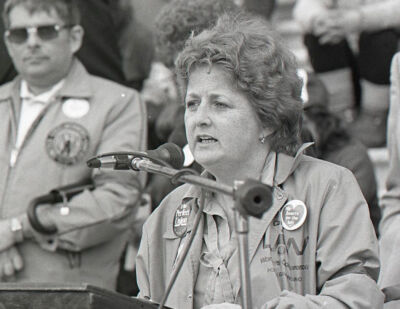
BC Fed vice-president and coordinator of provincial Unemployed Action Centres, Joy Langan. Pacific Tribune Photo Collection, SFU, MSC160-809_31.
The interview was recorded by Tom McGrath in Ottawa in 1989 while Langan was a Member of Parliament. It is part of a large collection of recordings with individuals involved in the 1983 Operation Solidarity movement in BC.
Langan discusses her key roles on various Operation Solidarity committees, including the Trade Union Steering Committee and the BC Federation of Labour Executive Council. She describes the challenges of coordinating the participation of diverse community groups and unions, as well as the difficulties in keeping the momentum and unity of the movement as negotiations with the government progressed. Langan reflects on the successes of the large rallies and marches, as well as the tensions and disagreements within the labor movement.
Langan describes a private conversation she had with labour leader Jack Munro hours before he met with BC Premier Bill Bennett that ultimately ended the Solidarity strike. She is critical of some in the labour movement who “scapegoated” Munro afterwards. She offers her analysis of why the Solidarity movement, despite its widespread support, ultimately did not achieve its goal of reversing the provincial government’s austerity measures.
Related Resources
Mervyn Van Steinburg Interview: IBEW, Activism, and Heritage
As a founding Board Member of BC Labour Heritage Centre, Mervyn Van Steinburg recounts his story of a worklife spent in service to BC’s unionized community. In this interview, Brother Van Steinburg re...
George Hewison Interview: Music for Social Change
George Hewison grew up in Campbell River where he learned his unionism and politics at “the kitchen table” during the Cold War years. He was an organizer and executive member of the United Fishermen a...
Art Kube Fonds
The Art Kube fonds includes newspaper clippings, flyers, leaflets, research papers, legislation, briefs, speaking notes, press releases, personal notes, photographs, and documents pertaining to Operat...
Jef Keighley Interview: Canadian Autonomy and International Solidarity
Jef Keighley was born in Vancouver, BC in 1950. He spent time working in Jamaica through the Canadian University Service Overseas. He worked in the automotive and construction industries before becomi...
Art Kube Interview Pt. 2: Summer of Solidarity
This interview covers the intense period in 1983 when Operation Solidarity and the Solidarity Coalition brought the province to the brink of a general strike. This interview was conducted by Jum Sincl...
Art Kube Interview Pt. 1: Socialism, Steelwork, and the BC Fed
Art Kube was born in Poland where he attended a socialist kindergarten. He joined the Metalworkers Union in 1949 and became a member of the socialist faction of the Metalworkers Union. This interview ...