
Mike Old Interview: A Remarkable Career at the HEU
Mike Old was born in Calgary to school teacher parents, who were both involved with their union and in progressive politics. He was heavily involved in student politics at the University of Calgary, which set the foundation for his future work. He moved to Vancouver in 1989.
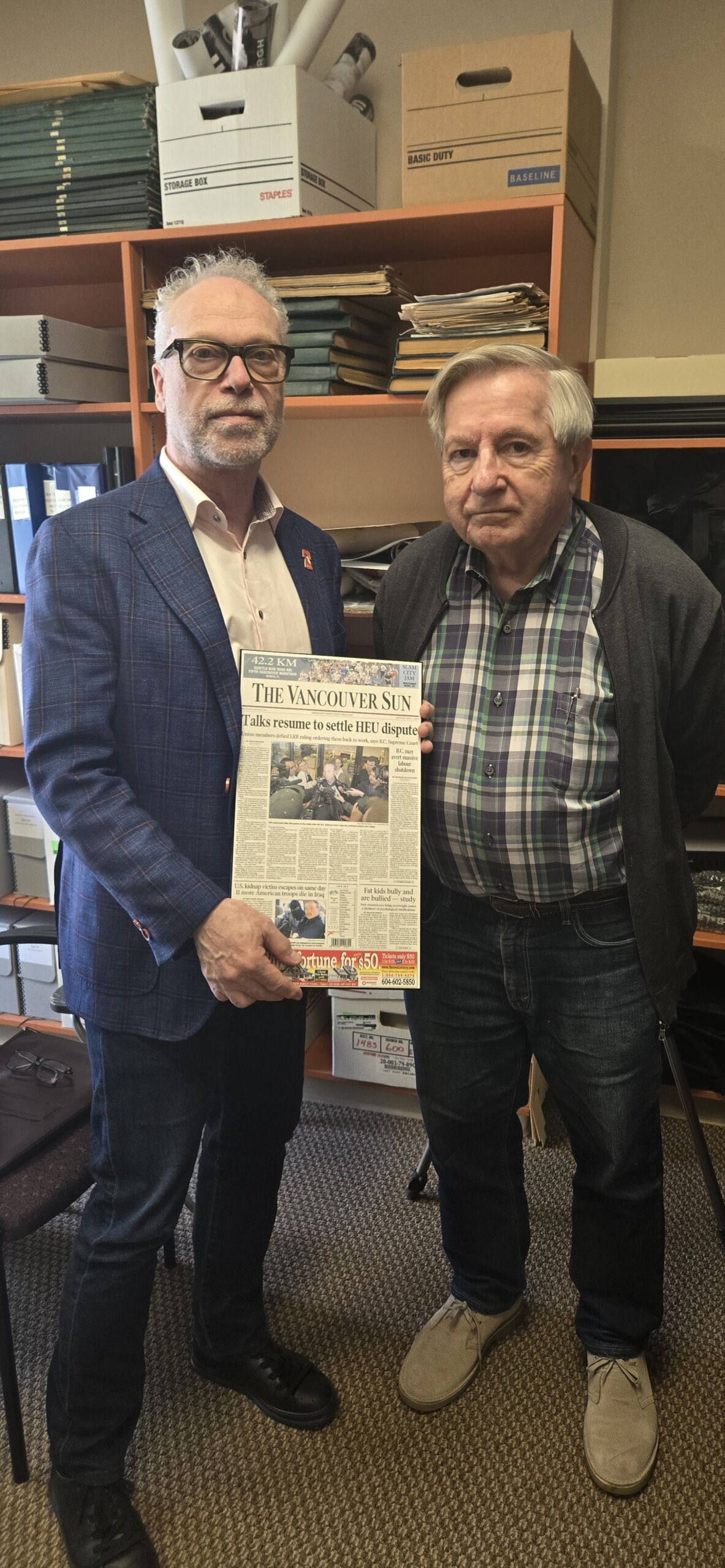
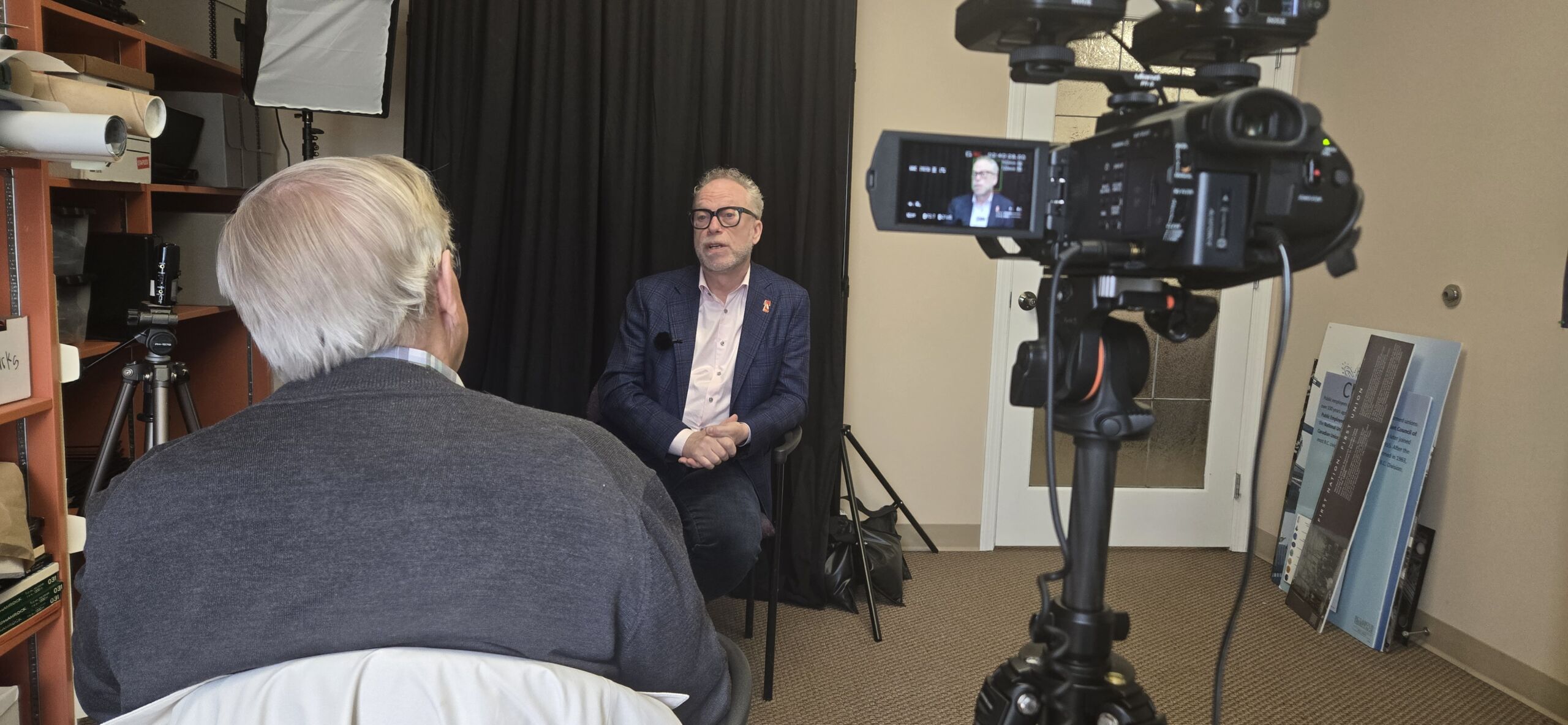
This interview was conducted by Ken Novakowski on May 5, 2025 in Burnaby, BC. It is part of our Oral History Collection.
Interview: Mike Old (MO)
Interviewer: Ken Novakowski (KN)
Date: May 5 2025
Location: Burnaby, B.C.
Transcription: Pete Smith
KN [00:00:05] Good morning, it’s May the 5th, 2025, and we’re here this morning to interview Mike Old, who was a significant staff member for the Hospital Employees Union from 1997 to 2023. Mike, we’d like to start by having you tell us where you were born and in what year.
MO [00:00:28] Great, well first of all, thanks for inviting me to participate in this. I’m really looking forward to it. Yeah, I was born in 1962 in Calgary.
KN [00:00:38] Can you tell us a bit about your parents? Were they union members or did they have progressive politics? Did you get any of your politics from your family?
MO [00:00:46] Yeah, I think I got a little bit of politics from my parents. They were both school teachers. And they were involved with the union. And my dad, at one point, was the president of his teacher’s union local. So they instilled in me some values about unions, and also about the importance of public education that was really important to my parents, and then later on my dad became involved in the NDP in Alberta, which is very courageous at the time. So I remember as a young tween kind of out delivering leaflets on E-Day, et cetera. So there’s a bit of that as well, as I was growing up.
KN [00:01:31] Okay, and can you tell us something about your life as a student, you know, through elementary, secondary school, but also into university and your field of study? I know that you did go to the University of Calgary and got involved in student politics as well as other progressive causes. So tell us something about that experience as well.
MO [00:01:51] Yeah, I mean, nothing very remarkable about grade school, I got to say, don’t remember much about it. But I did go to the University of Calgary and I met lots of great people there and got really involved in politics, the peace movement, the fight against tuition fee hikes, and other causes like that, and I did get involved with the students’ union. I’d met a crew that grew up in my neighbourhood with me that I didn’t actually know until I got to university. People like Jim Stanford, who went on to be an economist with the CAW [Canadian Auto Workers], and is now with the Centre for Future Work, and does a lot of work. And Donna Baines, who teaches at the Social Sciences, the Social Work Department at UBC, they were very good and old friends of mine, and we got involved in student politics together. And then I eventually got elected to student council. Most of the 1980s for me were involved in the student movement. I was on the National Executive Board of the Canadian Federation of Students and worked for CFS eventually just after I got into grad school. So yeah, there was a lot of political activism in my university years and I think that really set the foundation for me. Kind of over the long term in the labour movement, and I think that’s been the story for lots of people in the labour movement, actually. So, yeah, it was a great foundation for getting involved in activism over the longer term.
KN [00:03:26] Having met Roseanne Moran, who was to become your life partner, you moved to Vancouver in 1989. You then took up casual work here and there with different unions. More specifically, you were also hired to organize an important public sector conference investing in people maintaining public services held in March of 1993. What do you remember of all those experiences?
MO [00:03:51] Yeah, I sort of came out to Vancouver in 1989 to join Roseanne. We had met in the student movement. And I didn’t know a lot of people out here, so I was really kind of starting from scratch in a way. So I was trying to get involved in as many things as I could and I did a bit of consulting work for the government on post-secondary policy, also did some work at Langara. Helped somebody there organize a conference in the early 90s on public services, did a little bit of work for, you know, faculty unions here and there, and then of course you mentioned the Investing in Public Services conference, and I think that’s where I first met you, perhaps, Ken. And that was a big opportunity for me because I got to meet many people in the unions, especially the public sector unions and that opened a lot of doors for me in terms of future work.
MO [00:04:51] So for instance, I did a couple of stints doing summer relief work for the HEU [Hospital Employees Union] in the early 90s. And then in 1993, I actually was hired by ACTRA [Alliance of Canadian Cinema, Television and Radio Artists], the Actors Union, by their BC branch here in Vancouver. And it was an interesting few years. I was there from about 93 to 96. There was a big jurisdictional battle happening at the time between the National Actors Union, ACTRA, and a small branch that had been set up by some local unions here in BC, the Union of BC Performers. It was a very hard struggle. There was about probably fifteen hundred actor members who, because of the way the film industry was structured in the day, had to belong to both unions because both unions had production agreements with different film companies, so you didn’t really have options. But as you can imagine, for mostly low paid actors who weren’t making a lot of money, this was a big problem. So there was many efforts during those three years to merge the two organizations and that finally did happen in 1996 (ish) and I ended up working for the merged organization for a few months. We had some staff representation issues to take care of. I was a member of the CAW and we eventually got the staff certification for the merged union and then I left the film industry after that raucous three years.
KN [00:06:30] Okay, you then ended up working for the HEU on a full-time basis in 1997 and you ended up working in the communications area. Can you tell us a bit about some of the early initiatives you were involved in with the HEU?
MO [00:06:45] Yeah, sure. It wasn’t an exact straight line to get to HEU. So after I left ACTRA, I actually did a stint of relief work as a research rep for almost a year at CUPE [Canadian Union of Public Employees], working out of the regional office in Burnaby. And that was a really interesting year. I did a lot of briefs about privatizing garbage collection and privatizing services in public parks, et cetera. And it was a really, really busy and intense year. But after about a year of that, someone with more seniority bumped into the job, so I was looking for work again, and that’s when I ended up at the HEU in early 1997. I was awestruck because, of course, the HEU really had a reputation for a big communications department. They’d done a lot of interesting work through the 90s that I had heard about, and it was a great opportunity for me to join the HEU team there. There had been a lot of change. Two people who’d been in that communications department for a long time, Geoff Meggs and Chris Gainor, had recently left the organization. And the new director was Stephen Howard who’d have been there for a few years and he recruited me and several other people and kept building that comms department. So yeah, it was a really great opportunity for me. I didn’t think I would be there for 27 years, but it was a good fit and I really am grateful for that that little bit of fate back then.
KN [00:08:29] During the period of the NDP [New Democratic Party] government from 1991 to 2001, the HEU actually made specific improvements to their collective agreement and their working relationship with government. Can you talk about some of the gains that they made during this period of time?
MO [00:08:44] Yeah, absolutely. I spent a bit of time as I prepared for this interview, looking at some of your other oral history interviews, and I noticed that many of the people that you’ve talked to were at the table, had an upfront view of what happened in the 90s with the HEU. But to summarize, the union had made some really great gains in terms of winning a pay equity decision that had been implemented through the 90s and into the early 2000s. Really important in an industry that was very much female dominated. And they’d also made some good gains around employment security so there had been a move in the 1990s to move more healthcare into the community. I don’t think it went as far as they predicted it would at the time, but they did close, for instance, Shaughnessy Hospital. And the union and employers and government had reached a, really a benchmark deal that provided for an Employment Security Agreement and a Healthcare Labour Adjustment Agency that made sure that healthcare workers with experience weren’t thrown out on the street when there was restructuring in the health care system that they were able to have wage continuance, get retraining and be redeployed so that the skills they had were protected and used to benefit British Columbians. So a really important deal in the 90s that of course became a bit of a target for the opposition Liberals and eventually when they came into government they got rid of it. But a very, very important, very important gain for workers and one that was looked at with interests by unions and jurisdictions all over North America at the time.
KN [00:10:40] You referred to the subsequent election of the BC Liberal government, and they were elected in 2001, and shortly thereafter, in early 2002, they passed legislation that stripped the Hospital Employees Union Agreement of important job protection and other provisions as a first step to privatizing the health care services that were provided by your members. Can you tell us about that legislation and its impact on both your members and on the HEU, the organization itself?
MO [00:11:14] Yeah, that is such a long conversation and we’re still feeling the impacts of it today. But in the lead-up to the election of the BC Liberals in 2001, the HEU had reached the culmination of decades of work to basically pull the sector into very few collective agreements. So in terms of the members that HEU represented, it meant pulling together workers in long term care, funded long term care in all the hospitals. And by the end of the 90s, through a bunch of labour relations processes and collective bargaining, we had gotten to the point where probably 95% of HEU members in the province were covered by one collective agreement with standard wages right across the board. It was a very significant gain that brought a lot of equity in the sector, but it also made HEU a big target for the kind of neoliberals at the time and got the attention of the Fraser Institute, et cetera, who were condemning the agreement as too expensive for the public. Where hotel workers were basically treated like health care workers, it was a very worrisome point for the HEU.
MO [00:12:39] And just before the election, the HEU had managed to make another gain which was we had convinced government to make amendments to the Health Authorities Act that would have eventually actually taken the wall down between people who work in hospitals and long term care, and people who provided community health services. So that would have meant a further integration of the wages and working conditions of health care workers and would have resulted within a couple of years of eliminating that wall between community and facility. And that was also a target of the BC Liberals in Bill 29.
MO [00:13:18] So moving on to what happened in that election. There was the famous interview just before the election that the Guardian did with Gordon Campbell where he said he would not tear up health care collective agreements. Of course, within a few months, he did exactly that. In late January of 2002, he passed three bills one weekend in the middle of the night. One that targeted health care workers, the Health Care and Social Services Delivery [makes finger quotes] Improvement Act. And also two other pieces of legislation, one that affected members of the BCTF, and another that I think was targeted at college workers. And yeah, that was a very hard time for us. We could see the writing on the wall. I mean, the legislation was basically targeted at the contracting-out protections that had been in hospital workers’ agreements since the late 60s. And along with that, it had basically pulled the government out of the Health Labour Adjustment Agency. Got rid of the Employment Security Agreement. Had really undermined provisions around bumping and seniority. It was a very, very difficult moment for our union that really dominated us for probably the next 20 years. A significant attack on HEU members and within a few months of them tabling the legislation we received a leaked document out of a budget lockup. These were the private notes of a bureaucrat that basically laid out what the plans were for health care, including service cuts, et cetera. But, had also spelled out that there was going to be more than 20,000 layoffs in the health care system. At the end of the day, it wasn’t 20,000 because of the fight back and other factors, but very, very scary for the members of our union.
KN [00:15:34] Ok, by 2004 you had actually become the Director of Communications for the HEU. And then the union was out on a very significant strike which threatened to expand and involve the entire public sector out in support of your union. Can you tell us about that and can you also tell us what was happening with your union, your members and you personally in terms of what you were experiencing during this period of time?
MO [00:16:03] Right, I feel the PTSD coming on (laughs). Yeah, well I think it might be constructive to just look at the couple of years leading up to 2004. So you know, in 2002 the legislation was passed and we immediately started to mobilize our members around the fight back that would be required to push back on privatization. It was clear that the government intended to privatize a huge swath of health care workers who delivered what was referred to as non-clinical services. So, largely in the case of our union, we were the union that was mostly impacted by this. It was housekeeping staff. It was food services staff. It was security staff. And it was the whole range of staff in long-term care including bedside care workers. So it was a big group of people that would be impacted.
MO [00:17:03] The leadership of the union in the day, Chris Allnutt had been the Secretary Business Manager, and our provincial executive made a very determined decision that we would fight this hard and that we would reorganize the people who were privatized. So those were two really important decisions in the day. One of the first big events that happened was the government made moves to privatize laundry services across the Lower Mainland in hospitals to a company from Alberta called K-Bro. And in the initial stages of that privatization, which resulted in many, many layoffs of our members, they were shipping the laundry in BC to Alberta to get cleaned and then shipped back to BC because they didn’t have a cleaning facility here at the time. And there was sort of a kind of a transportation point out in Chilliwack where they had a warehouse and they would transfer the laundry to bigger trucks and the union made a decision to blockade that. I think that was in late 2003, might have been late 2002, don’t quote me. But it was a big blockade. Hay bales all over the place. We had stopped the laundry trucks from coming. And during that sort of blockade the RCMP ended up arresting the three kind of top officers of the union, Chris Allnutt, Fred Muzin, and Mary LaPlante. So they were kind of arrested and released, but it was kind of a significant moment in the early part of the fight back against privatization.
MO [00:18:54] Many other things happened, occupations here and there, but the government did start to proceed with the privatization agenda. So during 2002 and through 2003, there were many, many layoffs, firings of our members. And by early—by 2003 we were looking for a way to kind of reduce the damage and in 2003 the government and our union started talking about some kind of an agreement, an extension of our 2001 collective agreement for two years that would put a cap on privatization, on the number of layoffs in exchange for unspecified wage cuts. And that was negotiated and put to a vote of the membership of the union who rejected it, and so this set the stage for us going into 2004.
MO [00:19:54] So in early 2004, up until into March, the government proceeded to privatize many, many workers, and by the time we were in the weeks leading up to the strike and late April 2004, there had been 2,500 workers fired just that year. Including about 1,300 in the weeks leading up to the strike to Sodexo for Food Services in Vancouver Coastal Health. It was, I think, a $300 million 10-year contract that they’d signed with the company that resulted in massive layoffs for our members. So very provocative in the weeks leading up to the strike in late April, 2004.
MO [00:20:44] Do you want me to talk a little bit about the strike itself? Yeah, it was a really, really difficult strike for the union. So in the weeks leading up to the strike, as I said, there had been some very provocative layoffs. The union had been at the table demanding that there be a moratorium on contracting-out, which government had rejected. Government was looking for significant wage cuts. I think by the time we got into March or so, they were still looking for 14% wage cuts, and they were also looking for a longer work week and huge benefit cuts to the plan that our members had in the facility subsector. We had gone through a few kind of mediated processes that had failed, and our members returned a massive strike vote, I think, in March. So things were set up for a big confrontation, and on Sunday, I think it was the 26th of April, our members went out, and it was a massive province-wide strike. There was media everywhere. Our members were super strong on the line. They knew what was at stake. And I think we were at a point in 2004 where the ‘Campbell Cuts’ had started affecting everybody in very, very serious ways. So in some ways, the HEU strike became kind of a focal point for all sorts of legitimate grievances that people had about the policies and the cuts of the Campbell Liberals. So there’s a lot of support for our members on the line.
MO [00:22:43] By the middle of the week, sort of mediation efforts had failed. And on the Wednesday, government brought in back-to-work legislation that included massive wage cuts and also a longer work week for our members. By Friday, they had managed to get a Labour Board decision around that legislation filed in the Supreme Court, which basically made us at that point in contempt of a court order. So we were, in fact, at that point on an illegal strike. And that’s how we headed in to that weekend before the settlement of the strike. And at the end of the week, there were many, many unions who were coming out on strike along with us, you know, to various extents. But yeah, but there was a lot of support for HEU during that strike. And a very, very difficult situation for the union to manage, given what was happening both with our members and both with the expectations around the whole progressive movement about what was happening at that stage.
KN [00:23:53] And yet, it seems that the union did get a deal hours before the strike was going to expand to other public sector workers and so forth. Can you talk a bit about that deal and what you know of how it was achieved?
MO [00:24:10] Yeah. No one really wants to know how the sausage is made. And I wasn’t in the room. I was at the time, the Communications Director for the union and had only been the Communications Director for a few weeks. So I was, yeah, it was intense. You’ll recall that on the Saturday there was a huge kind of May Day rally in downtown Vancouver. On Sunday, the Supreme Court had ordered a hearing into our contempt of court, of a court order. The union was, of course, involved with discussions involving government and health employers, and also a working group of some other union leaders were involved on that weekend. Chris Allnutt, the Secretary Business Manager at the time, was engaged in all those talks and couldn’t actually be at the court hearing on Sunday, so he sent me to represent the union, which was intimidating, to be sure. And by the end of that hearing, of course, we had been found in contempt.
MO [00:25:32] And then the discussions went late into the night on the Sunday. I remember being at the BC Federation of Labour Headquarters that night, basically managing all the media who’d gathered there because Chris had been meeting with our provincial executive having also been dealing with our bargaining committee around the terms of a possible settlement to the deal and late, late that night a settlement was announced. And the settlement basically—it established that there would be a limit on the amount of positions that would be contracted out over the next two years. So going back a week, government had basically said no limits on contracting-out and they’d already contracted out 2,500 positions by the time the strike had happened and many more to come. So the establishment of that 600 FTE [Full Time Equivalent] cap for the next two years was really, really significant. Also established that there’d be no retribution against individual union members. And we were about to walk into a world of legal pain at that point, given the decision earlier in the day by the courts. And there’d also been established some funds to assist workers with severance who’d lost their jobs. So there were a few things to lessen the blow of what was a really bad situation.
MO [00:27:10] It didn’t go that smoothly, for sure, because, of course, the settlement was reached late, late in the evening. At that point, it was really difficult to get the news out to members who were pretty ready to expand the strike significantly with the help of many other unions the next day. And I think a lot. Well, to give you a good example of how this went, we went from the BC Fed back to the HEU office that night to start getting the word out on our, what was social media channels back then, mostly our website. The traffic was so intense that our site crashed so we didn’t have that happening. And word was starting to get out, but it was getting out very, very slowly. The next day we arrived at the office early in the morning to be greeted by burn barrels at either side of our parking lot by HEU members who were really upset about the turn of events overnight. And that kind of established a bit of a difficult moment for the next period of time in the union as we had members who were quite disaffected by the outcome who thought that something was going to happen that week that may have reversed the fortunes that the union was facing. But it took us a long time to sort of re-engage members in their union after such an intense moment and such a kind of a grim outcome generally. So, yeah, it was a very, very hard moment for the union.
KN [00:28:59] So the government, the settlement prevailed but the government continued to hire private contracts to take up the work formerly done by HEU members. Your union set out to successfully to organize the employees of these contractors into your union. Can you tell us a bit about that campaign of organizing people who had now been hired by private contractors.
MO [00:29:30] Yeah for sure. This is the success story of HEU in the 2000s and 2010s. They established an amazing organizing team based on member organizers recruited out of the membership to basically go and attempt to reorganize health care workers who now worked at half the wages that they were getting before. No benefits or very few benefits, and were working for multinational corporations like Sodexo, Aramark, Compass, and others. And they had no interest in having their employees be represented by the HEU. And in fact, they had in some instances made an arrangement at the time with a, I’m gonna call it a rogue local of the IWA, which signed very, very long-term agreements, seven-year agreements that basically locked workers in at very, very low wages. So a lot of the work of our organizers was to basically organize people and then also reorganize people who are now subject to these sort of voluntary agreements that had been signed by this IWA local and ultimately were successful because they were just a very, very effective organizing crew which are still there today and organizing people like crazy.
MO [00:31:12] So this is a, this was a real critical decision by the leadership of the day to say we are not abandoning that part of the sector as a result of privatization. I’m not sure every union would have done this, but the HEU did this. They invested a lot of resources into organizing privatized hospital workers and privatized long-term care workers. And one of the techniques that they used or strategies that they employed was to start lining up all the expiry dates with the collective agreements that they were negotiating with these big multinational corporations. So by the time we got into the mid-2010s, these contracts were all coming up at the same time, which was causing a lot of pressure on these multinational corporations. And slowly, the union was starting to ramp up the wages in the sector.
MO [00:32:14] But really, it’s a story of the—just, I don’t want to call it resilience, I think that’s a word that gets overused sometime, but they were very committed to an outcome which was to be HEU members and to improve their wages and working conditions. And it sort of breathed a lot of new energy into our union at a time when many of our members had been slightly disengaged because of the outcome of the 2004 strike which was affecting people who hadn’t been privatized already. And really important to the health of our union in the long term, and we’ve kept those activists for decades since then, so it was really really, really awesome organizing that the union did.
MO [00:33:06] What else can we say about that time? I mean the organizing was super important, especially because in the long-term care sector, especially, the tactic of employers was to wait until we had organized a workplace, we’d have a collective agreement, and then the long-term care operator would fire the subcontractor and it would flip to somebody else. And we had some long-term care facilities where the workers had been flipped three, four, five times. And every time the union would have to go back in and reorganize the workers. So that was super challenging, not only for our members, but for the impact that it had on quality of care for seniors and their families because there was a lot of disruption in care. And that of course has really, can have really dire care consequences for the frail elderly that they were looking after. So the union campaigned a lot on that. We brought these stories to light often. And I think that started to resonate a lot with the public and helped us in our work through campaigns in the 2010s and towards significant provincial elections in the late 2010s. So, yeah, really, really important and lots of respect for those workers, amazing organizers.
KN [00:34:36] Unfortunately, during this very period of time when you were experiencing success in very many areas of fighting back, the HEU ended up being a target of a raid by the BC Nurses’ Union. Can you describe the impact this had, what the raid was all about, the impact it had on the HEU and on the labour movement in BC generally?
MO [00:35:00] More PTSD, thanks. Yeah, you know, this was a very dark period for the labour movement in BC, and it really hurt because our union was being raided by a traditional ally of ours. I mean the HEU. And the BC Nurses’ Union, especially in the early years of Gordon Campbell, had coordinated their work in the workplace and in the public forum very closely around resisting what was happening. There’d always been some tensions between HEU and the BCNU because of the kind of nursing politics around the scope and practice of licensed practical nurses (who the HEU represented) versus registered nurses. And in the months after the 2004 strike, the head of the Nurses’ Union at the time had been, there had been some very general comments about representing nurses from the HEU. That went away, but by 2008, it was clear there was going to be a raid by the BC Nurses’ against HEU to basically raid licensed practical nurses. And that was, that period kind of went from about 2008 ’till I think late 2012. There was a couple of rounds of raid attempts. They were successful on the second campaign.
MO [00:36:41] But it was really unfortunate. I mean, our union had lost thousands and thousands of members to privatization, to Bill 29 and subsequent legislation. And we had spent a lot of resources on fighting privatization and trying to reorganize those workers. And in the middle of this, when we were kind of down and fighting, the Nurses’ launched this raid on a large group of probably our better paid members. And it was extremely divisive in, you know, on the shop floor in healthcare, obviously, but also within the labour movement. And within a short time, the BC Nurses’ Union had been basically evicted from the BC Federation of Labour and the Canadian Labour Congress and are to this day.
MO [00:37:45] Yeah, it just basically undermined the important work that we needed to do as health care unions to kind of fight what was happening to the health care system. Like we needed to have unity on the ground and instead we were dealing with a raid which was, it was really unfortunate. I mean, I had friends over at the BCNU that we’d worked closely with over the years that—I kind of haven’t talked to them since. I mean it’s just it was a very, very, very difficult time and I hope that there will be a path where we can all be united in the labour movement again, and I wish those people who are trying to make that happen a lot of luck. That was a very, very difficult time for our union and for the labour movement.
KN [00:38:38] Soon after the Campbell government stripped your agreement in the legislation in 2002, the HEU and other affected unions in health care and education launched legal actions against the government. As well, they sought rulings from the International Labour Organization on the legality of these government actions. The HEU was the first one, the first case, to reach the Supreme Court of Canada. Can you tell us about that court action, including the ILO actions, and also talk about the very successful decision that the Supreme Court of Canada came down with in 2007?
MO [00:39:20] Yeah, so shortly after the legislation had passed in 2002, Bill 29, and that was followed the following year by kind of a companion bill called Bill 94, which kind of took those provisions and spread them out to privately publicly funded care homes as well. We went to the Supreme Court of BC, so this would have been in 2002, challenging the legislation on, I think a couple of grounds, including the equality provisions and the right to association provisions. There might have been a third one, too, but I think that one didn’t last too long, as I recall. I’m not a lawyer. So yeah, we and other health care unions, I know there’s other stuff happening in the education sector, but the health care unions went to the Supreme Court. And in, I think in 2003, the Supreme Court ruled against us.
KN [00:40:25] Supreme Court of BC.
MO [00:40:25] Supreme Court of BC ruled against us so we took that in appeal to the BC Court of Appeal and I think it was in 2004 the BC Court of Appeal ruled against us and at that time we, you sought leave to appeal to the Supreme Court in Canada. It’s not automatic, they had to give you permission to do it. But we successfully convinced them that that would be a good idea so it did go to the Supreme Court of Canada and in June of 2007, I think it was June 8th, I always get that mixed up, was it June 7th? I think it was June 8th 2007, the decision came down and the Supreme Court struck down several provisions of Bill 29 and Bill 94. Not the whole piece of legislation or the two pieces of legislation, but they struck down provisions that prevented health care workers and employers to negotiate provisions that would require employers to consult with unions and also to put a ban on any contracting-out provisions or negotiating those provisions. So. It was a significant win.
MO [00:41:53] I remember it really well because we were all gathered around to phone at the HEU office just down the street from the Labour History office here. And Judy Darcy was the Secretary Business Manager at the time and our lawyer, Joe Arvay, was sort of reporting to us in real time as he was reading the decision. Which came in very, very early in the morning, because of course they release it first thing in the morning out in Ontario. So it was like very early. And I remember Joe Arvay kind of reading it very slowly and then declaring that we had won. And it was a very, very exciting moment for the union for sure. The court basically determined that those provisions would be struck down. It would be, I don’t know what the legal word is, but they basically held it in abeyance for a year to allow union and employers and government to work out what this meant in terms of implementation.
MO [00:42:58] So to be clear, the ruling did not basically make all of the unions and their workers whole. It basically struck down those provisions that prevented us from negotiating any contracting-out provisions. But it definitely didn’t instruct government or employers to renegotiate those provisions, it just meant that that was a legitimate subject for collective bargaining and we still needed two players to play on that stuff. So not a super clear win, but over the next year the unions basically negotiated a big package for members who’d been impacted by Bill 29 for the facilities subsector, which was mostly the HEU. It was in the range of 80 million dollars of settlement payments, and those were distributed kind of starting in late 2008, I think. And then we started to go to the table and try to negotiate contracting-out protections back in our collective agreement, but of course they weren’t willing to play, and we knew that in order to kind of restore those kind of rights in our collective agreements, we would need a strong political action agenda to make sure that we had a government in power that would negotiate those provisions back. So that’s what we set our sights on.
KN [00:44:26] What did that result in, like, in your political action strategy without getting active in campaigns?
MO [00:44:33] Yeah, we were, HEU is—it’s always been a very, it was never a, it’s funny. The union is not an affiliated union. I mean, at the time before the changes in legislation in 2017 or 2018, many unions were direct affiliates of the NDP. That was never the HEU’s approach, but the HEU was a very, it was a very partisan union. I mean, it kind of understood—and underlined by what happened to our members in 2002—that we could not sit out provincial elections. We had to be very involved in them because the consequence of losing those elections was really detrimental to our members and to the public healthcare system. So the union was really active in the ’05 election and of course the liberals who had basically had every member of the legislature except for two at that point lost a lot of MLAs and there’s a bit more of an equal thing happening after ’05. In the 2009 election, I don’t remember that one very well, but in 2013 of course we were very active and many of us actually thought we were going to win that election and unfortunately we didn’t. But we just were very aggressive about mobilizing our members to be engaged in political action especially around elections and eventually that paid off in 2017 when the NDP was elected and became a minority government.
KN [00:46:14] And eventually, a year later, actually, the NDP government repealed Bill 29, the legislation that gutted the HEU Collective Agreement clearing the way for the return of privatized workers to public health or public sector employment. Can you comment on this event as a moment in the history of your union?
MO [00:46:34] Yeah, I can. And this one’s always hard for me, because I always feel like I’m going to start crying. Yeah, it was quite something. So the leaders of the NDP, from the moment Bill 29 was passed, had come basically to every single HEU convention and said, ‘When we are government, we are going to repeal Bill 29.’ And repeated by Carol James when she was the leader, of course, Joy and Jenny when they were the MLAs fought that thing all night. Adrian Dix when he was leader, and John Horgan when he was leader, everybody committed to the membership of the HEU that that was gone. And then in November of 2018 at the HEU convention (so this was about a year and a bit into the minority government) we had about 800 delegates on the floor at the Hyatt, and we understood from our dealings with government that they were about to introduce the legislation. Our members didn’t know that. And we were able to basically live broadcast in the convention hall. Them getting up and introducing the legislation. And it was wild. Like it was really the craziest thing I’ve ever seen on a convention floor. The cheering, the crying, like it was nuts. Really, really important moment for the union.
MO [00:48:18] And we had lots of reorganized members on the floor who’d sort of been involved in the fight. They’d lost their jobs, they’d fought to become members of the union again, they’d stuck it out, and they were on the floor when this happened. So, yeah, super, super important moment for the union, and I’d say for the labour movement. It wasn’t the end of the story, there was a lot more to do.
MO [00:48:45] So, for instance, in early 2019 or late 2018 we had our first significant round of bargaining since the change in government. And we, at that point, Jennifer Whiteside was the Secretary Business Manager of the HEU and negotiated a return of the contracting-out protections and the collective agreement. So we got that because of the change of government. There were changes done to the labour code that strengthened the successorship provisions which HEU had been exempted from as a result of Bill 29 (or HEU and other healthcare unions), which also had stronger provisions to make sure that contract flipping outside of the facilities sub-sector workers would be protected. They would keep their union and their collective agreements. And that round of collective bargaining, we’d also established what was called a Labour Adjustment Transfer Agreement. And this basically was a template to help us when we’ve identified groups of workers who could come back into the public sector. People who’ve been working for privatized, private corporations. It was a template for how you manage that transfer, how you deal with issues of posting and seniority and preserving years of service and stuff like this. So a really important labour adjustment agreement template had been negotiated in that round of bargaining which set us up for success in the subsequent years.
KN [00:50:26] Okay. The HEU also, in addition to all of the collective bargaining related matters, has a long history of being a social justice union. Can you talk a bit about this and some of the actions and programs of the HEU which have contributed to this aspect of union work?
MO [00:50:46] Yeah, I can. But Ken, I wonder if you can indulge me, because there’s just something about that little chapter that we just finished that I feel like I need to, okay. You know, it’s really important to acknowledge that we had a Health Minister at the time, Adrian Dix, who had also been the opposition health critic and really, really understood the sector and understood where our members were in the sector quite well. And he was a very determined ally to the union in terms of trying to rectify privatization in the sector. And post that wild convention where they repealed Bill 29 there was a lot of work done to try and put things into place. A lot of it was slightly waylaid by the COVID pandemic in 2020. But by the August of ’21, there was a big announcement that they were basically bringing the whole sector and hospitals back in, all the housekeeping and food service workers. And that was accomplished within a year. And that was a really, really, really significant moment for the union, happening in the middle of a pandemic. So I just thought that was important to mention. That was the final closing of the circle for that section of our membership who worked in hospital cleaning and food services. So really, really important. And 20 years later. So just think about all those members who basically were doing this for 20 years, like held out for 20 years to get back in. So it had an immediate, immediate and significant impact on their paychecks, on their benefits, on their job security, on their role within the healthcare team. Like, it was a super, super important moment for the HEU and a moment of great celebration. And celebrations happened all over the place. But back to your question about—
KN [00:53:00] And political action paid off.
MO [00:53:02] Political action paid off. It’s a struggle. I mean labour and government will not always see eye to eye on things, but you can’t ignore that part of the political algebra about trying to make these gains for your members. And HEU members know that more than most, I would say. But in terms of HEU’s kind of traditions, I mean one of the things that attracted me to HEU early on was the fact that it had a reputation as quite a militant union and involved in lots of causes with community and that was really important and I think led to the HEU’s strength.
MO [00:53:50] When I joined HEU in 1997, it was just a year after a very contentious HEU convention where the union brought in equity standing committees for the first time. And it had been a very, very fraught convention because this was the mid nineties, late nineties, like these people did not have the, they did not have the language or experience at the time to deal with what was what was happening. But I would say that the HEU at the time was kind of at the forefront in the labour movement of trying to start to establish this way of recognizing the equity ambitions of parts of the HEU membership. So that was the start of a process that went on for 20 years that eventually resulted in, in 2021 I think (our conventions got all kind of off-kilter because of COVID), I think it was in ’21 where we actually brought in big changes to the HEU constitution that established these Equity Vice Presidents in our union. So that was a long and carefully planned campaign around equity in our leadership. So really, really important. So, that’s one example.
MO [00:55:17] I know in the early 90s the union had managed to succeed in the courts to establish same-sex benefit rights in a fight that the union they had with the Medical Services Commission at the time. By the late 90s, the union had, in a federal arbitration of some kind, had established the union’s right to kind of organize in First Nations’ health organizations and subsequently we organized with our Indigenous health care members a lot of locals around the province. When we engaged in the fight around privatization after Bill 29, we had consulted with some folks in the UK who’d established these Living Wage Campaigns. And so our union was really key to establishing the Living Wage Campaign that everybody knows about in BC now. And we used that really to—initially, we were going to health authorities, et cetera, to talk about the importance of living wages for health care workers, but the campaign really took off, and of course, it’s been a real success in BC over the last 20 years or so. So yeah, the union’s got a real history of that kind of social activism and being militant, which is something that members of the union should be very proud of.
KN [00:56:53] During the latter part of your 26, 27 years with the HEU, BC, along with the rest of the world, experienced the COVID pandemic. This would have been particularly significant for your union, as its members work directly in the healthcare system. Can you tell us about the impact on your members and their work of this pandemic, and also about the impacts that it had on your union operationally, as well as in the Governance and Decision-Making Center?
MO [00:57:22] Yeah, I mean us like the rest of the world is like, can’t remember what happened before COVID-19 and especially in healthcare. It was pretty clear to us early in 2020 that we were in for a bit of a horror show. And by March, I think the first death in BC had been reported at the Lynn Valley Care Center in North Vancouver where we had members, and yeah, it was terrifying for the union and for union members. Nobody knew what to expect. There was a lot of uncertainty. There was lot of anxiety about lack of access to personal protective equipment like masks and respirators and other things that you might need. We were trying to iron out the protocols. We were really concerned based on our experience with SARS about 20 years earlier, but the system needed to be very well-coordinated around its response on infection control issues. And of course, the difference over 20 years is that we had a very fractured healthcare system in terms of the many employers that existed because of privatization. The cleaners were represented by a company and the nurses were being directed by the health authorities. So the issues of coordination were really important there.
MO [00:59:02] It was, it was scary for our members, for sure. And especially in long-term care, because that’s where a lot of the deaths were happening. And a lot of stress on those members who were basically trying to provide good care in a very difficult situation, but also trying to be family to residents whose families could not visit them anymore. So, a lot of stress for members. If there was a silver lining with COVID-19, I almost hate to say it that way, but it’s that the public really appreciated what healthcare workers actually bring to the table and not just care aides but you think about like everybody got pretty fast how important it was to have good housekeeping in a hospital. Like people got it. People were at home washing their vegetables and their grocery bags. They knew that the work that hospital housekeepers needed to do in hospitals to keep us all safe was really, really important.
MO [01:00:21] One of the things that we had identified early on was that as a result, partially, of privatization and the fragmentations of collective agreements and seniors’ care is that there were a lot of health care workers who were working at two or more different care homes because they needed to put together a living wage for their families. But the problem with that is that was a lot of travel happening between care facilities and that meant that healthcare workers were, in fact, becoming vectors for COVID-19 from one care home to another. So early on in the spring of 2020, there was an order by the provincial health officer to basically, I’m oversimplifying it, but basically to assign care workers to single sites. So basically saying, we need a process to basically make sure that a health care worker can only work at one site and can’t work their other jobs. Of course that had huge implications for health care workers because they needed the jobs. So there was a lot of work done by our union and others with health employers in government to try and come up with a labour agreement that would allow us to basically increase people’s hours at single sites and preserve a way for them to get back to other agreements and workplaces where they could preserve their seniority and their benefits. And part of that was a decision by government that we pushed hard for to basically raise wages for everybody in that sector up to the public sector agreement standard.
MO [01:02:12] So that was significant because of Bill 29 and other legislation, a situation where 20 years before, almost all funded care homes, no matter whether they run by government or non-profit or for-profit, were covered by the master agreement. And by the time COVID hit, about two-thirds of the care homes in the sector that were funded were no longer covered by that master agreement and some of them had wages that were far, far below the master agreement wages. So part of what happened at the time was that all wages were raised to the standard and they have been there ever since and they’re not going away. So another silver lining of COVID I think, was that we were able to demonstrate that if you’ve got a big problem and you need to solve it, you don’t need years of negotiations and arbitrations, et cetera, to deal with it. You can do it in a few weeks or a couple of months. And we managed to do that. That was a significant amount of work for the union. But it really has—I think what we did in the early days of COVID-19, it saved a lot of lives, especially in long-term care. And it also established a modicum of employment security and economic security for workers in that sector, which perseveres to this day. Those leveled-up wages are still in place, and I don’t believe they’re ever gonna go away. Still work to do in that sector for sure, there’s the benefits, but we’re on our way there, and that’s really important.
KN [01:03:52] So, you did retire from employment at the HEU at the end of 2023. Are there any other highlights, issues, or events that happened during your many years there in the HEU that you’d like to talk about?
MO [01:04:06] Yeah, I’m gonna forget something and I’ll feel very bad about it. I mean one thing that happened in the middle of—in 2015 I became a Coordinator of Policy and Planning, they called it, at the union. It was like a senior executive staff level job. So I coordinated the work of research and communications and education. And then in the the middle of the pandemic, at the height of the the pandemic, the Secretary Business Manager of the day, Jennifer Whiteside, decided to run in the 2020 provincial election and was elected. And I had been basically voluntold I was gonna be the Secretary Business Manager when she went off to work in the election. So it was, I don’t know if I’d call it a highlight. I guess I’d call it sort of a highlight, I mean I did not aspire to be the Secretary Business Manager, but I did that job while we recruited somebody else for the job. But I was kind of the Secretary Business Manager for eight months during the height of the pandemic, which was super, super challenging for a lot of reasons. The stress our members were going through, the difficulty in trying to operate a union when everybody was kind of at home at that point and there was a lot of uncertainty about what was in their future. But I think a big highlight, a highlight for me at the time, was just knowing how kind of solid the union was. Like, I always felt like members were gonna be well-served by the union. The staff were very, very committed to making everything work during a very, very difficult time in terms of the operations of the union, et cetera. So it didn’t end up being a terrible experience, and we ended up recruiting a good candidate for the job so that was good. So yeah, that was a bit of a highlight. And then I guess the other thing I would say is, I was really privileged to lead for a long time, a great communications department. They were, and continue to be award-winning department, kind of building on the legacy that I guess Geoff and Stephen had built in the 1990s and they continue to be a really, really, really effective comms department, and I’m super proud of that for sure. And then just, I just feel very grateful to work with such great members, like HEU members are the best, and super enthusiastic, super positive, almost all the time. They have their moments, like all union members do, but it was a real privilege to work with them, it was such a great experience for me.
KN [01:07:00] My last question, Mike, what advice, if any, might you have for young people who are just becoming active in their unions, and particularly in the public sector about dealing with the important issues facing working people today?
MO [01:07:14] Well, I kind of reflect on me in my 20s. And I guess what I would say is, if you’re in a unionized workplace, seek out the opportunities, because they are there. You may not see them immediately, but go find a shop steward. Ask how you can get involved. There’s lots of ways to do it. You might want to be a steward yourself. You might want to go to a convention or partake in a committee. You might want to become a health and safety activist, a way lots of people get involved in their unions through health and safety. Unions are, they’re great because they’re not corporations. They’ve got some resources. They’ve got people with a lot of experience and they can help you get things done in your workplace and also in your community. So there’s, unions are just a, they’re a great place to get involved with almost any issue you want to work with. You’re going to find people who you share a lot of common views with. And if you’re in a workplace where you think the door is shut and you can’t get in, demand to be let in. There are a lot of great young activists that I met in the HEU who are so, so impressive and they are usually such welcoming places for young workers. And I really encourage you just to keep asking and get involved, it’ll change your life for sure. And if you’re not fortunate enough to be in a unionized workplace, find a union who’s going to come in and help you make it a unionized workplace, and it’ll be much better for you and your fellow workers.
KN [01:09:00] Okay, well, thank you very much, Mike. Really appreciate all the preparation you did for this and a great interview. Thank you.
MO [01:09:08] That was great, a real privilege for me to partake in this project, so thank you.
The primary focus of this interview is Old’s long career with the Hospital Employees Union (HEU) in British Columbia, spanning from 1997 to 2023. He started in the communications department, and by 2004 had become the Director of Communications. In 2015 he became the Coordinator of Policy and Planning, and served a challenging eight months as interim Secretary Business Manager at the height of the COVID-19 pandemic.
He discusses the union’s fight against the BC Liberal government’s efforts to privatize healthcare services in the early 2000s, including the landmark Supreme Court of Canada decision in 2007 that struck down key provisions of the government’s legislation. Old also describes the HEU’s successful organizing campaigns to bring privatized workers back into the union, as well as the union’s role in social justice issues and its response to the COVID-19 pandemic.
He reflects on the importance of union activism and involvement for young workers, encouraging them to seek out opportunities to get engaged and make a difference in their workplaces and communities. Old highlights the HEU’s commitment to protecting workers’ rights and improving healthcare services, even in the face of significant political and economic challenges.
Related Resources
Chris Allnutt Interview: Fighting for Healthcare Workers
Chris Allnutt’s deep desire to fight for people who can’t fight for themselves and make the world a better place led him to work in the labour movement. This interview was conducted by Rod Mickleburgh...
Hospital Employees’ Union Fights Privatization
On August 30, 2021 the provincial government of BC under the New Democratic Party (BC NDP) announced that dietary and housekeeping workers in the healthcare industry would be brought back into the pub...
Judy Darcy Interview: Leading CUPE, HEU, and BC’s Mental Health Ministry
Judy Darcy started out as an enthusiastic public speaker and leader in her kindergarten days in Sarnia, Ontario, and has never looked back. Judy was very active in the student movement and in the wome...
Mike Kramer Interview: CUPE, BC Federation of Labour
Mike Kramer (d. 1995) was a national representative of CUPE (Canadian Union of Public Employees) and Secretary-Treasurer of the BC Federation of Labour. This interview was conducted by Tom McGrath in ...
Sharon Yandle Interview: Feminist Activist at HEU and BCTF
Sharon Yandle was born in 1941 in Vancouver, BC Raised in the East Side of Vancouver, Sharon spent the majority of her career as a freelance negotiator for various unions across the province, speciali...
Bonnie Pearson Interview: Rebuilding in the HEU
In this interview, Bonnie Pearson talks about growing up in Saskatchewan and the early influence of her activist parents. Bonnie details her early union involvement as a national representative with C...