
Signatures from Spain
Published: July 27, 2026
Authors: Donna Sacuta & Patricia Wejr
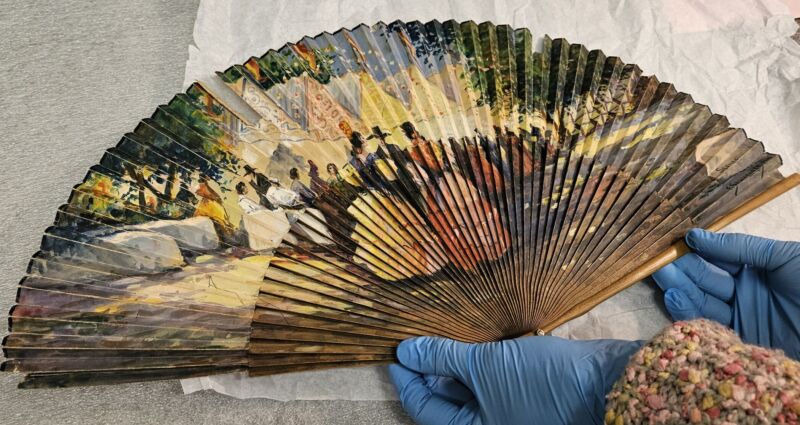
A rare artifact documenting British Columbians who fought in the Spanish Civil War (1936-1939) has surfaced at the Museum of Vancouver. At first glance, the 90-year-old abanico (the Spanish word for a folding fan) — measuring about 20 inches by 11 inches — is a time-worn souvenir; a painted scene of men and women relaxing in the outdoors adorns one side. But what is on the reverse side is astounding.
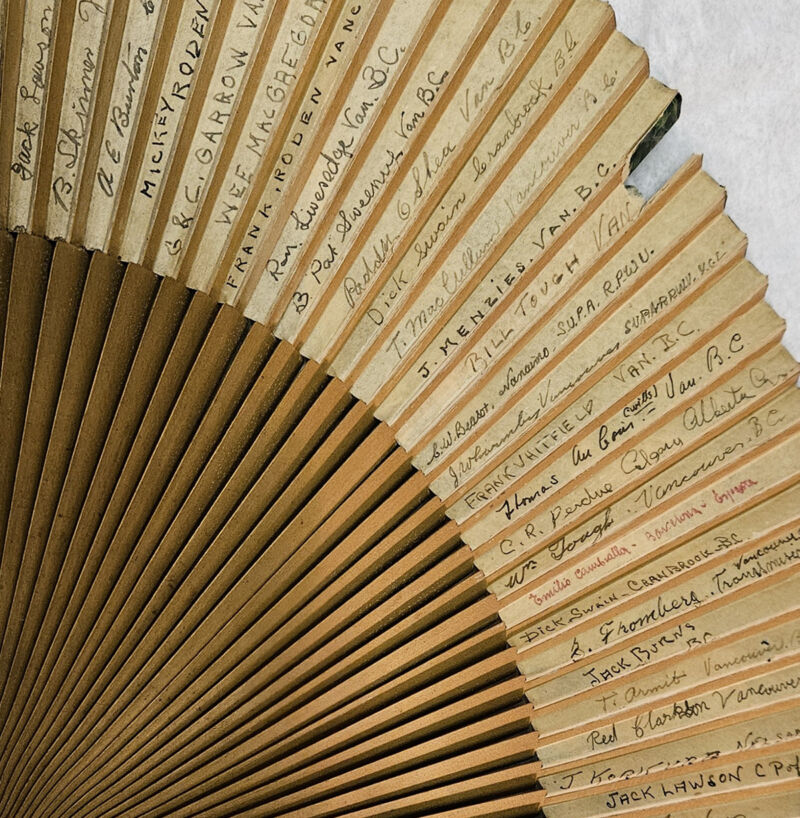
The wooden struts which form the skeleton of the abanico are autographed. The 35 names have been identified as Canadian volunteers who fought to save the Spanish Republic from fascist forces between 1936 and 1939. Of the 35, most were from BC. A solemn footnote is that one-third (13) of them died in the war.
Members of the Canadian section of the International Brigades are commonly referred to as the “Mac Paps” (Mackenzie-Papineau Battalion), named after the leaders of the 1837 democratic rebellion in Upper and Lower Canada. The Mac Paps traveled to Spain despite the federal government making it illegal to do so.
Museum of Vancouver curator Wendy Nichols alerted the BC Labour Heritage Centre (BCLHC) in early 2026 when the abanico was donated to their collection. Along with labour historian and retired lawyer David Yorke, the BCLHC arranged a visit.
Yorke edited Ronald Liversedge’s (1899-1974) book “Mac-Pap: Memoir of a Canadian in the Spanish Civil War” (2013). Liversedge’s name appears on the abanico.
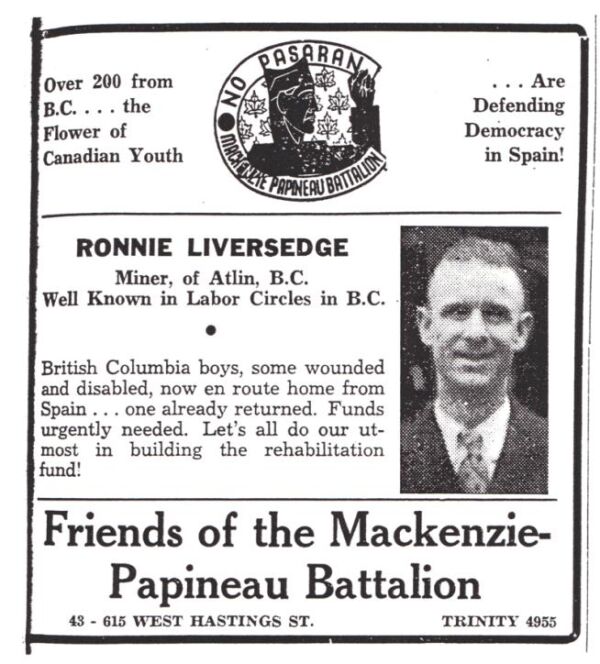
People’s Advocate, April 19, 1938.
Index Card of Names
“Wendy sent some pictures of the abanico, and I immediately could see that it had a very, very strong connection to British Columbia,” recalled Yorke. “Many of the names on the fan were known to me. It’s a sort of an index card of names.” Yorke has assembled biographical information of many of the other names, though several mysteries remain.
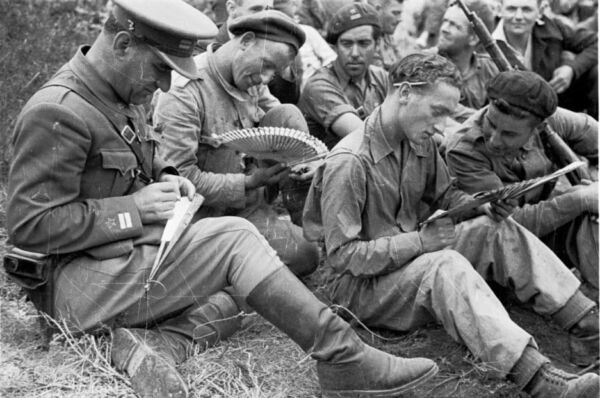
Vladimir Ćopić, the Commander of the Fifteenth International Brigade in 1937 and spring of 1938, signing an abanico, together with other volunteers. Communist Party of Spain Archives.
Following the museum visit, Yorke discovered that the Vancouver abanico is one of just a handful known to exist worldwide.
“It turns out it was a not uncommon practice in Spain for groups of the International Brigade volunteers, when they were at rest or not on the battlefield, to get together and sign these fans. Essentially the abanicos were souvenirs and statements of what they had gone through together,” Yorke said.
A second abanico is in Ottawa at the War Museum. The third is in the People’s Museum in Manchester, England. The fourth is in a private collection in Arizona. Another is in Spain.
Working-Class Fight Against Fascism
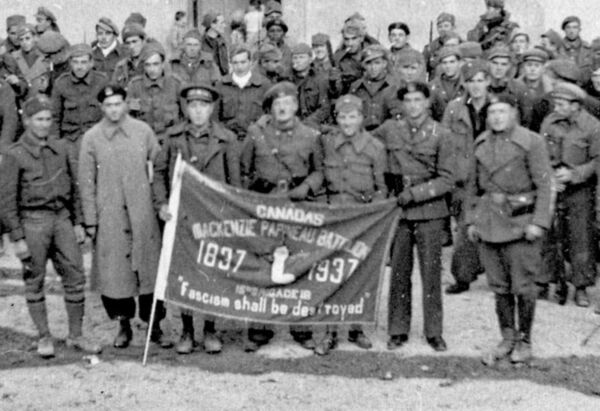
Group of MacKenzie-Papineau with banner, December 1937. Harry Randall: Fifteenth International Brigade Films and Photographs, Tamiment Library/Robert F. Wagner Labor Archives, #C252.
Canadians who fought in the Spanish Civil War have a deep connection to the labour movement. Most were working-class, motivated to fight fascism by showing solidarity with the Spanish people.
“The trade union movement was very heavily influenced by the left at that point, and a lot of the volunteers that went to Spain had trade union history,” said Yorke. Of those who survived, many continued their union activism when they returned.
Yorke reflected sadly when asked why so many of the Canadians whose names appear on each of the four abanicos had been killed in action.
“It was just such a terrible portrayal of what kind of courage and bravery these guys had … because they knew what they were getting into,” he answered. “The reason the death rates were so high was because of the terrible, terrible military disadvantage that the Spanish Republicans [had].”
Appeasement of Nazism
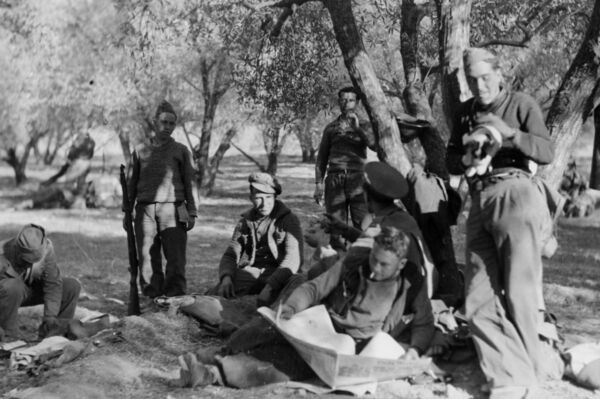
Company 3 Headquarters, MacKenzie-Papineau Battalion, March 1938. Harry Randall: Fifteenth International Brigade Films and Photographs, Tamiment Library/Robert F. Wagner Labor Archives, #C468.
“When the Spanish Civil War broke out, the reaction of the international community in general was not to rush to the assistance of the democratically elected Republic. It was to stay out of it.”
“The reason they were staying out of it was absolutely tied to the central policy of appeasement of Nazism,” Yorke adds.
The Canadian government “did not want to become involved in a war that would provoke Germany and Italy. The Americans, the British, and even the French were not prepared to take on Hitler. That meant that the Spanish Republic was unable to get the kind of military equipment and ammunition and arms and support that it needed.”
“They were tremendously out-powered by the combination of the troops in their tens of thousands that came from Italy, well-equipped, well-trained, well-armed. The German Luftwaffe was ferocious in the Spanish Civil War. It was actually simply trying on all of the murderous techniques that it then employed in the Second World War.”
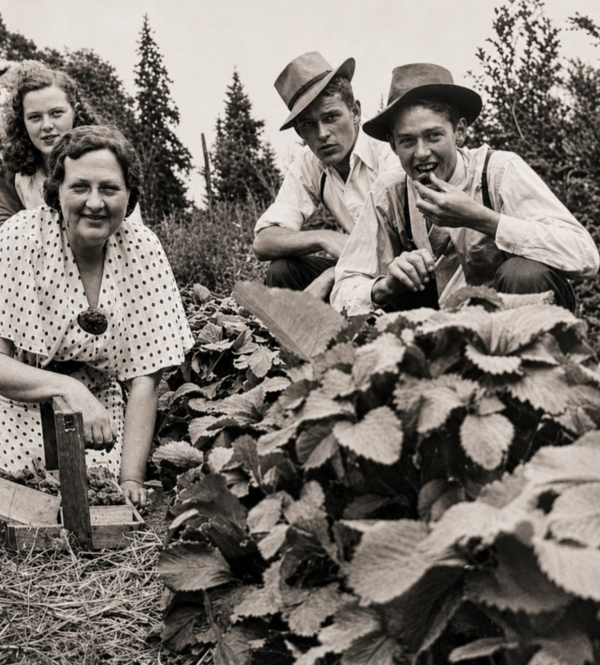
Mary Erickson, left front, volunteered with the Friends of the Mackenzie Papineau Battalion during the late 1930s. The Vancouver abanico was donated to the Museum of Vancouver by her family. Photo supplied.
Friends of the Mackenzie Papineau Battalion
The Vancouver abanico came to the Museum of Vancouver from the family of Mary Erickson, who died in 1960 on BC’s Sunshine Coast. Erickson was widowed in 1926—with four children between two and nine years of age—when her longshoreman husband was killed in a Vancouver waterfront accident.
Mary Erickson volunteered with the Friends of the Mackenzie-Papineau Battalion during the late 1930s. The group raised funds and sent packages of comforts like socks, chocolates and cigarettes to the volunteers in Spain. It is surmised that through these connections she came to possess the abanico.
The Vancouver abanico will remain in the Museum of Vancouver’s collection and can be viewed through the museum’s online database.
Sources:
Liversedge, Ronald. Mac-Pap: Memoir of a Canadian in the Spanish Civil War. Edited by David Yorke. Vancouver: New Star Books, 2013.
David Yorke. Interview with Patricia Wejr and Donna Sacuta, 22 June 2026.
See also:
BC’s Spanish Civil War Memorial