
Larry Kuehn Interview: Solidarity, Justice, and History
The interview covers Larry Kuehn’s extensive involvement with labour and social justice organizations beyond his work with the BC Teachers’ Federation (BCTF). His time as president of the BCTF is covered in an earlier interview, available in our BCTF Past Presidents Collection.
This interview was conducted by Ken Novakowski on April 30, 2025 in Burnaby, BC. It is part of our Oral History Collection.
Interview: Larry Kuehn (LK)
Interviewer: Ken Novakowski (KN)
Date: April 30, 2025
Location: Burnaby, B.C.
Transcription: Natasha Fairweather
KN [00:00:08] Hi, it’s April 30th, 2025, and we’re here to interview Larry Kuehn, who was the president of the BCTF [BC Teachers’ Federation] from 1981 to 1984, and had a very extensive involvement as a staff person for a couple of decades after that. Three decades, I think, so a very extensive work. And this interview by the B.C. Labour Heritage Centre is an addendum to the extensive interview done of Larry Kuehn for the BCTF History Project in 2015. Larry, I’d like to go back to your solidarity experiences in the early 1980s and ask you specifically about your work with Operation Solidarity and the Solidarity Coalition in 1984 and ’85. This is after the actual protest movement and the strike. You know, after your term as president of the BCTF had ended, can you tell us about that and about the People’s Commission that was launched by Solidarity Coalition and who was in that group and what their mandate was and what was the result of the work that they did?
LK [00:01:18] Yeah, after Solidarity and the collapse after the Kelowna Accord, there was pretty much a lot of disillusionment in the whole left, I think, in B.C. The focus of much of my work in the next few years was really trying to find ways of refocusing, of getting the people thinking about what the alternatives were to the neoliberal approaches that had been imposed violently in 1983. Because in the long term, that’s really necessary to rebuild and to get positive direction again.
LK [00:02:08] And one of the things that we did, I worked for the Operation Solidarity for a year and a half after I was president. And, we did a number of things to try to stimulate discussion in the labour community about what the alternatives were. And one of, probably the most significant thing we did was to have a commission that went around the province and interviewed people and produced the report on the Solidarity Commission with a whole range of recommendations about what the alternative for rebuilding a more social democratic kind of economy in the future was. And the commissioners included Mel Watkins as the chair, who of course was a very respected economist that produced reports in the ’60s and ’70s that really set—outlined a direction for the future, for the kind of Canadian economy that had the kind of resilience that we need to have now with what’s happened with the breakdown of it. You know, the globalization. And the other people on the commission included Margaret Marquardt, who was an Anglican priest, and Carol Evans, was it? Jane Evans. And Ray Haynes, of course, who had been past secretary-treasurer of the BC Federation of Labour. And they went around the province and held these hearings, got some really great ideas put together into a report, which got some coverage but not nearly what it deserved and still can be looked at as a kind of a blueprint for the kinds of changes that needed to be made.
LK [00:04:33] That was probably the major thing that we did during that period of time. We did hold a number of other smaller conferences; one on pensions and how the investment of pensions, the union pension funds and public pension funds could be a part of rebuilding the kind of economy we need. And several other times where we brought together, trying to get the kind of spirit we had in the Solidarity Coalition of bringing labour and the community groups together. But the most successful thing was probably the commission.
LK [00:05:20] Out of that, I then went to the BCTF and worked on a project called In the Wake of Restraint. And it was really trying to do the same thing where we looked at what the impact of the tremendous cut in education services had been because of the decisions made by the government that we were fighting against in the solidarity strike, and the solidarity movement that we had. And so we produced a report called In the Wake of Restraint, which again outlined what the impact of current policies was and how the policies needed to change in education specifically, growing out of the situation that we found ourselves in the mid-80s. I was involved in a couple of other projects, too, that sort of had the same purpose of trying to stimulate discussion and thinking about what alternatives were. One of them was New Directions magazine, which a number of us started, and was published for about five years, had a circulation of about 1,500. It had a variety of things, some of them cultural, about what’s going on, but many of them analyses of what was happening and sort of the beginnings of trying to bring more of a green perspective to the NDP at that stage as well.
KN [00:07:09] Well, during the 1980s, Larry, you were involved in a number of things, and both while you were BCTF president and subsequently you were directly involved in the work of an organization called the Pacific Group for Policy Alternatives. In addition to your role in that group, what else can you tell us about this group? Who were they, what did they accomplish, and why did they not continue beyond the 1980s?
LK [00:07:33] The creation of the Pacific Group really grew out of a conference that the CCPA [Canadian Centre for Policy Alternatives] had in Vancouver. Again, after Solidarity and trying to bring together people to think about what the alternatives would be to building the kind of economy and society that was more desirable. Out of that, a number of us got together. Clay Perry was a key person in that, and the BC Fed was represented in it at the time. I think David Rice was the person who participated in it. And we developed a series of conferences. And we put out some publications as well. We got some grants from a federal program that was open at the time for employing people who were unemployed, and so it was an EI [employment insurance] top-up program, and, so we had actually a staff of five or six people who were doing research and helping to organize the conferences we had. David Schreck was a key person in it, in the organizing and in the continuing work of the Pacific Group and Patsy George, who had been active in Solidarity as well played a significant role in it.
LK [00:09:20] We brought in speakers. We had conferences, about two or three a year. They generally drew about 150 or 200 people to talk about the current issues. Marjorie Cohen was one of the early speakers and she was still in Toronto at the time and came out. And Sam Gindin, who was with the Canadian Autoworkers as it was at that time. So we had brought in speakers as well as having local people talk about things and engage in debate and discussion. At one stage we lost the support of the BC Fed. One of the things that we did over four years was to have summer institutes. Popular economics institutes. The first one was with Sam Bowles and Juliet Schor who were left economists from the U.S. Bowles was one of the authors of the major study of the class structure and education in the 1970s. And Juliet Schor is one of the people who was involved in studying precarious work over the last several decades. So they sort of got us started on this, of having a week-long residential workshop. And for four years, we held those and brought in speakers from out of province, as well as drawing on local people, like Gideon Rosenbluth from the economics department at UBC. Most of our publications at that time also were done by academics who were interested in producing things that were not for academic publications, but for a broader audience to try to understand the economy and what the alternatives were. And those were published as a number of issue papers. And then some of them were collected into a book as well.
KN [00:11:48] Okay. Also in the 1980s (you were obviously very active then, you’ve been active all your life), you were quite involved in the anti-apartheid movement which was becoming fairly prominent and significant during the 1980’s. What was this group and what was their goal and who were the people primarily involved in this work here in B.C. with you?
LK [00:12:16] There were really two main groups that were—there were two main groups, primarily, that were involved in the anti-apartheid work. One of them was really a labour group that was a SACTU [South African Congress of Trade Unions] support group. SACTU was the exiled trade union federation from South Africa. And they had support groups around the world that were basically involved in labour kinds of activities. And they—Jef Keighley was one of the key people in that. And they primarily did things like they picketed the ships that were taking, carrying sulfur to South Africa because it was used in the development of explosives and a whole variety of kinds of activities like that. I think they were primarily involved as well in the wine boycott.
LK [00:13:27] The other group was the Anti-Apartheid Network and I was chair of that and it existed from I think 1986 to 1991 and it did, focused primarily on the Shell boycott. Shell was a major company in South Africa. Internationally, there was a boycott of Shell taking place to try to influence them. We would hold pickets at Shell gas stations to let people know and to try and encourage people not to buy their gas at Shell stations. And probably our major activity that was successful was going to Vancouver City Council and convincing them to boycott Shell. So they made a policy that—adopted a policy that the city wouldn’t buy any Shell products. Shell took them to court, and eventually won, that said that boycotting was beyond the authority of municipalities, but for a period of time—and of course all of these activities were focused as much on raising awareness as they were on, you know, on thinking we’re actually going to bring Shell down, Shell down, you know. But it kept alive the idea of boycotts and, and controlling the investments of—to encourage the large industrial investors, and especially organizations like universities to withdraw their funds from Shell, investments in Shell.
LK [00:15:37] The Anti-Apartheid Network was made up of a range of organizations, the BCTF was involved and I was representing the BCTF there. One of the major groups involved as well was Oxfam Canada and they had an office in Vancouver and we used their facilities for our activities. There were a range of other community groups there. There were some ANC [African National Congress] people in exile who participated. There was the SAC, the South African Action Committee. That was made up of mostly of South African exiles who had been active in the struggle in South Africa and were here and wanted to participate. So it was a community organization. Mostly not the labour organizations, they mostly were involved in the SACTU support kinds of things, but together they helped to create a climate for the anti-apartheid work.
LK [00:16:50] Probably the best known activity we did was the birthday celebration for Nelson Mandela for his 70th birthday while he was still in Robben Island. We rented a billboard. ‘Happy birthday to Nelson Mandela’ and put his picture on it. The only picture we could find, which was from his trial in 1981, because the South Africans didn’t allow any photos of Mandela. And so this was a big billboard that was up at the corner of Broadway and Cambie, a very prominent place. And on his birthday, we held a celebration and then we had several hundred people blocked off Cambie Street, right by. Broadway and had a big birthday cake, you know, and Libby Davies and Brown—the first Black woman—Rosemary Brown cut the cake, and we shared it with the people who were there.
LK [00:18:10] And of course then, on the day that Mandela was released from prison, we had a big celebration at the BCTF down in the basement, and we had The Ginger Group there to play and just celebrated the release of Mandela and the clear change that was taking place in South Africa.
LK [00:18:40] I was also involved in IDAFSA, the International Defense Aid for Southern Africa, which was a British organization, primarily of ANC exiles, but that had a branch in Canada and in some of the Scandinavian countries as well. And IDAFSA was a banned organization in South Africa. And so none of its activities could be reported there or whatever, but what they did was to provide money to the families of political prisoners. To support them, and they provided most of the funding for the legal support in the trials of people who were arrested because of anti-apartheid activities. And the way they got the money there was through entirely underground approaches. And I was involved in that, in the Canadian version of that. The Canadian government at that time, with Mulroney as prime minister, actually provided a million dollars to IDAFSA Canada to be surreptitiously smuggled into South Africa.
LK [00:20:09] And the way it was done was the money went to IDAFSA, IDAFSA gave the money to a separate organization had been set up just for that purpose, had entirely independent accounting and so on. And then it had a network of people who would be sent the money and the names of South African families, names and addresses of the families of South Africa political prisoners. And then the job of the person who got the money was to find other people to send the money in the form of postal money orders, along with a letter. The people who sent the money couldn’t know where the money came from, nor could the people who received the money, because it was all an illegal organization that was operating. So I found five or six people to write letters and send off the postal—and I couldn’t tell them who the people were. And they were just to write a letter that was sort of a friendly letter, you know, of ‘I hear you’re in difficulty and you know here’s some money’ and would send the money off. And you know it was really amazing to me that the Canadian government was prepared to support something that there was no way that they could ever account for. Because it went through all of these steps, and each step, you didn’t know what else, who else would do it.
LK [00:21:56] And IDAFSA, the international group, which mostly was funded by Scandinavian countries, you know the Swedes in particular, managed to, for several years, to run this system that provided for the financial aid and for the legal support for South African political prisoners. So that was something I couldn’t even talk about until well after it all took place. There were two levels of what we did. One was what we did in a public way, which included bringing various people here like Dennis Goldberg who was the the first of the Rivonia trialists who was convicted with Mandela and the only white person who was. He was the first one released from prison in the late 80s as the government was kind of testing what they could do. So he came on a tour and we had him here in Vancouver, and then Govan Mbeki. Who was also one of the Rivonia trialists and very close to Mandela, was released before Mandela was. And again, IDAFSA sponsored a tour across Canada of Mbeki, to sort of introduce people to the fact that things were changing and we’re going to see some change coming out of that.
LK [00:23:40] I then went to South Africa in 1990 on a Canadian Teachers’ Federation project where I was to provide some computer training for producing newsletters for the newsletter editors for the Black teacher unions. There were, I think, 18 different—each province and each so-called homeland had its own education system and its own union. And then the unions were divided, so there was a Black union, two white unions, I think, an Afrikaaner one and an English one, and a Coloured union and an Indian union. And each of these unions was, well, they operate within their own system. So the CTF [Canadian Teachers’ Federation] had this project to offer training to the newsletter editors for the Black unions. They came together, 18 of them in a hotel in Johannesburg in June of 1990, which was just three months after Mandela had been released and there were these changes taking place in the country that were amazing to watch, being there.
LK [00:25:10] I didn’t think I would get in, because the previous year the CTF person couldn’t get a visa to get into South Africa, and they had to do their project in Swaziland and take the South Africans out into Swaziland. But I didn’t think I’d get a visa because I was all then IDAFSA. But the change, it was so dramatic of what happened that it was no problem. And so I was able to do that. And we made connections there with the people from the other unions. At that time, the international organization of teacher unions, WCOTP [World Confederation of Organizations in the Teaching Profession], was bringing together all of the unions in Zimbabwe to—brought them out of the country and into Zimbabwe to try to create a single union that represented all of the racial groups and to create a unitary union out of that. And that happened in 1990, in October of 1990, they all came together. So the Black unions I’d been working with mostly joined into the South African Democratic Teachers’ Union. This union, plus the Indian unions came in, and some of the white unions, initially at least, and the Coloured unions, so that they, out of what had been a fragmented teacher union movement, they created a single unitary union, that most of the South Africans, with some exceptions participated in.
LK [00:27:09] But that union had no resources, except for what the Indian union brought. They were the only ones that really had any resources. The others didn’t really have any. So they had no money to organize. Because they had to go and sign up everybody, because it now was a unitary union to reflect the unitary education system that they were working towards. So the BCTF, as part of an international solidarity program, contributed $50,000 a year for three years, and the Canadian Teachers’ Federation matched that. You know, so that was a major source of the funding that SADTU [South African Democratic Teachers’ Union] used to organize, you know, in that period. And SADTU is now probably the most significant teacher union in Africa, and has its own support programs for working with other African unions. Our ability to do that really grew out of the work we did in the anti-apartheid work in the 1980s.
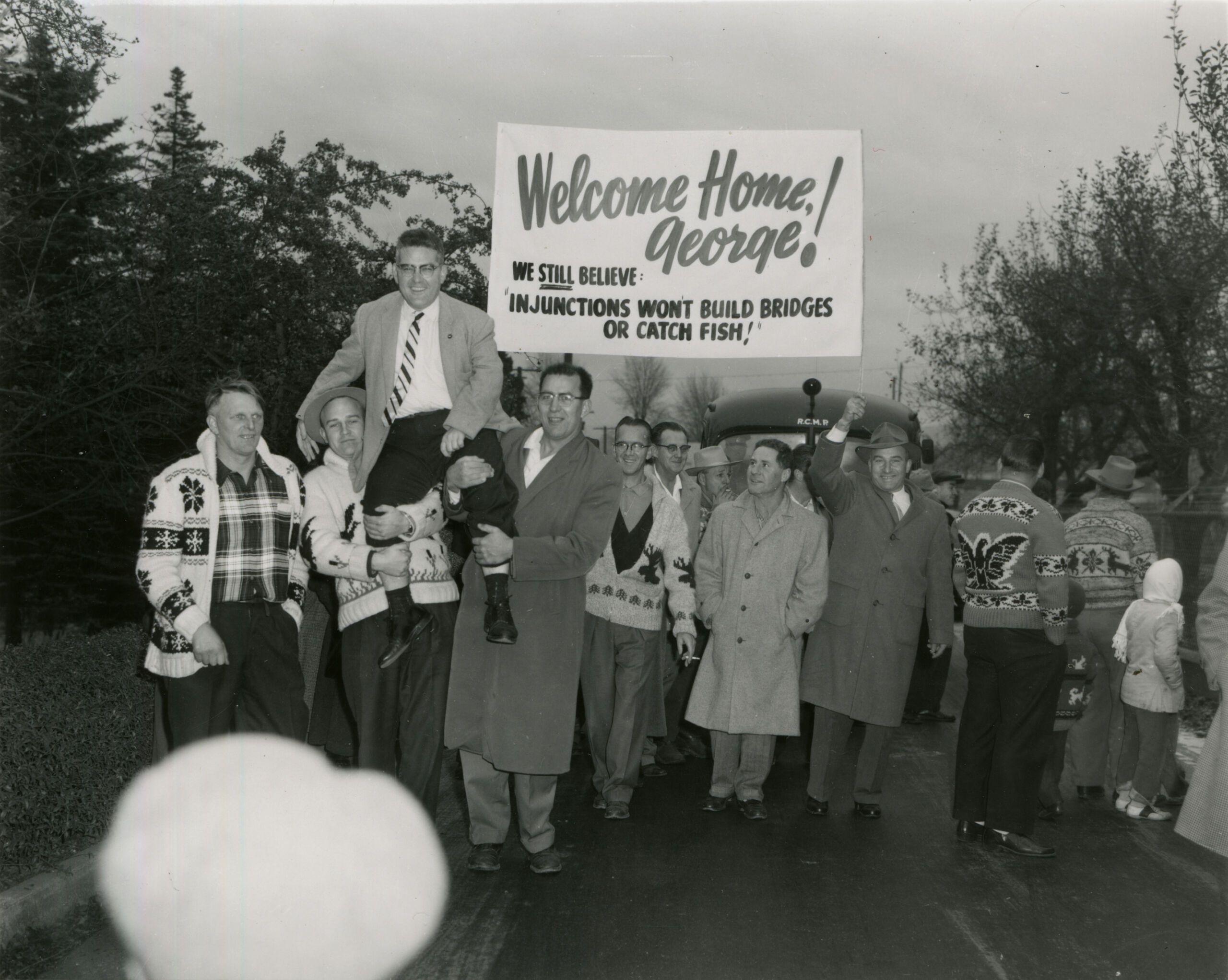
KN [00:28:38] Now at one of my July 1st galas at my home and yard in Langley in 1989, you brought a much larger picture of George North being carried on the shoulders of some union brothers who were displaying a huge sign that read ‘Welcome Home, George’. We honored George North that day, he was there. Can you tell us a bit who George North was and the story behind the picture and the celebration?
LK [00:29:11] George was, at that time, he was the director of our bargaining division at the BCTF, but he came to teaching late. I think he was in his 50s when he became a teacher. Before that, he had been an editor for the Fishermen’s newspaper. You know, and at the time that the bridge, the Second Narrows Bridge was built and fell down in the course of it being built and a number of people died in this industrial accident.
KN [00:30:01] That would have been 1958.
LK [00:30:03] ’58. And there was a court injunction that the workers were not going to go back to work in those conditions, and there was a court injunction that ordered them back to work. And George wrote an editorial in The Fishermen’s newspaper that said that injunctions won’t—
KN [00:30:36] Won’t build bridges or won’t catch fish.
LK [00:30:39] Yeah, because of course in the fishing industry there had been a whole series of injunctions against the fishermen’s union when they would go on strike, and this one as well. And so George was thrown in jail because he had attacked the judges. When you see what goes on now with the way the president of the United States and you know, and others in Canada to attack the courts. You know, you’re amazed for something as simple as that, that you would be jailed in those days. But he spent a time in Oakalla, I believe it was, and when he came out, he was greeted by a big ‘Welcome Home George’ sign, and this photograph was the photograph that probably came from the Fishermen’s union paper. We had that blown up into a huge photograph, into a poster, in recognition of what he had accomplished there.
LK [00:31:54] It was after that that he became a teacher and very quickly became active in the BCTF. And then in bargaining and then joined the BCTF and was a key person in the period of when we got full collective bargaining rights in pursuing— and just being able to bring that labour experience that we didn’t have in the BCTF. He and a few other people who we hired at that stage for the staff, from Ray Haynes and Sharon Yandel, who had extensive experience in the labour movement, it helped us really establish the collective bargaining in the expanded scope that we had in the BCTF.
KN [00:32:50] So Larry, while you were the Director of Research and Technology at the BCTF, you were also a member of the board of the BC office of the Canadian Center for Policy Alternatives [CCPA] for over ten years. Can you tell us something of that particular experience?
LK [00:33:08] Well, the CCPA-BC office was very important to me because we basically tried to build that in the 80s with the Pacific Group for Policy Alternatives. And so to a large degree from the work that you did when you were president or executive director, I guess, at the BCTF of getting other unions to provide the basis of support for creating the CCPA. And again, the importance of the CCPA is in creating the climate for progressive ideas. Idea generation in public policy issues that had been dominated by the Fraser Institute and created basically when the NDP was in power the first time. Their long-term plan was to create the political climate or the intellectual climate for the political right-wing neoliberal approaches. And so CCPA, it was really aimed at doing the same kind of thing but for progressive ideas. The BC office became very significant, and you know it produced papers that set the debate and got a lot of media coverage. Much more by that time than by the early 2000s than the Fraser Institute was getting. So it provided kind of the basis for when the NDP came back into power that there was a public understanding and acceptance of the kind of different ideas of what kind of society and what kind of governing we should have. As a board member, mostly I was making sure that we had the BCTF support because I was representing the BCTF there and you know that we had the BCTF support for the CCPA, which was an important part of both the organizing of the BC office initially and the maintenance and building of the BC office.
KN [00:35:57] During the 2010s, the BCTF put a lot of energy and resources into establishing the BCTF Online Museum, and you were actually an integral part of making this happen. Can you give us some idea of the breadth of this project as well as its development over the years and its final status as a source of historical information about the BCTF?
LK [00:36:21] Our idea was to create something for the 100th anniversary of the BCTF, which was in 2017. We wanted to create something that gave access to the history of the organization as part of the celebration of it, and hopefully to be an ongoing resource. A group of us have formed a committee and the staff, and there were eight or ten people on the staff. Moira McKenzie, who was executive director at the time, played a key role in this, in both providing the support for staff spending their time working on this, you know and contributing things to it as well. So the idea was to be kind of an online archive that gave access to the range of things that the BCTF had done over 100 years.
LK [00:37:28] We were able to include on it documents like the annual general meeting minutes from the very first annual general meeting in 1917. Various documents of articles about the BCTF over a period of time, et cetera, as well as there were rooms devoted to particular programs. So there’s one, for example, on pensions that told about the development of the pension plan, when it went bankrupt in 1940, and the rebuilding of the plan, the history of, you know, the kind of struggles the BCTF had to have a really good pension plan. Another section on the status-of-women, about the development of the status-of-women program, and the kind-of network, the provincial network, and the kinds of successes that they had and really changing the nature of the BCTF. One on Aboriginal education that focused on the development that particularly had started around 2000 and trying to finally come to terms with the fact that Aboriginal kids were not doing well in our schools and there were very few Aboriginal teachers and we had to do things to change that situation. And so each of the programs, you know, on collective bargaining, you could go in and learn about the history of the collective bargaining.
LK [00:39:20] So this was all on one website. And our graphics department did a major part of the design and building of this, as well as our IT department, and the people who contributed the content to it as well. So it’s probably as extensive an archive as, in terms of accessibility, as any union had. Unfortunately, two or three years later, the BCTF decided to completely revise its website and adopt a whole different set of underlying program for maintaining their website. They said that they couldn’t keep it on the BCTF website. So some of us made arrangements to have it archived on the Internet Archive, and there was a link from the BCTF website that would take you to the place on the Internet Archive, so you could at least get access to it. You couldn’t do the search—we lost the search potential of it, which was a very powerful feature because it lets you really hone in on—not only the minutes, but the BC Teacher Magazine, which was published from, started in 1921, I think, and continues to be published. It’s a major source of information about the, not just the BCTF, but about education history in B.C. If you read any historical account of the BCTF, you’ll see most of the references are to the BC Teacher as a resource. So it now is very difficult to get to. It still exists on the Internet Archive. You have to know to go there, and you have to know which version to—because the Internet Archive operated in a way where they would keep every few months they would go in and capture what was there. And of course there’s nothing new being added to it because we can’t add anything to it now. So you have to find the right one that has all of the original content in order to get to it. And it’s a much slower process because the Internet Archive is archiving as much of the internet as they can. And so it’s an incredible resource for everybody. But it’s much more difficult to get access to and isn’t really publicized by the BCTF as a place to go to look at it.
KN [00:42:30] Okay, well during this period of time you also play the key role in helping to establish the BCTF History Project, can you tell us a bit about this group and some of the work that they accomplished over the years?
LK [00:42:45] Yeah, just a group of mostly retirees, some from the staff, mostly from the staff, and a few others. And probably the main thing that we produced is the series of interviews of all of the past presidents who were alive when we did the interviews, several have died since then. These interviews give a really rich resource in looking at the history of the Federation and the various struggles and successes over a period of time. I think the oldest one is probably about 1961. Wes Jansen, I think, is probably the earliest of the past presidents were able to interview. And that’s probably been the main product of that. But there have been a series of articles, as well, that appeared in, some in the BCTF Teacher magazine, and one that you wrote on that’s in BC History. And so it’s, again, trying to give access to the, to really the incredible things that have been done by the BCTF over the century plus.
KN [00:44:27] In 2019, I believe it was, you were aware of the G.A.—
LK [00:44:31] 2018, yeah.
KN [00:44:34] In 2018, you were awarded the G.A. Ferguson Award by the BCTF. That is the highest honor the organization can bestow on any of its members. Can you tell us a bit how you felt upon receiving this award?
LK [00:44:47] Well, unfortunately I was ill at the AGM where they gave it to me, and I had a written response that somebody else had to read for me because I was there but I just couldn’t even get to the microphone and read it. But it reflected, I mean, it was basically—I became the local president in, full-time in 1976 and except for short periods after that and until 1919 [ed: 2019] when I retired, my working life was entirely the BCTF, you know at various levels, doing lots of different things in the organization. So for me it was a feeling of you know, positive feeling of recognition of, basically of the life I’d spent committed to the work of the organization and to the work of teachers.
KN [00:45:59] So after you retired from staff in 2020, you remained very active in CoDev. Can you tell us about this organization and your involvement in it, particularly since retirement?
LK [00:46:12] Co-Development Canada is of course a BC NGO, non-governmental organization, that its purpose is to have solidarity relationships between B.C. unions and unions in Latin America. It really started in 1985, and this is the 40th anniversary of it. I was involved at the very beginning. I was on the first activity tour that they organized in 1985 with the president of the Ontario Teachers’ Federation and vice president of the CEQ [Centrale de l’enseignement du Québec] in Quebec and myself, who went to Honduras, Nicaragua, El Salvador and Guatemala at a time when there were either military governments, illegal unions, or civil wars going on in that area. Commitment to that international work really was solidified in that experience, seeing the resilience and the ability of these teachers who were under these incredible conditions to maintain an organization, to fight for public education and for the interests of teachers. And so I was very much committed to the work that, the kind of work that CoDev was doing. The BCTF was the main partner of CoDev in the first decade basically, of CoDev’s existence. It was the only Canadian union partner that had projects in Latin America, solidarity projects with the teacher unions there.
LK [00:48:20] While I was on the staff at the BCTF, I was the director responsible for our International Solidarity Program. Almost all of our program was working in conjunction with CoDev, as partners with CoDev in the work in Latin America. So I had a very close link to CoDev. So when I retired, I joined the board of CoDev and I’m currently the treasurer of the organization (on the board), and part of the coffee group, Café Etico, which is a company that CoDev owns, that sells coffee, that has arrangements with co-ops, coffee growing co-ops in Central America and in Peru. And so we buy the coffee in bulk, we bag it and grind it for the people don’t want to grind themselves, and sell coffee primarily at union organizations, because it’s a way for CoDev to be present and to let people know about CoDev. And mostly, it’s their unions are contributing. CUPE is now a major partner with CoDev. But there are, I think, 14 different unions and organizations that are partners with CoDev now that have support projects in unions. In some cases it’s with solidari— With social movement groups like Maquila Workers in Central America, a number of our projects are with supporting Maquila workers to organize even if they’re not in a formal union to try to improve their conditions as well. So I’m, you know, involved in as much as I can be in the current activities of CoDev as sort of a continuation of what I’d done for the 35 years before I retired.
KN [00:50:51] But also in retirement, Larry, you became active in the BC retired Teachers Association, particularly by serving on their Heritage Committee. Can you tell us about some of the work that you’ve been doing on this committee and the role you’ve playing with the BC RTA?
LK [00:51:06] The Heritage Committee is aimed at encouraging the local branches of retired teachers to look at the history of both of education and of their locals in the BCTF. You know, and we give grants to projects and we are trying to encourage people to do these kinds of projects. In Cowichan, they’ve identified every site where there has been a school since the first school in Cowichan, in the Cowichan district, and they’ve put plaques on each of the school sites to indicate that this was a school. And in Victoria they were doing a history of the union, which of course was the first union to have a strike in B.C., in 1919. First teacher union to go on strike for recognition and better wages. And one group in the Kootenays is digitizing school yearbooks and putting them online for people to be able to find trace of their relatives over a period of time. So a lot of projects like that, and I’ve done some writing for the magazine of the retired teachers that, again, to try to encourage people to—tell them about some of the projects that are going on, encouraging them to start their own project, to build a local archive, or to create some kind of a historical project about the role of teachers and the role of education.
KN [00:53:10] Okay, finally, just wondering if there’s anything else you would like to comment on that I haven’t covered in these questions, either about the BCTF or any of your other organizational work.
LK [00:53:22] Yeah, I think you’ve covered lots of the activities I’ve been involved in over time. I did a lot of writing for Our Schools Ourselves as well, some other publications also. Our Schools Ourselves, which is a Canadian organization, a progressive publication that was actually put out by the CCPA, you know, and from the first issue, I contributed an article for almost every issue that was published until fairly recently. Mostly focused on globalization issues and on technology and education issues. The critical perspective on the use of technology and kind of the corporate role of technology in trying to take over a lot of education, and privatization issues, a range of kinds of things that I’ve been interested in and that it seemed to me that there needed to be some public discussion of to try to impact the policies that are adopted in education.
KN [00:54:43] Okay, all good. Well, thank you very much, Larry. We appreciate it.
Kuehn discusses his work with Operation Solidarity and the Solidarity Coalition in the 1980s, including the People’s Commission that examined alternatives to neoliberal policies. He also describes his roles with the Pacific Group for Policy Alternatives, the anti-apartheid movement, and the Canadian Teachers’ Federation’s support for the South African Democratic Teachers’ Union (SACTU).
Kuehn played a key part in establishing the BCTF Online Museum and History Project (now archived) to preserve the organization’s history. He has remained active with CoDev, a non-profit focused on solidarity between BC unions and Latin American unions, as well as the Heritage Committee of the BC Retired Teachers’ Association, working to document the history of education in the province.
Throughout the interview, Kuehn highlights his lifelong commitment to progressive causes and the importance of preserving the history of the BCTF and education in British Columbia. His work has spanned decades, from labor activism to international solidarity efforts, all aimed at promoting social justice and progressive change.
Related Resources
Timeline: BCTF Past Presidents Interviews
The BCTF History Project interviewed past presidents and other leaders of the BC Teachers’ Federation, with most of the interviews recorded in 2015–2016. In 2024, the collection was given to the...
BCTF History Interviews Collection
Beginning in 2014, a working group of BC Teachers’ Federation staff and volunteers conducted interviews with past presidents of the BCTF. These interviews cover most presidencies from 1963-2022,...
Larry Kuehn Interview: BCTF President 1981-1984, Pt. 2
Larry Kuehn served as President of the BC Teachers’ Federation (BCTF) from 1981 to 1984, and later spent more than three decades on Federation staff, primarily as Director of Research and Techno...
B.C. Unions Take a Stand Against Apartheid in South Africa
The fight against apartheid in South Africa was long, arduous and often violent, costing many lives. Starting in 1976, until the first free election in 1994, B.C. union members worked tirelessly in su...
Taking a Stand: Union Solidarity Against Apartheid, Podcast Ep. 30
The fight against apartheid in South Africa was fought on many fronts with the solidarity of anti-apartheid groups around the world. BC unions and activists were a proud part of this global movement. ...
David Chudnovsky Interview: BCTF President 1999-2002, Part 2
David Chudnovsky served as President of the BC Teachers’ Federation (BCTF) from 1999 to 2002. In Part 2 of this two-part interview, he discusses the Public Education Advocacy Plan (PEAP), his wo...