
Ginger Goodwin: A Workers’ Friend
Published: January 5, 2026
Authors: Rod Mickleburgh
Charismatic union activist, socialist and organizer Albert “Ginger” Goodwin was fatally shot on July 27, 1918, by special constable Dan Campbell in the woods overlooking the working-class bastion of Cumberland. Goodwin, a vice-president of the BC Federation of Labor, had been hiding out to avoid a politically suspicious order that he report for military duty. The order, which followed his equally dubious reclassification from unfit to fit for service, took place during a strike he led for an eight-hour day by Trail smelter workers. The Dominion Police had been tracking Goodwin for months.
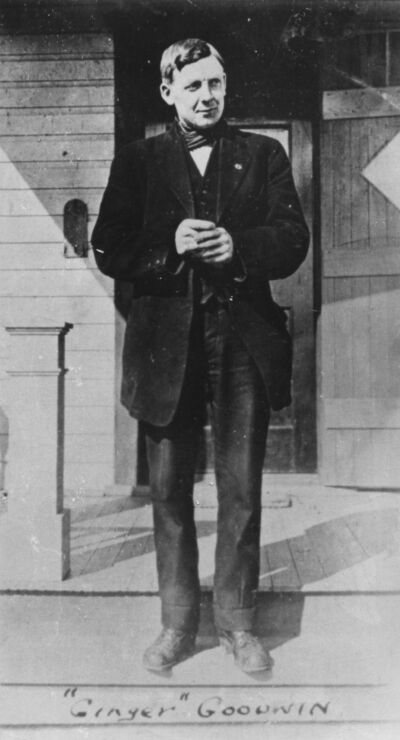
Albert “Ginger” Goodwin, Cumberland Museum & Archives C110-002
Although the precise circumstances of Goodwin’s killing remain inconclusive, there is no doubt he died a martyr to the cause of working-class struggle, pursued solely for his trade union leadership. Remembered for his role in the 1912–14 coal strike, Goodwin was revered by the people of Cumberland, who had helped him survive his clandestine existence. Already a veteran of nearly nine years in the mines of Yorkshire and Canada, Goodwin had come to Cumberland the year before the strike began, five months shy of his twenty-fourth birthday.
His solid play for the local soccer team and growing espousal of socialism and worker rights soon made him a community fixture. On a hiring blacklist after the strike, Goodwin managed to find work at the smelter in Trail, where he significantly upped his activism. He ran for the Socialist Party in the 1916 BC election, winning 20 percent of the vote.
He helped organize and was elected full-time secretary of the local smelter workers’ union. He was also chosen as a vice-president of the BC Federation of Labor.
His prowess as a Socialist orator, urging “the wage slaves” to rise up and overthrow “the master class,” led to many speaking engagements. A reporter for the Vancouver Daily World covering a Goodwin speech at the Rex Theatre on August 19, 1917, praised his socialist knowledge and calm delivery. Six months later, he was on the run.
His sombre funeral procession, led by the municipal band, stretched from one end of town to the other. “The casket was packed shoulder-high right through Cumberland,” miner Ben Horbry recalled years later. “When one bunch of men got tired, another bunch took over.” Police were told to make themselves scarce. “The miners were so incensed over it,” Horbry said. “It was a good thing for [Dan] Campbell that he got out and disappeared when he did. He would have been hung or shot.”
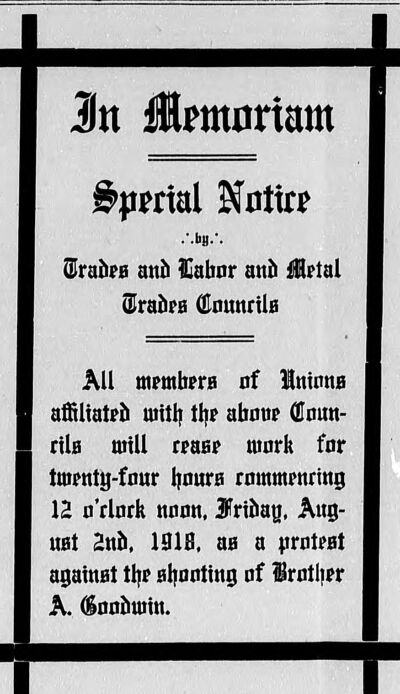
In Vancouver, news of the shooting hit like a thunderbolt. At noon on August 2, the day of Goodwin’s funeral in Cumberland, close to six thousand workers walked off the job across the city to mourn Goodwin and protest his fatal shooting. Shipyards and the docks were shut tight. Trolleys were taken off the streets by their drivers. Construction trades, linemen, garment workers and other assorted groups also took part. The shutdown lasted twenty-four hours. It was Canada’s first general strike.
Reprinted from Rod Mickleburgh. “On the Line: Stories of BC Workers” (2018), Harbour Publishing © BC Labour Heritage Centre.
See also:
Roger Stonebanks. “Fighting for Dignity: The Ginger Goodwin Story” (2004), AU Press. Free download.
Susan Mayse. “Ginger: The Life and Death of Albert Goodwin” (1990), Harbour Publishing.