
Syd Thompson interview
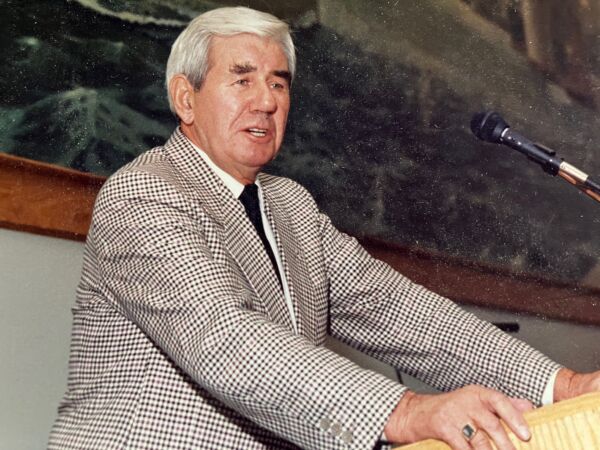
This interview was conducted by journalist Rod Mickleburgh with Syd Thompson around the time of his retirement. Thompson was president of both the large Vancouver local of the IWA [International Woodworkers of America] and the Vancouver and District Labour Council until his retirement in 1980.
[00:00:00.100] – Rod Mickleburgh
Feelings at this moment?
[00:00:03.630] – Syd Thompson
Oh, I have no qualms about leaving. I’ve made up my mind some time ago that comes a time in life that you should do something different. And mainly what I want to do is do some hunting and fishing and be in the outdoors. I love the outdoors, and in the life that I’ve had, it’s been pretty difficult to do that the way I would like to do. So I, I have no misgivings about it. I’ve left the IWA last summer and I really don’t miss the place.
[00:00:36.710] – Rod Mickleburgh
Not a bit?
[00:00:37.950] – Syd Thompson
Not really. I, I’m enjoying every bit of my retirement and I keep active doing things. I’ve always loved to read and I have no problems putting in the time. And this stuff that you have to work in order to be happy in this world is a crock of crap. This is employers’ propaganda, lock, stock, and barrel. You don’t need to work for somebody to be happy. You can live a beautiful life without it. Just look at the rich. They spend all their time living off of somebody else’s bloody work rather than their own.
[00:01:11.240] – Rod Mickleburgh
When you look back at your many years in the labour movement, are there a couple of things that really stand out, a couple of the struggles that you were involved in?
[00:01:19.990] – Syd Thompson
Oh, there have been a number of IWA struggles. I guess my biggest struggle in life was to become the president of the IWA local. That was 22 years ago. It was one of the dirtiest, rottenest political fights that anybody ever got involved in in the labor movement in this province, and there’s been lots of nasty fights. I won that fight, and I guess that probably stands out more than anything else. We’ve had numerous struggles in the forest industry. In fact, in the early days, almost every set of negotiations was war of one kind or another. Our settlements were so miserable and cheap that there was literally no other way of doing it. We’ve overcome that over the years where we get good settlements now, and the whole approach has changed. Management is different, and I guess the union is different because we get different results and different settlements. But from among those struggles, it’s pretty difficult to pick any particular one out. I remember people like Nathan Nemetz, who was involved in negotiations, who on more than one occasion would get me in the corner and lay the wood to me. We would have half the industry around our ears here, and he was hell-bent and determined to get the guys back to work before there was a settlement or before he could have sensible negotiations.
[00:02:49.100] – Syd Thompson
And I would keep telling him, well, there are some bloody things that took place long before you arrived on the goddamn scene, and they have to bloody well be resolved. And I had an understanding with Nemetz that he understood that, and I have the greatest respect for the man. And every time we had him we got good settlements, and he was the kind of a force that played a part in helping, in my opinion, settle down negotiations in the forest industry.
[00:03:18.730] – Rod Mickleburgh
You mentioned the really ruthless fight that went on for the presidency of the Vancouver local. Do you still see those kinds of struggles within the labour movement? Are they the same kind that they were 20 years ago?
[00:03:28.350] – Syd Thompson
I wouldn’t be surprised that there may be times again. The labour movement has matured a lot. But then when you look across the border in the United States, in my opinion, the labour movement has degenerated and is still degenerating, and that will result in internal troubles where rank and file and militant forces will come to the surface that will take the leadership on, and rightfully so. It hasn’t reached that stage in Canada. We basically have a good leadership in the labour movement, a fighting leadership, and the kind of leadership that brings results for the rank and file.
[00:04:06.690] – Rod Mickleburgh
But the Syd Thompson of old— I’m sure you’ve been asked this question a lot— was often at loggerheads with the leadership of the trade union movement. Has the trade union movement changed, or has Syd Thompson changed?
[00:04:18.010] – Syd Thompson
Well, I suppose that nothing stands still in this world, including me. Of course we change and alter. The labour movement has changed and altered. The society in which we live has altered. As I pointed out earlier, we can now get settlements, good ones, sometimes without all-out war, in fact frequently without all-out war. 20 years ago this seemed impossible. We have, and I quote and go by the IWA, that’s what I understand, an altogether different leadership than we had 20 years ago, leadership now that brings results in my opinion, and in those years they didn’t. So all of that has changed and of course people change with that. You wouldn’t accomplish anything if you didn’t. That doesn’t mean to say that you’re less militant or that you’re less prepared to fight. I just don’t believe that. Certainly when you get older you should get wiser and I think you do. It’s like the bloody jackass who stumbles over a rock. He has enough sense not to do it the second time. And the same with human beings in the labour movement. So you become smoother and you can get results a little easier, and then they say, “Oh, the guy is losing his marbles, he’s lost his fight,” and blah blah blah, and on and on it goes.
[00:05:36.990] – Syd Thompson
Well, I don’t think that that takes place whatsoever.
[00:05:39.780] – Rod Mickleburgh
What about the young Turks in the labour movement? You know, they say the same things about you that you might have said about the leaders of the IWA at a certain point. Do you think— what’s the difference in that?
[00:05:52.470] – Syd Thompson
If they didn’t say what they said, I would be highly disappointed in the young fellas. Young people above all else have fight and should have rebelliousness in them. If they haven’t got that, then we’re in bad shape. And they must be allowed the opportunity to say their piece in the labour movement. Leadership has to lead, and I’ve always advocated that. And I don’t think anybody can ever say that I was a weak-kneed leader. If I saw a thing a certain way, I pushed it. And I don’t agree with the Maoists, Trotskyites, the Marxist-Leninists, and there is a variety here today, it’s like the alphabet soup. I think they’re all on the wrong track. The labour movement is not prepared to accept that philosophy. I learned that many, many years ago. The Marxists and the Leninists throughout the world believe that the labour movement should be used as an instrument for political purposes. Working people in the Western world resent that and don’t want any part of it, and I have yet to see where that philosophy is successful. Where the system has been overthrown, it’s always been where there is no labour movement.
[00:07:09.220] – Syd Thompson
Russia, China, Cuba.
[00:07:11.630] – Syd Thompson
In fact, the labour movement in Cuba opposed Fidel Castro almost until the very last minute and played no part in overthrowing the system there. And where you have a strong labour movement, working people object to their movement being used in that bloody fashion. They want pork chops, they want steaks on the table, they want bacon and eggs, they want a good house to live in, and they are not interested in revolution. That’s the philosophy of the labour movement in the Western world, and in that sense, leadership comes into conflict with the young guys who say bullshit on that stuff. That’s not what we want. We want to turn the system upside down. And I repeat, working people don’t want any part of that.
[00:07:52.190] – Rod Mickleburgh
Well, I guess you used to be one of those young people saying those things. Was it a gradual realization, or is there one particular event that changed you, or what?
[00:08:00.850] – Syd Thompson
Oh, I think that it was gradual. The days when I was a young fella, practically all of the left was in the communist movement, and the communist movement, I think, played a constructive role in organizing the unorganized. They certainly played a role here in the forest industry. They played a role in the CIO, both in the States and in this country. But as the horrendous bloody crimes of Stalin surfaced and the close link between the communist movements throughout the world with Soviet foreign policy, all respect for the communist movement went by the bloody board. In this part of the world, it’s a nonentity today, and the young people now don’t have anything to do with that movement. They go in other directions. They wouldn’t touch the Stalinist Communist Party or the Communist Party that aligned itself with the Soviet Union with a 10-foot pole. And all of that has changed. And again, a guy like me— certainly you change, you change with events. We’re products of the world that we live in. We don’t live in bloody vacuums. And I suspect that if I had to do it all over again in the ’30s, I would again join the Communist Party, which I did.
[00:09:25.640] – Syd Thompson
The system was in a horrible bloody mess and no other parties had a solution. The CCF wasn’t even in existence when I was on the bum first in 1930 and ’31. It didn’t come into being until 1932.
[00:09:40.320] – Rod Mickleburgh
You’ve had some legendary fights against people, I guess Jack Moore and Joe Morris and people like that. How do you get along with those people today? Those grudges die hard or are you friends now?
[00:09:51.880] – Syd Thompson
Oh, some of them are there forever, and in that sense I guess I have mellowed. I can say hello to them and shake hands with them, which was very difficult to do at one time in life. And in that sense, things also change. The fights in the labour movement are are pretty bitter. The politics in the labour movement are as vicious as any politics in the world, and the throat-cutting that goes on for ordinary people sometimes, you wouldn’t believe. And it’s all part of the world in which we live. I’ve come to the conclusion in my old age that human beings are not very nice. We leave a hell of a lot to be desired a lot of times. Over the years I have preached to the membership that have elected me that the labour movement is “we,” “we,” not “me, me, me.” And the ordinary guy and woman in this world, it is always “me,” never mind the other guy. And I repeat, we have a long ways to come to be the kind of civilized human beings that I would like to see in this world. And the labour movement reflects that, as all other institutions do.
[00:11:17.430] – Rod Mickleburgh
You don’t sound that optimistic about the future.
[00:11:21.690] – Syd Thompson
Oh, I have an unholy fear of what’s in store. The Western world is in a terrible mess, and that’s no secret. Anybody with half an eye should be able to see that. And I listened today, like everybody else, about the new president being inaugurated in the United States. There are no easy answers to today’s problems. I am convinced that the politicians don’t have answers, and those that think they have answers and try them, invariably is at the expense of working people and the poor. The Conservatives in England are on a disastrous route for working people. 9% unemployment, guaranteed 13% unemployment by the end of this year, and many politicians and economists figure that it will reach 18% before it levels off. And this is the deliberate policy. Christ, Churchill years ago at one time said what Britain needed was 12 working people for every 10 jobs. Well, old Lady Thatcher is accomplishing that, and this is the road they’re on. Working people, they suffer. The guy that’s out of work, the guy that’s on welfare, the poor are getting it in the bloody neck. And I suspect we’re going to go the same route in North America here.
[00:12:43.330] – Syd Thompson
They don’t know how to get out of this mess, and they unload the economic troubles on those that are already overburdened with them—the poor and the working people.
[00:12:51.980] – Rod Mickleburgh
One last question. I remember a postal workers rally or something 2 or 3 years ago when you said no union leader is is worth anything unless he has a bit of hate for the boss. Do you still feel that?
[00:13:04.250] – Syd Thompson
Yes, you bet your life I do. You have to have that for the system. The labour movement is an instrument to fight, and there’s nothing wrong with that. Working people, we come into this world kicking and screaming, and this is what life is all about. And the employer, he will grab everything that he can get his hands on. I have never to this day seen an employer that will give a working man anything unless he has to, and you have to fight for it. And the system is changing, there is no doubt about that. Now in many instances, the people that run the businesses don’t own them. You have a managerial staff, many of them that are also working for a wage a hell of a lot bigger than what the working man gets. Cal Knutsen, you can hardly put him in the category of an hourly-rated people in one of his mills when he draws down a quarter of a million bucks a year and has a pension, a yearly pension about 10 times more than what the average guy gets in a year. But in industry you have a lot of people that because they don’t own it, they don’t want problems, and they lean towards solutions and settlements rather than to turmoil.
[00:14:20.730] – Syd Thompson
Because they have to produce for the shareholders, the banks that today own industry. So here also, in my lifetime, there have been some drastic changes.
Thompson discusses his transition to retirement, expressing no regrets about leaving the International Woodworkers of America (IWA) to pursue other activities. He reflects on his career, citing his intense campaign for the IWA local presidency as his most significant struggle, alongside changing dynamics with industry management. Thompson details his evolution from joining the Communist Party during the Great Depression to favoring pragmatic labour goals over political revolution. Ultimately, he expresses deep concern for the future of the working class amid worsening economic policies and systemic inequality.
Related Resources
"Put Your Go****n Money on the Table!" - Labour Icon Syd Thompson, Podcast Ep. 34
For almost five decades Syd Thompson (1914-1992) was a formidable force in BC’s labour movement. President of the large Vancouver local of the International Woodworkers of America (IWA) and the Vancou...
BC and Western Canadian Lumber Worker Newspaper, 1938-2006
The Lumber Worker collection comprises digitized newspapers from 1938-2006, published by the International Woodworkers of America (IWA), the most prominent forestry union in Western Canada. Visit The ...
Bill Routley Interview: From the Sawmill to the Legislature
Bill Routley was born in 1948 in Chatham, Ontario. He was the son of two ministers who raised him in Duncan, on Vancouver Island. The treatment of employees at a shoe repair business in Victoria kindl...
Breaking Barriers, Labour Heritage Moment Video
In the 1940s, British Columbia’s sawmills and logging camps were marked by racial division and discriminatory policies targeting workers of Chinese, Japanese, and South Asian descent, often supp...
Jack Munro, Labour Leader, Video
Jack Munro (1931-2013), a prominent BC union figure, shares his life’s journey and career, highlighting his dedicated work in championing workers’ rights and enhancing workplace safety wit...
Neil Menard Interview: Forest Worker, IWA Vice-President, Mayor
Neil Menard was born in Nipawin, in northern Saskatchewan. Neil joined the navy and served as signalman on the HMCS Fraser and the HMCS St. Laurent. When he returned from the navy, Neil worked a few y...
Syd Thompson interview
This interview was conducted by journalist Rod Mickleburgh with Syd Thompson around the time of his retirement. Thompson was president of both the large Vancouver local of the IWA [International Woodw...