
Vancouver’s Labor Temple: A Place That Matters
Published: April 28, 2026
Authors: Janet Nicol
The Vancouver Trades and Labor Council (VTLC) discussed the idea of a spacious, centralized building for working people at a meeting in the summer of 1909. Ten years earlier delegates had purchased the Methodist Church on the corner of Dunsmuir and Homer Streets, re-naming the wooden building, ‘Labor Hall.’ Over the ensuing years, the venue bustled with union activity and hosted visiting speakers of note, such as Emma Goldman and Eugene V. Debs.
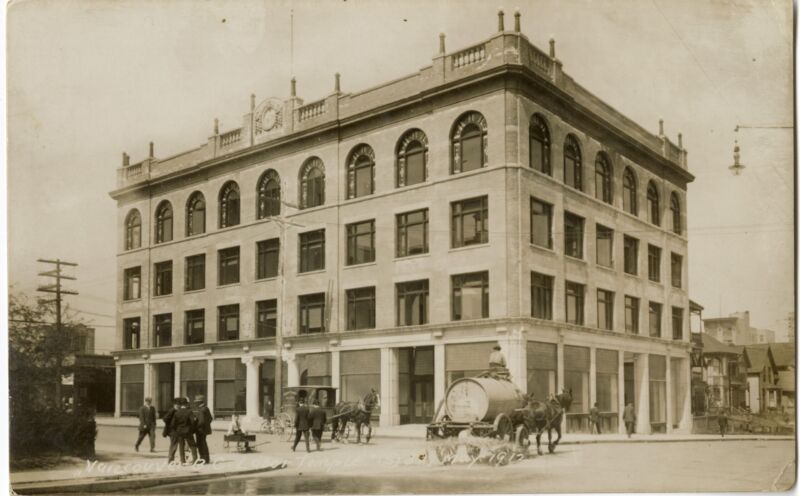
Vancouver Labor Temple, 1912. David Yorke Labour History Collection, Simon Fraser University.
Vancouver’s downtown building boom was still going strong when Council delegates decided to move ahead with their dream. They established the Vancouver Labor Temple Company Ltd. (VLTC) in December of 1909 with a Board of Directors comprised of union members. James H. McVety, a Council delegate, was designated Building Manager. VTLC affiliates, mostly in craft unions, purchased blocks of shares at $1 each. Architect Thomas Hooper was hired to develop the building design and Norton Griffiths, an engineering and contracting firm, to oversee construction.
The following April, the Labor Hall was demolished. Stonemasons, marble workers, bricklayers, machinists and teamsters began work on a four-storey, concrete and steel-framed structure. The interior work was contracted to carpenters and joiners, lathers, tile layers, glass workers, electricians, boilermakers, plasterers and painters. When Norton Griffiths attempted to hire non-union carpenters, the VTLC successfully protested through court and job actions.
The outside of the building remains much the same today, though a decorative rooftop feature was dismantled in the 1970s. Materials for the construction were locally sourced, the joinery comprised of fir and the concrete made from gravel. Up to the first storey, the exterior is built with granite and pressed brick trimmings. A row of windows line each storey, the top floor distinguished with arched frames.
At the grand entrance on 411 Dunsmuir Street, twin Grecian-style columns stand sentinel and above, the words “Labor Temple,” are etched in stone. A recessed entranceway is faced with marble and the front doors are framed with oak, a leaded glass transom at the top.
The original interior had an open staircase and elevator with a paid “elevator boy” operating the lever. Ceramic tiles covered the corridor floors and four-feet of glazed tile lined the walls. Two large meeting halls four flights up featured hardwood floors and six stained glass windows.
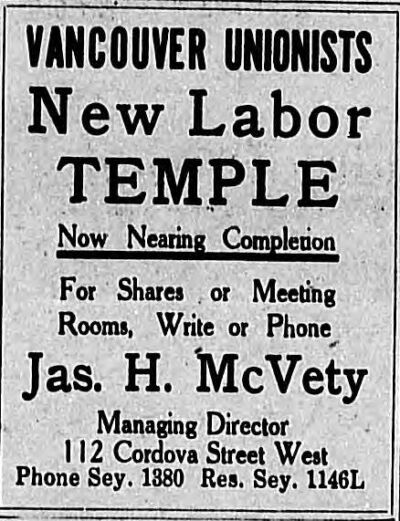
BC Federationist, 6 January 1912
On May Day, 1912 the doors to the Labor Temple ‘informally’ opened, the construction completed at a cost of $275,000. The following evening, the VTLC held their first meeting in the building. Soon after, 56 affiliated unions with a total membership of 8,000 met in rooms twice monthly. The VLTC defrayed maintenance costs by renting storefront space on the ground floor. Original tenants included a real estate agent, tailor, printing firm, cigar seller and a cooperative store providing low-cost goods for workers. Second and third floor offices were reserved for the VTLC, individual trade unions, the Socialist Party and later, the BC Federation of Labor. Parm Pettipiece, a VTLC delegate and editor of the BC Federationist, operated the weekly labour newspaper out of the Council’s office. Eugene T. Kingsley, a notable printer and fiery socialist speaker, also had an office in the Labor Temple. The basement housed a boiler room, printing press and a pool room with six billiard tables. Space was allocated for a lounge for unemployed workers, a library and storage for workers’ tools.
On June 16, 1912, VTLC delegates gathered for an official photograph in front of the Labor Temple, according to Council minutes. Though the picture likely disappeared long ago, the delegates’ gesture reveals their union and civic pride.
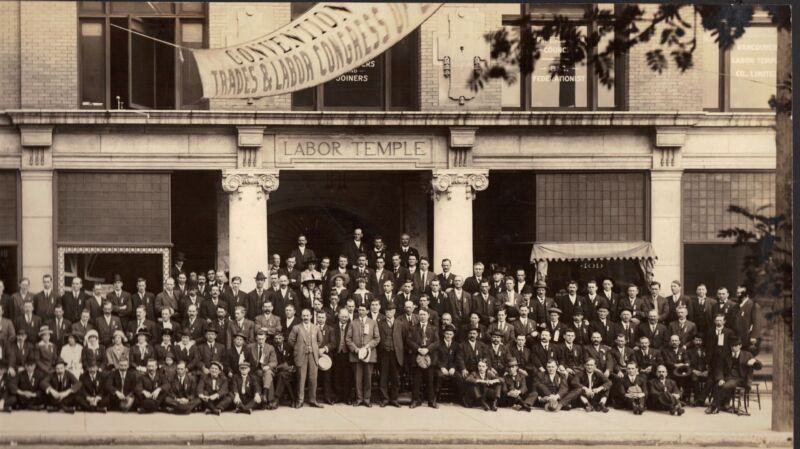
Trades & Labor Congress of Canada, Vancouver Labor Temple, 1915. David Yorke Labour History Collection, Simon Fraser University
Meetings, Speeches, Organizing and Attacks (1912-1920)
Many pressing issues were discussed at VTLC meetings inside the Labor Temple, including the status of women, unemployment, child labour and poverty. Rousing speeches were delivered by visiting speakers such as Mother Jones, Big Bill Haywood and Lucy Parsons. Rallies, labour conventions, political election forums, and female suffrage meetings took place. Union organizing drives got started among steam laundry workers, sugar refinery workers and police officers. Musical recitals and dances were hosted and fraternal societies and clubs gathered at 411 Dunsmuir too.
This wide community outreach was curtailed by the Council’s stance on excluding Asian Canadian workers from union ranks, though incremental changes on their position would occur over the years. Conversely, the American-based Industrial Workers of the World (IWW), with a chapter in BC, organized workers irrespective of nationality, gender or craft. Their members occasionally came through the doors at 411 Dunsmuir. During the free speech fights in 1912, for instance, the VTLC assisted the IWW in negotiating a truce with City Hall. When 6,000 IWW members employed at the Grand Trunk Pacific Railway went on strike that same year, the Council granted their request for a union meeting at the Labor Temple.
Also on strike in 1912 were unionized coal miners on Vancouver Island. Mass arrests of strikers followed a year later, then trials and several harsh prison sentences. The BC Miners Liberation League was established to lend assistance, many of its members active at the Labor Temple. The First World War had started August 4, when a short time later, the miners’ strike ended in bitter defeat.
Along with the labor movement’s losses, came gains and celebrations. Helena Gutteridge, the VTLC’s first female delegate, effectively organized working women into unions and set up an office for the BC Women’s Suffrage League at the Labor Temple. The VTLC took stock of their accomplishments at a 25th anniversary event in December of 1914. Joseph Dixon, the VTLC’s first President, reminisced about early meetings at the Sullivan Hall on Cordova Street.
At a VTLC meeting in February 1915, delegates expressed concern about the city’s 2,100 single unemployed men, many coming in from railway camps. Delegates also discussed the growing number of widows and deserted wives in financial need. The war was a factor, though patriotism was strong, as evidenced by a recruiting rally at the Labor Temple. But as the conflict overseas dragged on and casualties among Canadian volunteers mounted, the possibility of conscription loomed.
On the evening of May 28, 1917, more than 800 people filled the Labor Temple’s fourth floor hall to establish the Anti-Conscription League. A spill-over audience circled speakers on soapbox platforms along the sidewalk below. Next day, the newspapers described the event as “stormy.”
A year later, the war still on, the VTLC called a 24-hour strike. The decision was triggered by the shooting of labour organizer and pacifist, Ginger Goodwin by a deputized constable on Vancouver Island. At noon on August 2, workers walked off the job. Returned soldiers viewed the strike as unpatriotic. Incited to riot by members of the business community, about 300 men stormed the Labor Temple and invaded the VTLC office, assaulting delegates and vandalizing property. Fearing for his life, delegate Victor Midgley moved onto the window ledge. Frances Foxcroft, the Labor Temple’s stenographer and telephone exchange operator, stood at the window and faced down the rioters, likely saving Midgely’s life. After Midgely came in from the ledge, men dragged him into the street and forced him to kiss the Union Jack. Only when police arrived was order restored.
Download ‘The Ballad of 411 Dunsmuir St”
Poetry by Tom Wayman
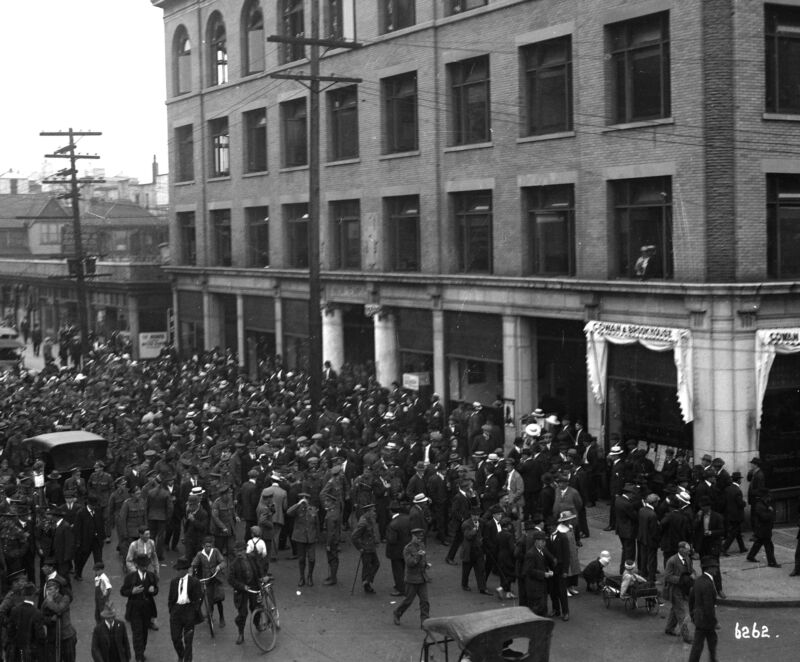
Returned soldiers storm the Labor Temple, 2 August 1918. Stuart Thompson photo, Vancouver Public Library, 18264.
By war’s end on November 11, 1918, the Spanish Flu was sweeping the globe. Over a period of four months, more than 1,000 Vancouver residents succumbed to the virus. The death toll was deeply felt at the Labor Temple. Among the union members mourned were boilermakers, longshoremen, freight handlers, plumbers, typographers, carpenters, and machinists.
The war over, social turmoil escalated. When 30,000 workers in Winnipeg went on Canada’s first General Strike for six weeks in May of 1919, sympathy strikes took place across the country. In Vancouver, the VTLC led the way as 10,000 workers struck for four weeks in June. Earlier that same month, several VTLC leaders joined the newly formed One Big Union (OBU), a racially tolerant organization that aimed to organize workers along industrial lines. The government felt threatened by these activities and reacted with a heavy hand. In Vancouver, RCMP officers entered the Labor Temple offices without warning and ransacked publications and records. Police also raided the homes of five Vancouver trade unionists.
Selling the Labor Temple (1920 to the present)
In the midst of widespread and spirited union activism, directors of the Vancouver Labor Temple Company were coping with a financial crisis. McVety raised the alarm to shareholders at the company’s annual meeting on January 15, 1918, and again, at the next year’s AGM. Lengthy discussions ensued at both meetings but no concrete strategies on how to save the Labor Temple were offered. When the 1920 AGM came around, the sale of the building to the provincial government was in the works. McVety made a plea to explore other options. A vote was taken on the matter by a politically divided Council—with OBU delegates on one side and moderates, including McVety, on the other. The decision to sell won out. The provincial government purchased the Labor Temple for $165,000 and tenants were notified to vacate. On September 16, 1920, the VTLC held their final meeting on the premises.
Renovations to re-purpose the interior for use as an all-boys manual trades school began. In the fall of 1921, Vancouver Technical School opened. As student enrolment increased over the years, the school board made plans to build a larger facility. In 1928, students moved to the newly built Vancouver Technical School on the city’s east side. The provincial government remodelled the building interior once again, this time for office use. From 1930 to 1970, 411 Dunsmuir became known as the Worker’s Compensation Building. During the economic depression of the 1930s, unemployed workers visited the Welfare and Unemployment Relief offices.
Other services offered included Mother’s Pensions, Old Age Pensions, Minimum Wage Board and Chief Inspector of Factories. In the 1950’s and 60’s, the former Labor Temple was home to the province’s Labour Relations Board. By 1977, the provincial government began focusing on services for senior citizens. As a result, the 411 Seniors Centre Society was founded. Over the ensuing years, hundreds of residents from diverse backgrounds participated in the ‘411 Seniors’ programs and events. Notably, in 1994, the building was added to the Canadian Register of Historic Places. Then in 2006, the provincial government gifted the property to the Society. Six years later, the Seniors Centre reluctantly moved to new quarters, due to the high cost of maintaining the building. As Society board president Elsie Dean explained to local media, “It has open asbestos, it has mould, the plumbing is all gone, the heating’s gone. It leaked in the basement, the north wall leaked.” Omicron and CRS Group of Companies purchased the building, and since then, there has been seismic restoration and a small addition on the back of the building. Ground floor retail outlets continue to operate, including a BC-owned White Spot restaurant.
For more than a century, a building constructed by trade unionists for trade unionists provided a dynamic meeting place for residents and visitors alike. The words ‘Labor Temple’ are still clearly etched in stone above the entrance, serving to remind passers-by of the city’s rich labour and social history. On May 1, 2026, the BC Labour Heritage Centre joined the Vancouver Heritage Foundation at the 411 Dunsmuir building for the presentation of a “Places That Matter” plaque.
Note: The spelling ‘labor’ is used here as a proper noun in phrases like ‘Labor Temple’ and is therefore spelled as it was written at the time. All other instances of ‘labour’ are common or non-specific nouns and are therefore spelled ‘labour’.
Janet Nicol is a freelance writer and member of the Writers Union of Canada with a special interest in art, history and social justice. She taught high school history for 29 years in Vancouver. She has volunteered for the BC Labour Heritage Centre, Room magazine and the British Columbia Historical Federation. She has a master’s degree from the University of British Columbia and was the recipient of the British Columbia Historical Federation’s Anne and Philip Yandle Best Article Award in 2013.
Sources:
Vancouver Trades and Labor Council Minutes and Vancouver Labor Temple Company Minutes, various years, University of British Columbia, Rare Books and Special Collections.
Vancouver Directory, various years, City of Vancouver Archives.
BC Federationist, University of BC library open collections on-line
Vancouver Daily Province, Vancouver Daily Sun, Vancouver Daily World, Victoria Daily Times, various years. Newspapers available on-line, Vancouver Public Library digital collection.
Irene Howard, The Struggle for Social Justice in British Columbia: Helena Gutteridge, the Unknown Reformer, (UBC Press, 1992).
Vancouver and District Labour Council Turns 135. PDF booklet by the VDLC, available online.
https://www.vsb.bc.ca/vancouver-technical/school-history