
Frances Foxcroft: An Englishwoman in Vancouver’s Labour Movement
Published: June 15, 2026
Authors: Pam Smith
Frances Foxcroft (1888-1968) is known in the BC labour movement as the woman who courageously stood in the way of a violent mob of soldiers during the “Ginger Goodwin General Strike” centred around Vancouver’s Labor Temple in 1918. In this article, Pam Smith* explores Frances Foxcroft’s life, prior to arriving in Vancouver in 1912, and upon her return to England in 1923, uncovering new details that explain her courage and resilience.
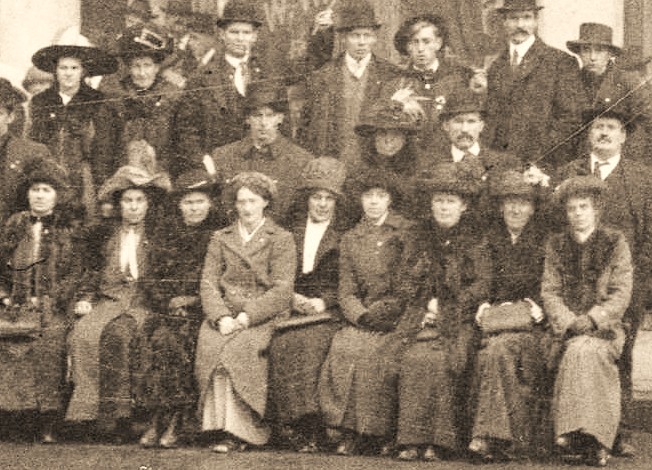
There are no known photographs of Frances Foxcroft, but she may be in this photograph taken outside Vancouver’s Labor Temple in 1913. City of Vancouver Archives, CVA 259-1 (edited).
Frances Foxcroft was born on 9 November 1888 at Hayclose, Hesket, Cumberland, the daughter of Robert Foxcroft, a journeyman joiner, and Mary Ann (née Carson). By the time of the 1911 census, she was living with her parents and siblings, Mary Ellen and Annie, and working as a postal telegraph clerk. At this date—2 April 1911—she was already pregnant.
Frances’ son, Lawrence Foxcroft, was born on 8 June 1911 in the same locality. No father is named on the birth certificate. This places Frances, aged 22, at a point of significant personal transition.
Shortly afterwards, she left England for Canada. By 1921, Lawrence was living not with his mother but with his grandparents and aunt Annie in Cumberland. This arrangement suggests that he was brought up within the extended family while Frances remained overseas.
Frances spent over twelve years in Vancouver, where she became closely associated with the organized labour movement. Contemporary reporting from December 1923 records her departure from the city after this extended period, noting that she had been employed on the staff of the Vancouver Trades and Labor Council and was well known in labour circles as a “hard worker and a ready friend.”
Known to colleagues as “Frank,” she appears to have been a respected and familiar figure within labour organizations.
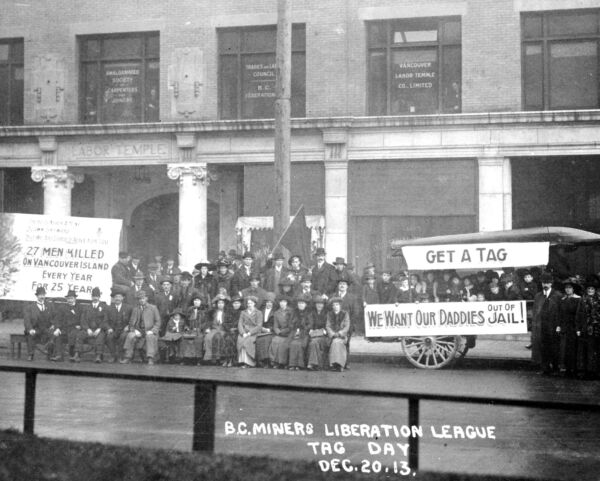
Miners Liberation League outside the Vancouver Labor Temple in 1913 where Frances Foxcroft worked as the telephone operator. City of Vancouver Archives, CVA 259-1.
Foxcroft’s time in Vancouver placed her at the centre of a turbulent period in British Columbia’s labour history, particularly the unrest following the death of Ginger Goodwin in 1918. Newspaper accounts of rioting at the Labor Temple describe escalating violence between returned soldiers and organized labour.
Within this context, a Miss Foxcroft, identified as a telephone operator, played a striking and courageous role. As a crowd attempted to throw a man from a window, she intervened directly, placing herself in front of the opening and preventing the act. In doing so, she was badly bruised, but her actions likely prevented serious injury or death.
After leaving Vancouver in December 1923, she returned to England. By 1939 she is recorded there under her married name, Frances McMillan, living with her sister Annie Foxcroft.
A marriage certificate cannot be located for Frances and William McMillan. Her son Lawrence does not appear in this household, by which time he would have been an adult. She died in Carlisle in 1968, aged 79, identified as the widow of William McMillan.
The available evidence suggests that Frances’s migration to Canada occurred during a period of personal upheaval, shortly after the birth of her son, who remained in the care of her family in England.
While the precise circumstances cannot be fully reconstructed, her subsequent life demonstrates independence, resilience, and a capacity to build a new identity abroad.
Her actions during the Labor Temple riot further show that she was not merely present in these events, but played an active and courageous role.
Frances Foxcroft’s story adds a valuable personal dimension to the history of the Vancouver Labor Temple and the wider labour movement in British Columbia, illustrating how individual lives intersected with moments of social and industrial conflict.
*Pam Smith is a professional genealogist from Yorkshire, England and the great-grand-niece of Albert “Ginger” Goodwin. We are extremely grateful that she agreed to piece together the life of Frances Foxcroft, the brave woman at the centre of the attack on Vancouver’s Labor Temple during the Ginger Goodwin General Strike of 1918.