
Jack Henderson Interview: Stationary engineer, community builder
Jack Henderson (1880-1968) was a labour activist and community leader in Vancouver, Canada. Henderson discusses his long involvement in the labour movement, starting when he joined the Amalgamated Society of Railroad Servants in England in 1896. He describes his experiences working in various industries and locations, including South Africa, Russia, France and Canada.
The interview was conducted in the 1960s by the BC Federation of Labour in anticipation of the publication of No Power Greater: A Century of Labour in BC (1967). Interviewers were author Paul Phillips and UBC student Bill Piket. The original tapes were digitized by the BC Labour Heritage Centre in 2024.
Certain parts of this interview contain historical language and content that may be considered offensive, such as language used to refer to racial, ethnic and cultural groups. The content reflects the period in which it was created. The recording retains the original language and perspectives to ensure that they are not erased from the historical record.
SP FC 3803 U54 N_5-12-trk1 Jack Henderson AUD.mp3
Recorded April 14, 1963
Transcribed: Donna Sacuta, 2025
Interviewer [00:00:00] Well, let’s start off where you got interested, and this is —
Jack Henderson [00:00:04] Where I got interested?
Interviewer [00:00:05] Well, where you got into the labour movement. But before we do, I’d better just say that this is Mr. Jack Henderson and the date is—what is the date?—April 14, 1963. So where did you — which union was the first union you joined?
Jack Henderson [00:00:24] The Amalgamated Society of Railroad Servants. That was in Northumberland, England, on the North Eastern Railroad, in 1896.
Interviewer [00:00:37] 1896, and were you active at all in any —
Jack Henderson [00:00:42] Well, I was just a boy at that time, 16, wanting to serve my apprenticeship. I wanted to be a locomotive engineer in the locomotive department. Then, when I was 19, the Boer War was on and they wanted locomotive men on the Cape Government Railroad. So I went out there, under the armored tins, and when the war was ended, I went on — I was at Maferking, between Maferking and Kimberley, Maferking and Vryburg, and Maferking and Bulawayo, we used to run both ways. Then I went on the construction of what was to be the Cape to Cairo Railroad, if Cecil Rhodes had lived. I was on the construction up to Broken Hill in Rhodesia. That’s where the big copper mine is. The construction ended at that time, so I had a school friend down in Johannesburg, he’d been bothering me to go down and see him.
Jack Henderson [00:02:06] So it was a couple of thousand miles away but I went down and saw him and the day that I got there, there was a protest meeting being held in the stock exchange building, protesting against Joseph Chamberlain’s plan to bring 66,000 Chinese labourers out on to the Rand, into the gold mine. So I decided that this was going to be no place for me. I was contemplating getting married, so I left the African country and I came over into the American continent.
Jack Henderson [00:02:51] Coming over I met a chap from Georgia and he insisted on me going down to see his home and I thought this would be an excellent opportunity of seeing the conditions of the Negro down there. I was always fairly alert and used to think a good deal about these problems, and I discovered that the Negro down in Georgia at that time, 1907 it was then, in the early part. I discovered that they were treated no better than they were in South Africa. I also had read Upton Sinclair’s book, ‘The Jungle’, which was depicting the conditions in the packinghouses in Chicago.
Jack Henderson [00:03:42] Well, I had a brother up here in British Columbia and I also had a man who had worked with me in the African country at Salmon Arm and they had been writing to me, so I decided to make my way up here. On the way up I stopped off at Chicago and had a look at these packinghouses. You know if you’ve ever read ‘The Jungle’, it’s Upton Sinclair. Where did I read that? I read the book in Bulawayo in Rhodesia, I guess about 1903 maybe, or 1904, somewhere in there. But the conditions in the packinghouses were such that the story that Upton Sinclair gave in this book, ‘The Jungle’, caused everybody in Africa to refuse to have the product of the packinghouses. You could send a native with a gunny sack and he’d get a sackful for two-bits I think, sausages or beef or whatever you want. What Upton Sinclair said in his book was that some of the employees were lost and undoubtedly they slipped down on these conveyors and they were turned into [unclear]. That was the story that Upton Sinclair gives in his books. So I wanted to see it.
Jack Henderson [00:04:58] Well when I came here I was interested in the Indian, and I found out that we were not treating the Indians very well, and I don’t think we are yet. I think that I may claim modestly to be something of a humanitarian, people are people as far as I’m concerned. I want to treat everybody like a human being, with a little dignity. However, conditions were not very good here and it was no use attempting to get onto the railroad because they were laying men off.
Jack Henderson [00:05:32] But I sat for my engineer’s ticket and stationary engineer and I practiced stationary engineering from 1907 until the War started in 1914. I was engineer in several of the sawmills, you know, and at that time, there was no international union with any men in the mills. They had one or two in the theatres, but nowhere else. They had what they called the BC Stationary Engineers, so I became a member of that, and I was a member of that till 1915.
Jack Henderson [00:06:19] I went to northern Russia. The reason I went to northern Russia, the people that I had worked for on the Cape to Cairo Railroad was the Sydney and the Pauling and Company of Queen Victoria Street, London, England. I had been in communication with them right along because they had been expecting to get some contacts in China and I was supposed to go there with them. However, if you recall, perhaps you don’t, but no, I don’t suppose you would be. In the First World War, the Germans had the Baltic closed and the Turks were fighting on their side, so the Black Sea was closed, and the only way we could get any assistance to the Russians was via Vladivostok and the Trans-Siberian Railroad.
Jack Henderson [00:07:08] Between 5,000 and 6,000 miles of a broken-down railroad at several different gauges, the situation was hopeless. But it was absolutely essential that they get help to Russia to keep as many of the Russians engaged on the eastern front as possible and relieve the pressure on the western front. Otherwise they would have probably overrun France and cleaned everything up there. So I went up to work on the construction of the railroad at Murmansk and I ran the first locomotive on the Murmansk Railroad. We erected the locomotives right out on the open. We had quite a time there.
Jack Henderson [00:07:47] The boats that had been supposed to bring the food out, they had been torpedoed, and it was quite a time. Had it not been for a few of us that had been around, I’m afraid there would have been a bit of a catastrophe in the [unclear]. However, it was obvious that there was something holding the development of this railroad up, and we had to give it up because we couldn’t get materials and of course it was the Revolution that was in the making and that was preventing — the country was all upset.
Jack Henderson [00:08:17] So I joined the Canadian Engineers and went to France and I was through France and Belgium. I did a lot of work in the Engineers. I was with the Army of Occupation into Germany and I was always tremendously interested. I had done a lot of travelling, and as a result of my experience in the African country, I did very well financially and I wanted to see some of these things that we had read about as boys and at school, the Coliseum and the Taj Mahal and all these kind of things. So I went over to Greece and so on and Italy and saw a lot of these things. I went on to India and saw the Taj Mahal. So I did get around quite a bit, before the Second War started.
Jack Henderson [00:09:25] In the meantime, when I came back from France in 1919, there was a strike on. And the strike was to adopt the 8-hour day in the mills here. When I went away overseas, they were working 11 hours in the day and 13 hours at night in the mills in British Columbia. So they had established the 8-hour day and I joined the International at that time. They had got built up here then, during the War they had got build up.
Jack Henderson [00:09:57] That was in 1919. While the strike was on, I had walked around False Creek and the Alberta Lumber Company. Right alongside of their mill there was a big engine lying dismantled off the track, which they were going to propose to erect in their mill. I was looking at this and one of the officials of the Alberta Lumber Company came to me and asked me if I was interested. I said, “Oh yes.” He said, “Well how about coming and erecting this?”
Jack Henderson [00:10:37] “Well,” I said, “I don’t propose to go to work until this strike is finished.” But I gave him my name and that kind of thing. I said, “When the strike is finished I’ll be quite prepared to come and install this machine.” By gosh the strike ended the next day. (laughs) So I went and I installed the engine. The chief engineer had been overseas in the Navy, and I had got this engine pretty well ready for testing, when he came back and we tested this machine.
Jack Henderson [00:11:09] Whilst we were testing it, I got a call from the Sydney Junkins Engineer contractors. They did most of the CPR (Canadian Pacific Railway) work, and bridges and all that kind of thing. They had a plant at Glacier, BC, which had a couple of rather tricky Baldwin engines. They were high-speed, coreless engines and they had to run in unison. They had a lot of the same speed and very tricky gobblers and they weren’t getting along very well and they were lining the Connaught Tunnel. That’s the tunnel which eliminated the Rogers Pass as a railroad.
Jack Henderson [00:11:49] So I went up there and I was there for four years. The time I was there, I had been sending my views into Vancouver. After I had got this plant moving, a question of a school came up. There were 36 children in the camp. My boy in Gilbert School in Vancouver, I had nothing to worry about, but you couldn’t see 36 children without a school. So they had a meeting and I attended the meeting and I saw that they had very little idea as to how to go about this and I had some experience. I made some observations and the first thing I knew I was chairman of the Ways and Means Committee. Well, to make a long story short, we built the school and I was a trustee there until I left in 1924.
Jack Henderson [00:12:47] The job was almost finished there then, and I got another man to take my place and the reason that I was moving was they had got the contract to build Pier B-C. You know, this Pier B-C here, in Vancouver, where you get the boats to Victoria and Nanaimo. Well, that was a six-and-a-half-million-dollar job in those days, and it’s built on concrete piles. It’s quite unique. They had engineers from all over the world whilst they were building that and they had, what was up to that time, the largest piledriver that had ever been built. I was brought down to be inspector, under while she was building, and to have charge of her when she, when we got her built. I was there until 1928. Then they got a contract to build a bridge over the Saskatchewan River, and I went up there as Master Mechanic with the Sydney Junkins people. 1928.
Jack Henderson [00:13:54] I was tremendously interested in the Legion and the ex-servicemen. I had so many of them come down looking for jobs, you see, and I helped a lot of them. In 1927 things were bad, and I presented a resolution to my branch of the Legion, Branch 19, which is now defunct. It’s defunct because it’s nothing but old men, you know, and it wasn’t in a very good location. Beer parlors all around and so it was known that they didn’t make much of a success. Except that I suppose old Branch 19 did more to help the ex-serviceman than any branch in the city, any branch in British Columbia.
Jack Henderson [00:14:37] I moved a resolution in which I said, “Owing to the prevalence of unemployment and the increasing difficulty of finding employment for all of our people, it behooves us to exercise all the means in our power, insofar as we are able so to do, to alleviate the situation.” That resolution went through the Provincial Convention, and of course I had to speak to it. I took quite an interest in it. Well, anyway, we went up to build this bridge in Nipawin.
Interviewer [00:15:06] This was in 1927, this resolution, was it?
Jack Henderson [00:15:08] Yeah, 1927.
Interviewer [00:15:09] So at that time, employment conditions weren’t all that good.
Jack Henderson [00:15:13] Oh, no, they were quite bad at that time. As a matter of fact, it’s — 1928 we finished the Pier, and we went up to build this bridge up in northern Saskatchewan. I have a lot of pictures of it, but it would take a lot time to show you all these, you know. This was done in the winter time. We’d actually put, in the Saskatchewan River, way up north, in 40 and 50 below zero, we put five piers in the river, 140-feet high. The banks of the river were 150 feet high, and this was to be a double deck bridge, vehicle traffic underneath and the railroad on top. So these piers had to be 140-feet high, and we put those in there in the wintertime up in that country, and I was the Master Mechanic on the job. Quite interesting experience, they had a German settlement and a Jewish settlement.
Jack Henderson [00:16:05] A lot of the boys up there had been in the Army, Navy and Air Force. A lot of Americans, some Negroes, a lot a French-Canadians. There was a lot of bootleg whiskey and the job wasn’t going very good, and the man who was the field engineer in charge, a Mr. Earl, he was an eastern Canadian, a graduate at the University of Pennsylvania in civil engineering, and all his experience had been in the States and Mexico except on the Pier. He was superintendent on the Pier. So we had had four years together on the Pier before we went up to Nipawin, they called the place. The thing wasn’t going good.
Jack Henderson [00:16:41] These men, they were getting drunk and burning the boilers and upsetting the cranes and bending the booms and raising hell in general. I wasn’t saying anything about it, I was having the machines dragged up to the machine shop and fixing them up. Presently Mr. Earl came to me and this is what he said. “Jack,” he said, “You’ve been around quite a bit. You can see that the job is not going as it ought to go.” He says, “What would you do if you were in my place?” Well, I thanked them for the compliment, and I didn’t hesitate about what I would do. I said, “If I were you, I would go up to the office, and I would dictate a notice to the effect that ‘forthwith any man reporting for duty under the influence of drink or becoming under the influence whilst on duty would be dismissed immediately, and he would forfeit all privileges.’ That meant that he would have to get back to where he came from under his own steam. He wouldn’t get any pass or anything.” Well, that fixed it, and we were successful and did the job.
Jack Henderson [00:17:45] When I came back to Vancouver in 1930, the bottom had dropped out the economic system in 1929, you see, and there was nothing doing anywhere. I got a call from the Hall Building, it was just completed. They weren’t getting the satisfaction out of the heating plant, and the men, the firm that installed it, were friends of mine. So they came to see me and asked me if I’d go down and take a look at it. So I went down and I straightened it out.
Jack Henderson [00:18:25] Then they asked me to take on the job of Engineer Superintendent of the Hall Building. So it suited me fine. I was my own boss, my own terms and all this kind of thing. It gave me lots of opportunity to devote to the Legion here. In 1930, oh, conditions were frightful. I was well acquainted with Colonel Cooper, who was the Relief Officer. He was a member of my branch of the Legion. I used to go around with him, Salvation Army, First United Church. Several of these places, I used to visit with them.
[00:19:11] So one day, when I was down at the Legion office, the old secretary, who was a veteran and had been in the Princess Pats (Princess Patricia’s Canadian Light Infrantry), and he was a J.P. (Justice of the Peace) from the up-country, and the auditor was a chartered accountant by the name of Sam Currie. Sam had been rather badly wounded, and we used to forgather at lunch and talk things over. On the old Legion badge it says, ‘British Empire Service League’, and old Charlie, the secretary said, “We’re talking about the conditions of these men running around, you know, no food, no place to sleep, nobody doing anything about it.” Charlie said, “You know, we should do something to warrant our title to a service league.” Well I said, “I’ve been thinking this over and I’ve thought out a scheme and I’ll propose it tonight. I won’t say anything about at the moment but tonight I’ll present it.”
Jack Henderson [00:20:11] Well, in those days, things were so bad that the meetings were packed. So many men were looking for some solstice from the economic tribulations that they came down there and all they did was talk and smoke, you know, and they never got anywhere. So I was sitting next to Colonel Cooper right in the middle of the hall, packed to the doors. You could just see the stage for the smoke. Under new business, I rose in the center of the hall and I said, “Comrade Chairman, I have a proposition that I desire to put forward at this time. In due of the circumstances of our province who are out of work and finding it difficult to live, I propose that we set up a soup kitchen and at least endeavor to feed them.”
Jack Henderson [00:21:05] You never hurt such a howl in your life! There was the president, he was opposed to it. Now, he was a man that had used the Legion as a means of livelihood, let’s put it that way. There were three other men, of course, because you know how these cliques get around in these organizations and this president, he had a clique which kept him in as president. However, I never have been interested in that kind of thing. I don’t care what a man belongs to, whether he’s white, black, or any other colour. If he has a good proposition, I’ll support it. If it’s going to be beneficial to humanity, I will get up and support it, no fooling about it.
Jack Henderson [00:21:55] However, the first man that got up and opposed it, he worked for the school board. He was an engineer in one of the schools. I just forget his name at the moment. Then the second man that up, his name was Galvin, Matt Galvin, and he was working for the liquor board. I’m telling you this because these men had government jobs, see? The third man that that up was working in the government grain department. He had a damn good job. He was getting about $225 a month, which was good salary in those days, you know, and he had a small pension. When the race meets were on, he used to come up and walk on the prime, he was doing very well. But he was a good speaker, and he ended up by saying that this was, ‘sentiment run wild’.
Jack Henderson [00:22:41] Well, I realized that I had to say something drastic, or else it would fall by the way, and I got up. I said, “Comrade President,” and I was chairman of the Public Affairs Committee, the special committee they had at that time. I said, “Comrade President, if you will place this matter in the hands of your Public Affairs Committee, I will guarantee to undertake to carry it out without cost to this branch.”
Jack Henderson [00:23:05] Well, that caused a bit of a sensation, and presently, Colonel Cooper got up and he said, “Comrade Chairman,” he says, “If any other member of this branch had put forward such a suggestion,” he says, “I would have opposed it. But,” he says, “Knowing Jack Henderson, as I do,” he says. “I’m satisfied that he has thought out some scheme whereby he can implement this, and I move, I second this,” that’s what he said, and it carried. Well, that was on a Tuesday night. We had a basement that had been used as a gambling joint, a little cubby hole. We had to tear all that out. We had to whitewash the walls or rather we had to put them into shape, they were dirty and black. We had to get all the equipment, we had to get a gas range, we had to get a hot water boiler, we had to get the lumber to make the forms and the tables, we had to get all the utensils, both for cooking and plates, saucers, knives, forks, spoons, all this kind of thing. Then we had to get the food.
Jack Henderson [00:24:19] We fed 70 people on the Saturday, I think it was. Just a few days we had it fixed up, and that would reach the place where we were feeding 400 men every day there. Then we had to have a billet. We’d have to have place to sleep, it was just getting worse all the time. There was a major fort, they had a building down on the Powell Street and it was a three-story building. It had windows on the street and went right clear to the lane, there was three windows on the back, and there was three floors. It was ideal for ventilation. It was In a filthy mess. Of course, a person being there like me knew what the potential was and I went back and reported that it would be suitable for the job.
Jack Henderson [00:25:03] I went down and I addressed the Trades and Labor Council on the subject, and they sent men up and they installed shower-baths and toilet accommodation on every floor. We got bedsteads from some of the camps that were shut down, these iron bedsteads, we got radios for every floor and all this kind of thing, and even had a delousing plant. The University branch wanted to make a contribution and I suggested that they give us the money to put in a delousing plant.
Jack Henderson [00:25:33] We reached a place there where we had 250 men billeted there. We had a chap, a good shoe repairman. We had a tailor who could repair clothes and a barber. It was a real motel so to speak. But anyway after a year, we turned it over to some of these officers who had nothing to do and who wanted to do something of this nature. Anyway, that was opened. When the War started in 1939, it was still going. In the meantime, you know, I had been active in the trade union movement. What I was going to tell you, and this — well, it wouldn’t. No, I’ll tell you this afterwards, this.
Interviewer [00:26:28] Do you want me to shut it off?
Jack Henderson [00:26:29] Just one moment.
Jack Henderson [00:26:34] We’ve got to get to the Trades and Labor Council.
Interviewer [00:26:37] From when?
Jack Henderson [00:26:38] Right from there.
Interviewer [00:26:40] Starting what date?
Jack Henderson [00:26:43] About 1920, it would be 1920, no, it would be 1930. No, 1928, and then I went up to this job on Nipawin. It was a few months elapsed between the time we finished the Pier to when we went up. I have been a member of that ever since, and for the last 20 years I have been the chairman of the Legislative Committee. Being elected by acclamation, I don’t think there’s anybody ever ran against me. Whilst I was there, I was still taking an interest in the Legion, you know. I have a brief that I presented to the — somewhere. In 1933, in 1933, with a population in this country of between 9 and 10 million there was 1,517,531 people on direct relief registered as the figures from the department in Ottawa, the statistical department. This resolution, it’s ahead of what — the recommendations in it are ahead of what they have today. I think I got it here somewhere. Where the hell did I put it?
Jack Henderson [00:28:30] Anyway, I have always been interested in these things, and not only that, in the community. My idea, used to talk, it’s like what the Premier of Canada said in London in 1941, I think it was, at the Lord Mayor’s banquet in London. Lyon McKenzie King was the Premier at the time, and he said this, he said, “There is a great deal of talk about a brave new world which is going to emerge from this war when the war ends.” He said, “In my opinion, unless the new world is in process of being developed before the war ends, we may look for it in vain.” That’s what we have done. That the new world didn’t emerge. However, I had that thing somewhere.
Jack Henderson [00:29:47] I drew up a resolution for the Canadian Legion, which I presented at their Provincial Convention in 1933, and it was carried unanimously. I advocated a six-hour day. At that time all the people that were unemployed was frightful. You’ve got to have knowledge of the situation to understand the terms of this resolution at that time. Quite drastic, but it carried unanimously. It recommended a national system of insurance covering sickness, accident, unemployment and death. That the school age be raised to 18. That we have a bank, that the banking system be nationalized, that we have a Bank of Canada.
Jack Henderson [00:30:50] I pointed out that we had reached such a stage in our economy that we could produce all the goods that were necessary. More. I pointed it out that with a million of our young people almost in the Army, we were still able to feed the nation and feed other nations. We send all kinds of food and produce to Europe, you know, from Canada during the War. I said, “With the means of transportation, with the methods of production brought to such a stage as they were, and the means of communication and transportation advanced to the stage they were, it was necessary to change the banking systems so that the monetary system would keep sufficient of the medium of exchange in circulation so that we’d keep the machines running.” You know, today if a plant closes down, the workers are thrown on the street. Even today it hasn’t made any difference. So that was put forward then, and the last recommendation on that brief, that an Economic Council be set up, composed of experts in engineering, science and public works. Well, did they put them into effect? No. They just put one in England last year. This new government. They established one in this county last year.
Jack Henderson [00:32:32] So you see, it takes a long time sometimes before they move in these directions. However, that was in 1933. I’ve been interested all that time. In 1936 I was responsible for the, or largely responsible, along with Justice Branca and the former Alderman DeGraves for the building of the Hastings Community Association just across the street here, you know, down beside Hastings Park where they have the swimming pool and I was on the school board at this time, you know.
Interviewer [00:33:20] When did you first get on there?
Jack Henderson [00:33:21] I got on the school board in 1942.
Interviewer [00:33:21] What about the unemployed in the 30s? What did the Trades and Labor Council do?
Jack Henderson [00:33:26] Well, they couldn’t do very much. They made protest marches here and there. Got maltreated, the Mayor he read the Riot Act down there at the cenotaph. Oh, it was quite a —
Interviewer [00:33:46] What about your own union?
Jack Henderson [00:33:48] Well, if I may modestly say so, I was responsible for keeping the union going. I think at one time there would be about a half-a-dozen of us, the same half-a-dozen that met. Not only did we keep our own union going, but we aided another union that is in the construction business. Oh, things were bad, bad, bad. As I say, I was interested in the — way back, 1920 after we came back from France. Up until 1916, this section of the city was known as Hastings Townsite. It was named after Admiral Hastings, who was the British government’s representative on the coast here. In 1916 it was incorporated in the City of Vancouver and they set up the ward system and this was Ward 4 from here down to Victoria Drive. They had a vote for ratepayers and I was in the vote for ratepayers. We saved a lot of boys from losing their homes. We insisted that the government give them jobs so they could pay their taxes. A lot of people needed help. I used to go out with Alderman DeGraves visiting people that were up against it with a sack of coal and all this kind of thing. All down through the years I’ve been engaged in that sort of thing.
Jack Henderson [00:35:36] Now then. In the labour groups and in the Legion groups and in the community they have representatives on various organizations. For instance, today I represent the Trades and Labor on the Community Chest. I’m on the director of the Community Chest today. I was on the priorities committee, one of the only labour men on the priorities committee. That was the committee set up to evaluate the work of these organizations who get financial support from the Community Chest. We spent about three years on that, and long, tiresome meetings. There was 22 people on the committee when it started. The former president of the university was the chairman, Mackenzie, but he had calls away so the man by the name of Ian Barkley practically ran the thing and there were 22 people on when we started, two of them dropped out so we finished up with 20 people, four medical doctors and several professional social workers. I never hesitated to tell them that in my opinion, the greatest social problem we have is employment. If you could find employment for the people, this thing would be practically cut out, you see.
Jack Henderson [00:37:04] I have been advocating that right along and I was responsible in large measure for the building of the school for the retarded children. They had these children in buildings prior to the school being built. They were in a frightful condition. If there had been a fire, they would have all been burned to death. They had a large committee went over to interview the Minister of Education. I was representative of the Kiwanis, I think, and the Retarded Children’s Association and school board. There had been a secretary of this Retarded Children’s Society who advocated the integration of these youngsters with the ordinary school. If you went and saw, you’d see it was just impossible, see? There was a lady writing a thesis for AMA, I think it was, and that’s what she was advocating. So you see, the Minister was sort of between the devil and the deep sea. Here’s one group advocating this, another group advocating that, and when this large organization, our large committee appeared before the Minister, they were at sixes and sevens. I was at the end of the line when I finally said to the Minister, I said, “Mr. Minister, this matter has been discussed by the Vancouver board over the years and they have always felt that there should be some special arrangement whereby these young people could be taken care of, and I suggest, sir, that you come over to Vancouver and see the conditions under which they are operating today.” And he did. Then George Robson, the lawyer, was chairman of the board at that time, and he went along, and as a consequence, the Retarded School came into being. I have been an advocate, I think, of everything that was for the betterment of the school system. I gave you a copy of what Dr. Sharpe said. There were talk about these things, you know. Some people think that they’re boasting. What the devil you want to boast about?
Jack Henderson [00:39:11] I was satisfied myself when I came back from the First War. First of all, I was satisfied that we had not been fighting for the things we were supposed to have been fighting for. It was [unclear]. Never a bomb was dropped. And in the last war, that was one of the things that they talked about, that they were going to destroy the [unclear]. Today the [unclear] is bigger than ever they were. And look at this huge chemical works, the Farben people. It occupies four square miles of territory and there was no bomb ever dropped on it. When the Americans went over there, they took this place over without any damage. They were manufacturing poison gas, and every other damn thing. So I made up my mind, that if this world was ever going to be any better, it’ll be by each one of us doing something about it. Just as simple as that, as far as I’m concerned. I haven’t got any axes to grind. I don’t hate anybody, I don’t want to hurt anybody, and I have never asked anybody for anything in my life.
Jack Henderson [00:40:21] If you look at the record, you’ll see that I headed the poll several times and the last time I ran in 1962, I got the largest vote that had ever been cast for a citizen in a civic election. And I’m proud of that for the fact that I’m a labour man, see. These people all know where I stand, I don’t hesitate about where I stand. I point this out, that had it not been for labour, people would have been a bunch of serfs today. There would still be serfs. I wonder why they don’t think these things over. I told you at the beginning that the organization that I joined as a boy was The Amalgamated Society of Railroad Servants. The word union —
Interviewer [00:41:15] Let’s go over some of the things that I had in mind. First of all, when you joined here, this strike that was on. Were you here when the sympathy strike was on with the Winnipeg General Strike?
Jack Henderson [00:41:28] Oh, yes. Oh yes, I knew all these fellas, Winch and all these chaps, and I know them well. I have got a picture here someplace with myself and Winch.
Interviewer [00:41:43] Now, uh —
Jack Henderson [00:41:46] Harold writes to me all the time. I write to him, tell him what I think about him and about everything. I don’t hesitate to tell people what I think, but I don’t be rude and vulgar.
Interviewer [00:41:59] What about, when exactly, do you remember, the strike didn’t last that long, did it?
Jack Henderson [00:42:06] No. No, it was short-lived. It didn’t last long. The march down to Regina.
Interviewer [00:42:13] Well, I’m talking about the 1919 strike.
Jack Henderson [00:42:15] Oh, yes, yes, strike. Oh, it didn’t last long. Well, as I tell, we were overseas when it started, but it ended very shortly after we got back.
Interviewer [00:42:28] I see. What about the ILP (Independant Labor Party) and the Canadian Labor Party. Were you involved?
Jack Henderson [00:42:38] Oh yes. When they amalgamated, you mean?
Interviewer [00:42:42] No, I think it was the Canadian Labor Party first, and then they changed the name to Independent Labor Party, didn’t they?
Jack Henderson [00:42:51] Yeah.
Interviewer [00:42:52] In 20—
Jack Henderson [00:42:53] Yes, well, they had their ups and downs. This thing, you know, it’s like topsy and just goo. And one of the problems has always been these men who get their training in the labour movement and get all of the knowledge that’s necessary to negotiate and then they go over to the other side. I look—
Interviewer [00:43:25] Yeah, in some cases, yeah.
Jack Henderson [00:43:28] I’m not able to understand the thinking of people that act that way.
Interviewer [00:43:32] Cliff Michaels.
Jack Henderson [00:43:34] Pardon?
Interviewer [00:43:34] Did you hear about Cliff Michaels in the IWA in Salmon Arm? You don’t know him. Young fellow
Jack Henderson [00:43:42] Oh, yes, yes yes yes.
Interviewer [00:43:49] There’s a fellow, what was it in Vancouver, in the Bakers’ union wasn’t he? Gervin?
Jack Henderson [00:43:57] No, Gervin. Mr. Gervin. He was with the BC Electric, on the railroad, you know, on a streetcar. Yes, he — of course, mind you, he could have put up a good case for extenuating circumstances, because labour was so uncertain. He was very uncertain of his job. One of the things, you know, that labor unfortunately has treated some of its people rather shabbily. Let’s put it that way. That’s a good word they used to use when I was a boy, shabbily. You know, the man Mr. Chris Pitchard, who was a member of the Workmen’s Compensation Board for several years and was formerly the secretary of the Trades and Labor Council. He and Teddy Jamieson, who also was — Teddy Jamieson was president of the Council it must be 25 years ago. He’s in the Musicians’ Union. Teddy and Chris and I, we forgather once a month to have lunch and just to sit back and reminisce, you know. And if you could sit in and listen and hear what we have to say, it would be very enlightening. I don’t think that any of us are disposed to speak disparagingly of anyone. I am afraid that the ethical standards which prevail today are not of too high a calibre.
Jack Henderson [00:45:59] You take that girl that’s in the office today, Muriel. I told you that I was building superintendent in the Hall building. I was five years building superintendent for the Workmen’s Compensation Board. The former chairman of the board, Mr. Adam Bell who died a few months ago, he came down and begged me to take on the job. I was 70 years of age and didn’t want the job. I had a job that just occupied about six hours a day down at the Standard building as engineer. There’s a high-pressure plant. He came and begged me. I have a letter to that effect. He thanks me for accepting his invitation to take over the job. Well, they had about 150 girls there. They had over 100 in the Hall building. And I had 22 years on the school board where they had 150 down in the administration building and they have secretaries and stenographers in all the schools, three or four in each high school, so I’m well acquainted with this business.
Jack Henderson [00:47:10] I’m going to say here without hesitation that Muriel Whelan is one of the most competent office women in this city. And because she doesn’t belong to this, what do you call it, the NDP (New Democratic Party), she’s had a rough time, and that’s not right. I don’t care what they belong to. If they’re doing their job, see, I would defy Almighty God myself. I believe with Stephen Leacock. Stephen Leackock was a great humourist, but like Mark Twain, he said some very pertinent things about human society, and he made this observation on one occasion. ‘The right to outspoken dissent is the free man’s most precious heritage. If you haven’t got that right, you’re not free.’ One of the things to remember, today in British Columbia, only about 44 percent of the workers are organized. And many who are organized don’t belong to the Trades and Labor. The internal dissensions have got to be eliminated. They’ve got to have people of a broad outlook in this business if they’re ever going to get anywhere. The first thing you have to do is to build up prestige, the image. And everybody knows this that’s doing any thinking and not afraid to speak out. The image of labour today is not good. What they want is people who can be accepted by society as being representative and reputable. And they can do all the hollering they like, and it won’t ever get them anywhere. This calling people sons-of-bitches and things of that kind, that’s no good. One of the things you have to remember, that these men who are in business have had an entirely different training from the man who was in the labour camps. They have their point of view and they have a right to express it, and so also has labour. I mean, surely they could get people who can see these things and sit down and deliberate their problems and arrive at some mutual satisfactory manner in which they can handle their affairs without — look at the strike. Every time there’s a strike, who suffers? The women and children don’t they? Who else?
Interviewer [00:49:46] Well, the people on strike.
Jack Henderson [00:49:46] The man that’s on strike. He’s the man that suffers. And I think that we have reached a place in our civilization, and I use that word with a little caution. I don’t think we’re civilized. I tell my church friends that I’m not much of an example of Christian rectitude, but I’m fairly well along the way to being civilized, which is quite different. That’s what I would like to see. I’d like to see us act like civilized people. I’d like to see a great many more of our people in the labour movement take an interest in public affairs. Here you have a city like Vancouver where we haven’t got anybody representing us anywhere.
Interviewer [00:50:34] I was going to ask you about some of the, some of the old trade unionists that were on the Labor Council.
Jack Henderson [00:50:43] There was some grand people, there was some grand people.
Interviewer [00:50:46] What about, for instance, Pettipiece? What kind of a fellow was he?
Jack Henderson [00:50:51] Which one do you mean?
Interviewer [00:50:52] Parm Pettipiece.
Jack Henderson [00:50:52] Parm Pettipiece. Parm Pettipiece was a good man. Parm Pettipiece was a good man.
Interviewer [00:50:57] Can you just —
Jack Henderson [00:50:58] Well, he took an active part in public affairs and he did very well and was very highly respected as a matter of fact. And his wife also, she was quite a capable woman, you know, in the women’s organizations. People who take that kind of an interest can do labour an enormous amount of good. They can raise the prestige so much. There’s quite a lot of them in the days gone by. This man Charlie Stewart, that’s the business representative for the streetcar people, his father, he was a great man. And old Munro, the father of Elspeth Munro, who was with Harry Rankin in the legal business, you know. Her married name is Gardner. Oh, there was quite a number of them. Old Angus MacInnis was a good man, and so was his wife, and so was her father was a great fellow. Oh yes, there’s been lots of fine men in the labour movement. The trouble today I think there’s a great deal of confusion by virtue of this propaganda. Anyone who speaks out and advocates a change in the present system, immediately branded as a red. And you know, I get a bit of a laugh about that because red was the colour that the czars used in Russia. The Red Square, it means the Grand Square, you know, really, that’s the interpretation. But then, if a man gets up and the forces, you hear this — what’s this man in the printing business?
Interviewer [00:53:06] Oh, Mitchell.
Jack Henderson [00:53:07] Mitchell. Well, you know, they’re ridiculous. They’re just something stupid.
Interviewer [00:53:19] What do you know was the relation between the various unemployed organizations and the Trades and Labor Council?
Jack Henderson [00:53:29] Well there might been a number of them, and unfortunately people who are unemployed are disposed to be illogical. The conditions under which they’re living has an effect. But I would say also, by the same token, that the experts on unemployment have been the unemployed. They’re the people who know what it is to suffer. I mean, the sensible thinking people who, after all’s said and done, not too many people do any thinking. You take in our labour movement. Makes you wonder sometimes how many are members of the labour organization because of the principle behind it.
Interviewer [00:54:24] You don’t know.
Jack Henderson [00:54:25] Pardon?
Interviewer [00:54:25] You don’t know that, there’s a check-off.
Jack Henderson [00:54:28] Oh no, it’s quite a business, and it’s unfair to make statements that you can’t substantiate.
Interviewer [00:54:37] What about the unemployed organizations generally, were they communists?
Jack Henderson [00:54:44] They have been communists. Well, they’ve been branded as communists, I don’t know. I was at the funeral of a man on Saturday. He was a communist. He didn’t make any bones about his political thinking. He thought that the communist philosophy was good, he was very clever, he spoke several languages, and I think that it could be said of him. He’s the secretary-treasurer of the Fishermen’s union. I think it could said of Bill that he gave more, put more into his life in the interests of the working people than what he took out of it. He wasn’t there for hubris of any kind. He was an honest person who wanted to do well by the working folks. He was their friend, and he was, as I say, he claimed to be a communist and I think an atheist. I’m not sure about that.
Interviewer [00:56:07] Well, I mean, how did the Council get along with the unemployed organizations? Did they pretty much go their own way, or was there much cooperation? Were you in the Council at the time?
Jack Henderson [00:56:21] Yes, I think myself that (pause) oh, just like all human organizations, there was many fine people and some that are not so fine. Some people who have the code of honour that they live by and others don’t seem to have any regard for these things. You find them everywhere. There’s only one way that you can become informed about these matters is to be with them, live with them, work with them. I would say this, that the human family by and large is inherently decent if you give them the opportunity to earn a living where they can have some degree of comfort and satisfaction. Working people don’t — are not very demanding really. That goes for every nation that I have bumped into. Although I have to say this about the people that we had to fight in the last war. When I was a boy, my father used to say, I remember when he was reading his newspaper, shake his head and say that he thought that we were going to have to fight the Germans one of these days. He said, “It may not be in my time, but it’ll be in yours.” You know the impression that the philosophy of that kind has on a youngster and it goes with him, see? I have to be careful that I don’t become biased or prejudiced. But when I think of what transpired during this last war, I’m not too happy about our leaders and their kowtowing with the leaders in West Germany. I’m afraid that they would be too poor to repeat what has gone before. That’s my candid opinion. Surely a person that has any knowledge of these frightful machines and methods they have of destroying people today, it would be suicide to start a war. Apart altogether from the foolishness of it. Why do you want to kill somebody because they have a different opinion to you, want to live a different way? That’s all it means, it’s just like fighting with your neighbour.
Interviewer [00:59:17] I think people are just pushing themselves into this, nothing else.
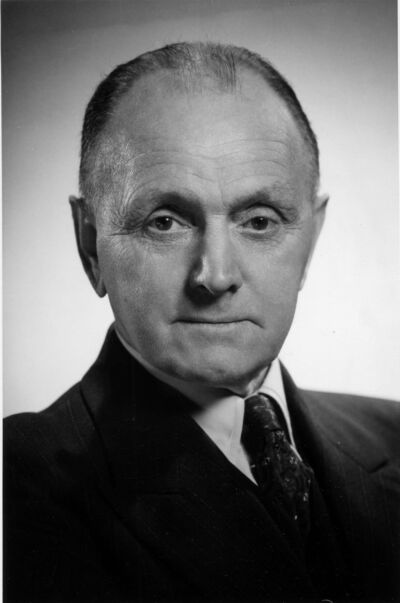
Jack Henderson c. 1948, Vancouver Archives, CVA 296-029.
Henderson recounts his working life in Canada where he arrived around 1907. He was employed in sawmills, constructing Pier B-C in Vancouver, building a bridge in Saskatchewan and managing steam plants. During the Great Depression, he led the Canadian Legion in Vancouver to establish a soup kitchen and shelter for the unemployed. He discusses his involvement in the Vancouver Trades and Labor Council serving as the chairman of the Legislative Committee for over 20 years, being elected to the school board, and helping to establish the Hastings Community Association.
Henderson also shares his personal perspectives on economic and social issues, and explains his commitment to improving the lives of working people.
Related Resources
Vancouver’s Hunger March for Basic Rights, 1932
Despite police predictions that it would be a “dismal failure”, 6,000 men, women and children descended on the Powell Street grounds (now Oppenheimer Park) in Vancouver on February 22, 1932 for a “Hun...
Sheila Pither Interview: Union Activism and Int. Solidarity
Born in 1932 in a small Saskatchewan town, Sheila Pither came to Vancouver with her mother after the death of her father. Sheila’s husband was a millwright in Vancouver, and she became active in the I...
Christopher Pritchard Interview: Plumbers Union, WCB
Christopher Pritchard (1894-1973) joined the Plumbers’ Union (United Association of Journeymen Plumbers, Gas Fitters, Steam Fitters, and Steam Fitters’ Helpers of the United States and Canada) in 1918...
Early Labour Day Parades in BC
Labour Day parades in Vancouver, BC which began in 1890, featured numerous such examples of floats constructed by unionized workers. This article is reprinted from the May 2019 Vancouver Historical So...
Percy Terise Interview: Granite & Stone Cutters & Firefighter Unions
Percy Trerise (1886-1965) was born in Cornwall, England and arrived in Canada around 1908. He initially worked as a granite cutter. He describes a jurisdictional dispute between granite cutters and st...
British Columbia Federationist,1912-1925
Originally started in 1907 by the Vancouver Trades and Labor Council as the Western Wage Earner, the British Columbia Federationist was a weekly labor newspaper published in Vancouver, BC. Visit the B...