
Mike Kramer Interview: CUPE, BC Federation of Labour
Mike Kramer (d. 1995) was a national representative of CUPE (Canadian Union of Public Employees) and Secretary-Treasurer of the BC Federation of Labour. This interview was conducted by Tom McGrath in 1989 and deals exclusively with Kramer’s participation in the Operation Solidarity movement of 1983.
Mike Kramer
Interviewed by Tom McGrath
May 30, 1989
Transcribed by Donna Sacuta, 2025
Tom McGrath [00:00:05] Secretary Treasurer of the BC Fed in 1983. The Interview is on May 30, 1989. Mike, when the Solidarity movement occurred, it really takes off with the formation of the OpSol (Operation Solidarity) and the all-union conference that’s called on the 15th of July. Prior to that, other than the Unemployment Action Centers, had there been any sort of direct attempt to respond to the restraint program that had been introduced the year before?
Mike Kramer [00:00:57] I don’t recall any concerted effort that was put together. There were discussions with various groups that were discussing what to do or what should be done, but there was nothing, there was no plan. We didn’t have a plan or a program at that time.
Tom McGrath [00:01:19] So then once the legislation came down, it was decided that you would have to take concerted action against the government?
Mike Kramer [00:01:29] Yeah, once the legislation came down, then groups started to come together. All kinds of interest groups came together and the different factions in the labour movement started aligning with different groups, with various groups, and it was starting to become a real hodgepodge of interest groups that were coming together, some of them carrying labour’s flag. The Federation then decided that we’d better put a handle on this, pull it all together. There were so many people that were pissed off about that legislation all for different reasons, but they were still all pissed off.
Interruption [00:02:13] Excuse me, please. Jerry Brown wants to talk to you regarding these.
Mike Kramer [00:02:19] I’ll get back to him, this won’t take long. At that time I think the Vancouver Labour Council got together with, oh I don’t know the names of the groups. There were so goddamn many groups. The Vancouver Labour Council got together with them and they put together the protest operation something or I forget even the name of it now.
Tom McGrath [00:02:47] The Lower Mainland Budget Coalition?
Mike Kramer [00:02:50] Coalition. Yeah, that’s what it was. That’s what it was. They were then carrying the flag for labour and it was decided that we better put a handle on it and do something provincially as opposed to just Vancouver and include all of the labour movement in the province. So at that time we called meetings with affiliates and non-affiliates of the Federation and put together a war chest and started to develop a plan of action.
Tom McGrath [00:03:19] Once that was done after the 15th there were a number of demonstrations that were held. One on the 19th, that was a smaller one, about 6,000, and you were partly responsible for organizing although it was you know the [BC]GEU (BC Government Employees’ Union) that was responsible for the activity in Victoria but then there was a bigger one on the 27th. There was the one on the 23rd which was huge, 25,000 in the march. Then the big one, a bigger one, 27,000 in Victoria and you were responsible for looking after the logistics of it for getting the disabled this sort of thing, the busses.
Mike Kramer [00:04:01] Well I wasn’t responsible for that as part of the office that went with, there were people that did all the work. Nor would I take any credit for putting that together.
Tom McGrath [00:04:15] No, I just remember seeing I guess a letter with your signature on it saying, “This is what we had to do. There’s gonna be X number of buses at Swartz Bay.”
Mike Kramer [00:04:26] Oh yeah, I had a good staff, very good staff.
Tom McGrath [00:04:31] How did you feel about those first two demonstrations in July?
Mike Kramer [00:04:36] We felt good. We thought that perhaps the government might pay attention. They might do, some of the old-time Socreds, the old Bennett’s were famous for taking a second look. It started to heat up a little bit politically, they’d take a second look. And we thought, well, that’s good. It’s starting to come together and if you can generate that kind of interest over on the Island, particularly right under the noses of politicians, in the parliament buildings, in the shadow of the parliament, that they might start to pay attention, but obviously they didn’t. They had their program and their agenda very well in place and we didn’t. We were still working on that, what we can do, what we should do.
Tom McGrath [00:05:17] Right. When the planning and strategy committee was set up, you know, there was a bigger trade union Op Sol steering committee that was set up. But you were on the the smaller one with Jack, who chaired that. Was there any great difficulty in planning then, for instance, the August 10th Empire Stadium rally?
Mike Kramer [00:05:52] I don’t recall any difficulties. I guess if there was any difficulties in trying to put things together is that it was virtually impossible to estimate the kind of responses we were gonna get. We just didn’t have a good idea of what kind of responses we were going to get.
Tom McGrath [00:06:11] Is this from the community groups, Mike, or from the from the labour group?
Mike Kramer [00:06:15] No, from the labour group. We could predict pretty well how the affiliates were going to respond because we were getting the feedback from the affiliates. But from the community groups and the non-affiliates, we were—
Tom McGrath [00:06:26] Not sure.
Mike Kramer [00:06:27] Not aware at all of the kind of responses we’re talking about.
Tom McGrath [00:06:30] How did how did you feel about the non-affiliates? Like CAIMAW (Canadian Association of Industrial, Mechanical and Allied Workers), Jess from CAIMAW. Art wanted them on quite definitely he wanted to include them, and there was [unclear].
Mike Kramer [00:06:46] If there was and when the real differences between Art and I started to appear, it was over the role of the non-affiliates. It was my view that the Federation is put together for the benefit of the affiliates first and the labour movement generally second. It seemed to me that if the labour movement and the Fed was going to carry the ball on this and eventually take the blame, then it should be the Federation and the affiliates that made the decisions, and not the non-affiliates. I had no reservations about that. In fact it was debated, it was quite a debate on it, and the side I was with lost.
Tom McGrath [00:07:31] So you were unsure as to how they would respond, be it the VRMEU (Vancouver Regional and Municipal Employees’ Union). But what about with Health Sciences or Jack Gerow and the Hospital Employees?
Mike Kramer [00:07:45] They were all part of a bigger public sector committee that was put together. They had some lines of communication and you know, I think we were fairly comfortable with where they would go because the legislation was aimed at the public sector particularly. It wasn’t private sector bashing, it was public sector bashing. Those public sector unions we figured would respond but also had a history of militant trade unionism. We weren’t too much in the dark for that. We were really uncertain of the teachers, and nobody could predict where the teachers were going to go or what they were going to do. Larry Kuehn was the guy that was instrumental in putting them up first, to have them go out first, which I really didn’t expect that they would go. At least I knew they would volunteer to do that and Larry really surprised me when he took that position. Then when they did go and they delivered to the extent they did, took everybody by surprise. Oh yeah. Yeah. And he must have had a very, very good feeling for the responses of his membership, because they did produce and they really turned out. That set the pattern or the pace for the rest of the job action. They really did turn out good and they held very, very solid until the very end, until towards the end, they started to come undone. Once the injunctions started to fly, people were looking at, “What’s going to happen to my job, my house, my savings, defiance of the law,” that shit. No, they did very well.
Tom McGrath [00:09:39] You mentioned the injunctions. There was an injunction taken out by McEachern, Judge McEachern to stop the picketing of the court house, which is a legal injunction. Why did you guys decide to adhere to that?
Mike Kramer [00:09:56] I don’t recall the debate specifically, but it seemed that what we were doing was action enough, and if we were going to keep everybody on side, we didn’t want to be seen as out-and-out lawbreakers that were going to be flying in the face of the courts. The courts, I think, were looking for a way to attack the OpSol, and that was to muzzle their guns somehow. And if you want to dry up any movement, you just take the money away. It was seen that the best way to do that would be to not out-and-out defy the law, defy the injunctions, defy the law, defy the legislation, but not directly fly at the courts. I don’t see that we would have been able to counsel people to take on the courts. Take on the government, yeah. That wasn’t a problem. But taking on the courts was seen to be something else.
Tom McGrath [00:11:00] But even though that one injunction was illegal.
Mike Kramer [00:11:04] Well illegal in whose eyes, in whose terms?
Tom McGrath [00:11:09] It was according to the Labour Relations Board.
Mike Kramer [00:11:16] But not at the time that it was issued. It was only after.
Tom McGrath [00:11:19] No, no, it was at the time because there was a questioning by the GEU about the thing and they challenged it, they only challenged it later.
Mike Kramer [00:11:31] That’s right.
Tom McGrath [00:11:32] Yeah, they challenged it later because it was raised by their lawyers that it was illegal, but there was no action. I know because I talked to Norm about this, Norm Richards, and he said, “Well, there was a problem of,” just as you said, “Looking as if they’re defying the law.” But their legal advisor said it wasn’t a legal injunction.
Mike Kramer [00:12:01] But that wasn’t the point of the whole thing.
Tom McGrath [00:12:04] Yeah.
Mike Kramer [00:12:04] The point of the whole thing was to demonstrate against the government, not to demonstrate against the courts. The courts were entitled to be wrong. If they screwed up, they screwed up. The main object was to demonstrate against the government and keep people focused on the government, not to shift them away to the courts or to anybody else. Bennett, Bennett, Bennett, Bennett. That’s who were were aimed at. So the courts, but the injunctions I was talking about were the injunctions that came down —
Tom McGrath [00:12:31] On teachers. If I can just go back for a minute and then I’ll come back to the strike because the strike is very important. But about the rallies, you know, there’s a number of rallies. There’s the 23rd in July, the 27th and the 10th, and then the the big one on the 15th of October. And that was that massive march-past sort of thing.
Mike Kramer [00:12:57] The Socred convention.
Tom McGrath [00:12:58] Yeah, and Art had wanted it to go from Beach to Beach and finally agreed to march past and end up at the Queen E Theatre and read the petition sort of thing. How did you feel about that as a demonstration, you know, 65,000, 70,000 people.
Mike Kramer [00:13:21] Oh, it was incredible. It was amazing. All kinds of people were walking. It was, you mean the demo itself or the fact we had to re-route it? The re-routing was done in consultation with the Vancouver Police.
Tom McGrath [00:13:38] Right.
Mike Kramer [00:13:38] You know, you couldn’t have a demonstration without involving them. They had to be there to clear the way.
Tom McGrath [00:13:45] Well they were participating in the march!
Mike Kramer [00:13:46] Fire fighters, everybody was involved. They were wearing buttons for Christ’s sake, it was just incredible. So sure, we worked with them. Oh there’s no way I can, I have the words to describe how it felt. It was something. All these people were there and in front of the hotel and Socreds were taunting us and they just couldn’t believe it. I heard one guy saying, “Oh that’s the same people marching around and around!” [laughter] It was something else.
Tom McGrath [00:14:24] No because it took approximately two hours, over two hours for the whole thing to march past because everybody, the beginning people were virtually down and the end hadn’t even started.
Mike Kramer [00:14:36] I mean Vancouver has got some experience with that with that peace walk. It takes virtually the same route. It was neat though to have all those different people.
Tom McGrath [00:14:54] Would you consider that one to be bigger and far more important than Empire Stadium?
Mike Kramer [00:14:59] I don’t know. I think Empire Stadium was the best one. That’s when the firefighters came in with their with the band, the ICTU (Independent Canadian Transit Union) drivers came.
Tom McGrath [00:15:09] That’s right with the bagpipe.
Mike Kramer [00:15:11] With their piper and all. There was a real good feeling in there. That felt better. The second one there were people were really I don’t know pissed off and angry but it was obvious by then, by the time of the march, that they weren’t going to do anything. They really weren’t going to. They were going to hunker down and tough it out. They weren’t going to change anything. Whereas at Empire Stadium there was still the feeling that, “Goddamn it, maybe they will listen. Maybe this is the one that’ll persuade them.”
Tom McGrath [00:15:48] Yeah?
Mike Kramer [00:15:49] Yeah, and people, I don’t know, there was a different air about. The second one seemed to me more determined somehow, that it was more I don’t know, not a job to be there, but the first one everybody was there and was happy. A happy event and things were going to happen. The second one wasn’t the same. It was it was more demonstrative.
Mike Kramer [00:16:15] Mm-hmm.
Mike Kramer [00:16:15] There was determination there, real determination. “Going to tough it out.” The first one was more, “Maybe this will change it. Maybe now the sun will break through.”
Tom McGrath [00:16:28] Yeah. Yeah. No, because some of the people I talked to who were just participants in the thing, a couple of teachers, a couple of the workers. And really interesting, some of them said, you know, they felt so angry with they wish they’d had a tomato or something just to throw at the building, not to hurt anything. You know, to manifest their discontent with the inability to get them to do anything. But there’s a difference in the response because you know, after Empire Stadium, Bennett comes out with a statement, “Well, I had more at my tea parties.” After the 15th, on the 20th he has his fireside chat.
Mike Kramer [00:17:13] Yeah.
Tom McGrath [00:17:14] So there is a response and says, you know, “Let’s get back to the negotiations.” And then four days later, you know, the 24th they’re back again. Do you think that the popular feeling, the popular support had started to dissipate? And I asked this question because Art says that that was happening, although I keep, I pointed out to him that The Province’s poll demonstrated that 60 percent of the people were opposed to what the government was doing.
Mike Kramer [00:17:48] Once the injunctions started coming down on the teachers, and bear in mind that the GEU were striking during all this time. Not maybe not all of it, but certainly were striking towards the end of it. They were on strike. And once it seemed that their strike was winding up, the injunctions were starting to come down against the teachers, and the teachers were saying, “We can’t hold them anymore.” If we were going to just like a big wheel keep rolling it, taking some people off and new people on, and we could have probably carried that on for a while longer. But that wasn’t the case. It was escalating. We were just rolling it. It was just getting bigger and bigger. And the ones that were up first and had been there longest were like the foundation of it, were starting to weaken. So there was no point piling more on top because it was going to come undone. And that was information that was given to us by the leadership in the BCTF. And it was decided that it’s gotta come to an end. There was no, there’s no way in the world that you’re gonna beat up on a government and turn a government over. A government had just been elected. And you know, popular support and opinion polls are great, but at the ballot box fucking Socreds win all the time. And it seemed to us that it had to end. Had to come to an end. We had to get as much as we could out of it, in that it was labour that was paying the price on it. It was workers that, organized workers that were passing up, you know, giving up their paycheques in there, they were throwing their paycheques in, they were investing in a day’s pay every day this went on. It wasn’t the community groups that had the big investment, they had fuck all in it, other than marching or attending meetings. So it was labour’s decision. We sat down and we made the decision that was the time to end.
Tom McGrath [00:19:55] Was part of the reason that it was decided to end the thing too have something to do with the increasing militancy on the part of some of the non-affiliates plus the community groups that had been talking about a general strike? And there is an escalation in the use of the term in September and October prior to the march.
Mike Kramer [00:20:28] No, that was never discussed, that was never part of the discussion.
Tom McGrath [00:20:34] Yeah.
Mike Kramer [00:20:34] That the community groups were getting too militant or the the non-affiliates were getting too militant. It was simply that, ‘What would a continued investment by our affiliates, by our members, what was it going to produce us?’ And it wasn’t going to produce us anything. We had gone as far as we could go and demonstrations and all the things that you need to do to try to persuade people. And they had decided that they were going to tough it out. They had a brand new mandate. They had four years or five years in front of them in parliament over there, and burning our members out any more wasn’t going to change anything. They were dug in.
Tom McGrath [00:21:19] But Mike, even with the GEU when they went out on the 1st there are groups, community groups, helping them to picket and picketing with them and certainly that with the teachers the week later, I mean my God, if it wasn’t for the community groups certainly in Vancouver, but also in some of the other areas as well, you know, where the community groups very definitely came forward and they were the pickets.
Mike Kramer [00:21:49] Oh sure, because the teachers couldn’t.
Tom McGrath [00:21:51] Yeah that’s right and you know they’re responsible for closing down almost 80 schools and specifically I guess out of those 80—
Mike Kramer [00:21:59] When the teachers were out that put our people out. CUPE members went out.
Tom McGrath [00:22:02] That’s right. That’s right, because they wouldn’t cross the line.
Mike Kramer [00:22:05] It was the paycheques that were being blown, that were being thrown away. The community groups didn’t lose any pay on this. May have taken a day off to go and demonstrate somewhere. But it was our guys that was costing money.
Tom McGrath [00:22:19] Yeah.
Mike Kramer [00:22:19] It was taking money right off the fucking table. We said, “No, that has to come to an end at some point.” You just can’t be taking that money away from them. There’s no point to it.
Tom McGrath [00:22:30] Then that’s consistent, like with the earlier approach of when Kube says the July 25, you know, “We’re gonna try every other means before a general strike, before we can consider the general strike.” Yet with the escalating strike, you know, as Jack Adams and you guys set up that program of you know, the GEU goes out first and on the 8th, teachers, then on the 10th the Crown Corps go out. Although the ferry workers were shifted.
Mike Kramer [00:23:04] They were moved back as well as the Hydro workers, yeah. Because of the statutory holiday that was in there.
Tom McGrath [00:23:09] Oh yeah. Because of the statutory holiday, not because of the contract that they had signed.
Mike Kramer [00:23:16] No, it seems to me it was for a stat holiday. What was in there?
Tom McGrath [00:23:19] Well, the 11th, you know, November 11th, that’s right. Yeah. Oh yeah.
Mike Kramer [00:23:24] Because if they went out before they lost the stat.
Tom McGrath [00:23:29] Oh I see, hadn’t thought of that. Yeah, okay. Because then they were placed with the transportation and communications workers with ICTU and so on and the civic workers on a Monday. And Hydro was two days later. Okay, I see. And when specifically were the private sector supposed to go out? Just if there was legislation introduced?
Mike Kramer [00:24:00] That’s right. If there was any attack on the private, on the public sector. Right.
Tom McGrath [00:24:04] So there was no specific date that was set for them at all.
Mike Kramer [00:24:07] No. Okay.
Tom McGrath [00:24:10] Back on the 3rd, Kube told the community groups that couldn’t do anything on the social issues. Would have to work out something else. That same day the CCU (Confederation of Canadian Unions) is kicked off the steering committee. Jess —
Mike Kramer [00:24:35] I’m nodding because I don’t recall those dates.
Tom McGrath [00:24:37] Yeah, okay, no, yeah. You’ll you’ll have to take my word on it, Mike. But at that time—
Mike Kramer [00:24:48] The CCU were kicked off because they wouldn’t pay their freight, they wouldn’t pay their assessment.
Tom McGrath [00:24:54] Okay. In September though, you sent a circular around saying that they didn’t have to do it.
Mike Kramer [00:25:03] Because then they weren’t on the steering committee.
Tom McGrath [00:25:05] No, they still were. This was sent to non-affiliates. You said they didn’t have to pay it on that circular.
Mike Kramer [00:25:22] I don’t know. If they didn’t pay, they weren’t on the steering committee.
Tom McGrath [00:25:25] Well they were until the 3rd of November and then they were turfed off.
Mike Kramer [00:25:31] On the 3rd of November?
Tom McGrath [00:25:32] Yeah.
Mike Kramer [00:25:34] Oh no, they weren’t, they were off before then.
Tom McGrath [00:25:38] That’s when a public statement is made by Art and that’s when Jess goes public with it as well. He doesn’t raise anything about it, and Art says it’s because of the the non-payment of dues.
Mike Kramer [00:25:50] Yeah.
Tom McGrath [00:25:51] Now they’ve been paying to organizations like the Lower Mainland and also been paying to the local coalitions.
Mike Kramer [00:25:57] Oh yeah, oh yeah. I don’t doubt that for a moment because those local coalitions did get some money.
Tom McGrath [00:26:01] Yeah.
Mike Kramer [00:26:02] Yeah, but they weren’t paying OpSol.
Tom McGrath [00:26:04] Yeah.
Mike Kramer [00:26:06] There was that and there was also we wanted them to sign a no-raiding.
Tom McGrath [00:26:09] Oh that four-year thing.
Mike Kramer [00:26:11] That’s right, yeah. And OpSol and that’s they decided they weren’t going to do that.
Tom McGrath [00:26:15] But they had already said that they wouldn’t do that with the ten-point program back on the 15th.
Mike Kramer [00:26:19] They may, well I’m not sure of that.
Tom McGrath [00:26:21] Oh yeah, no, they did.
Mike Kramer [00:26:22] Yeah. They said that?
Tom McGrath [00:26:23] Oh yeah. Yeah, they said they wouldn’t do it. That’s right in the recording.
Mike Kramer [00:26:29] Oh they said they wouldn’t join up under those terms.
Tom McGrath [00:26:33] Yeah, under that ten-point.
Mike Kramer [00:26:34] That’s right. It’s not that they said they wouldn’t raid.
Tom McGrath [00:26:37] Yeah, no no no. Oh yeah, well they said they were, no, they said they weren’t gonna raid. They also said that as well. They weren’t gonna raid.
Mike Kramer [00:26:45] Because that was one of the major disagreements between CAIMAW and us.
Tom McGrath [00:26:50] Yeah.
Mike Kramer [00:26:50] Succamore obviously was raiding already.
Tom McGrath [00:26:53] Mm-hmm. Yeah, that four-year thing. Jess said at that meeting that they were going to in practice not raid but they wouldn’t sign the four-year pact because it was at that point he also calls for general strike and everybody simply says, ‘Sorry it’s too early. No sense in having, let us find out what the hell’s going on before.’
Mike Kramer [00:27:21] You know we’ve always had militants in British Columbia that are prepared to sacrifice their members rhetorically to the hilt. They know goddamn well that they’re never gonna have to deliver on it because there are some responsible labour leaders that will see to it that we don’t chase our members over the goddamn cliff all the time. Christ almighty, if we had a general strike every time some of these hotshots wanted a general strike, this province would be down every day. It’s just fucking lunacy with these general strike, general strike. Christ almighty. Succamore and a few of the others were all prepared for the big general strike but there was no way in the world they expected they would have to deliver on that. That’s bullshit.
Tom McGrath [00:28:12] Well okay they claimed that they had taken polls of their membership and they were ready to go out.
Mike Kramer [00:28:20] Well, why didn’t they go? Why didn’t they go?
Tom McGrath [00:28:24] That’s interesting because I asked that question.
Mike Kramer [00:28:32] They’re not part of the Fed, they don’t want to take direction from the Fed, don’t want to pay their dues, they want the Fed to lead the way. They’re so anxious to go, away they go.
Tom McGrath [00:28:39] Well, the same sort of thing as in relation to Bills 19 and 20, which is they wanted to have a complete shutdown and the Fed said ‘No.’ Their membership once again, according to their polls internally, indicated quite clearly that they were ready to go. The 300,000 that was a magnificent day, that one-day stoppage in 1987.
Mike Kramer [00:29:05] And the work that that took and in places we had to picket them out, you know, that’s not any kind of a spontaneous demonstration.
Tom McGrath [00:29:13] Well, yeah, no, no, no. No. But the thing is, in each of the instances, and I pose this question because supposing the CCU had gone out, you know. As you and I know, there’s 20,000 in the CCU across the country and it’s what, 7,000-10,000 here. 7,000-8,000 I guess. But would they have been left just hung out to dry had they gone out? If they had gone out would the Fed have supported them? That’s the question.
Mike Kramer [00:29:42] You’re going to lead a popular movement, right when the movement is looking for a leader. Oh, I guess people will follow. If it’s a popular movement.
Tom McGrath [00:29:48] Right. We’re talking about 250,000 members.
Mike Kramer [00:29:53] That’s right.
Tom McGrath [00:29:54] Would a 250,000 members then support the individuals as they go out and if they get the support of the community groups.
Mike Kramer [00:30:01] The reason that 250,000 members are there and stay there is because they expected and have been getting responsible leadership. We’re not chasing them on the street every goddamn day. Not general strike or downing tools all the time. The CCU has got 20,000 people across the country. Maybe that’s why.
Tom McGrath [00:30:24] To go back to November, again because Jess publicly says that he would like to have had no deal under the table. He felt that this was why, one of the reasons why they were kicked out. Joy Langan says, ‘Well, you know, it was a convenient excuse of not paying.’ The animosity. It’s historic. There’s no question of it. God. But once they are out, is it already that early? Because you know they’re back bargaining again, GEU back bargaining again with Spector. Is there a possibility then that the GEU is going to make a deal? Did you people see that it was possible that they would be making, come to concluding an agreement with Spector?
Mike Kramer [00:31:22] We were having meetings every morning. We were having breakfast meetings every morning and we were getting daily reports. In fact doing three times a day on bargaining, so we knew where that was going.
Tom McGrath [00:31:33] Right. When the teachers go out, with the escalation, how did you feel about that program of the escalation? Did it seem to make sense?
Mike Kramer [00:31:45] Yep. Yeah, that was roundly, roundly debated, and it did make sense. Yeah, it seemed to be a good plan, a workable plan, and gradually building up the pressure, gradually building up the pressure. There’s always been some suspicion of the government employees and their bargaining tactics and dragging the Fed and the labour movement into their bargaining.
Tom McGrath [00:32:10] Yeah.
Mike Kramer [00:32:11] There’s always been some of that, and that was discussed at that time as well. That, ‘here we go again.’ This is the GEU.
Tom McGrath [00:32:21] Yeah, because the year before, in 1982—
Mike Kramer [00:32:24] Yeah, but at this point now it was very coincidental. Their contract was up, they were in bargaining, and down comes a government with all these bad bills. I’m sure the GEU didn’t engineer that. So timing I guess was fortuitous in one sense that they were able to lead the way and they were out there on strike. They’re everywhere in the province, everywhere and they were visible. At the end it did, well the reason that the trip to Kelowna was on Sunday instead of Saturday was simply because their contract hadn’t been settled. And we weren’t going to be pulling the rug out from under them. So it was intertwined with it, but it wasn’t it wasn’t the sole purpose of the whole operation.
Tom McGrath [00:33:23] Right. So that when you and Jack Munro got involved in the thing on the Monday, sorry the Thursday.
Mike Kramer [00:33:30] Thursday.
Tom McGrath [00:33:31] Yeah, and started the chats and so on and that night of 11th – 12th when you guys made the arrangement with Spector it was then just a question of getting the GEU to make their arrangement, sign their contract.
Mike Kramer [00:33:53] Yeah we had, I think it was Friday night we had a meeting with all the officers of OpSol down at the IWA building and it seemed like we were going to be able to come to some conclusion. Then we got the telephone message in that the government had just tabled a wage increase of 0-0-0 for three years, and we said, “Oh fuck there s no point. You can’t meet with them on that. If we settle the OpSol dispute and leave the government employees hanging out there by themselves with 0-0-0, you know it’s tantamount to pulling the rug out. So we told government that that was absolutely unacceptable, that they couldn’t expect—
Tom McGrath [00:34:37] Yeah, was this Spector or Kelleher?
Mike Kramer [00:34:44] No, I think that was relayed directly through Spector. No, Stevie was there more or less at my insistence because I wanted witnesses to what Spector was offering. I don’t trust that man and never did trust him. We wanted a witness, we had Vince Ready and we had Stevie and I wanted a witness—
Tom McGrath [00:35:08] That you could trust.
Mike Kramer [00:35:09] That’s right, to hear what the deal was. And that’s why we involved Stevie, as well as the LRB (Labour Relations Board) let us use their building.
Tom McGrath [00:35:20] Right. As that was taking place, and once that agreement was virtually made, why was it decided to go to Kelowna? Why not have Bennett come to you people?
Mike Kramer [00:35:43] Well, I wanted them to meet in Kamloops. That Bennett would fly to Kamloops and and we would fly to Kamloops. But Bennett had a problem in that he hadn’t cleared anything with his cabinet. And we understood that because we couldn’t do anything without clearing it with our cabinet, our committee. At that point, Christ almighty, we must have had hourly meetings, it seemed to me. Anyhow, it was impressed upon us that going to his home was unique. He never discussed business in his home. His home was his place, his residence, his private life, and his private affairs were conducted at his home. So this would have been the first time in the history of his premiership that he was going to use his home to do provincial business. And that was significant on his part of the concession. I wanted to go to Kamloops, I figured that find some neutral territory. Go to Kamloops, but I was persuaded that the venue wasn’t near as important as the fact that the meeting was going to happen.
Tom McGrath [00:36:56] Why, this is gonna be a difficult one because it doesn’t involve you specifically, but Norm Richards back in the end of July said, ‘we can’t trust this government.’ Now he’s talking for the GEU obviously but that’s reflected in things that Art said as well. Now we get to November and they’re trusting the government just on their commitment.
Mike Kramer [00:37:30] No, there was commitment made in front of witnesses. There was supposed to be, the press was supposed to be there. Supposed to be a television interview with Bennett coming out and making his statement on the front porch.
Tom McGrath [00:37:42] Right.
Mike Kramer [00:37:44] That all changed once they got there. That would change before they left. So once they got there then that changed and we were in constant phone communication. Jack called back twice and talked to myself, talked to Art. The committee was all waiting. We were all sitting in the government employees’ boardroom I believe. And they relayed the detailsof the settlement back. It was the best we could do. There’s no way you could walk away from that.
Tom McGrath [00:38:18] Why? He had reneged.
Mike Kramer [00:38:22] But it was over. The strike was over.
Tom McGrath [00:38:25] Why? Because the GEU had signed their contract?
Mike Kramer [00:38:28] Well, that was part of it, but in everyone’s mind it was over. We had made the deal. It was done.
Tom McGrath [00:38:36] But you hadn’t conveyed that to the membership yet.
Mike Kramer [00:38:41] Oh no, to the people?
Tom McGrath [00:38:43] Yeah.
Mike Kramer [00:38:43] No, no, no, no. As far as the officers were concerned. Yeah.
Tom McGrath [00:38:46] Yeah. Oh, okay, I see now.
Mike Kramer [00:38:48] Leadership had had it. That was it. That was over.
Tom McGrath [00:38:52] Okay. Mike, why did you decide not to go? Because you were the one who really should have gone up there. But you decided you didn’t want to go.
Mike Kramer [00:39:00] I wasn’t that happy with the whole thing all the way through. I wasn’t that happy with it. And I have a—
Tom McGrath [00:39:09] Why weren’t you happy?
Mike Kramer [00:39:11] Very much a dislike for Spector. He just didn’t ring with me at all. Not at all. And no, it seemed to me that they didn’t need me there.
Tom McGrath [00:39:29] And it’s just because the opposition to Spector you decided not to go.
Mike Kramer [00:39:33] What would you—
Tom McGrath [00:39:34] Now again this is hypothesizing and this is a difficult sort of thing, but it’s useful to do on occasion. What would you have wanted to have happened on the agreement? What would you have changed in that agreement?
Mike Kramer [00:39:47] Oh I can’t say. I wasn’t there. I was at the other end, I was at my end of the —
Tom McGrath [00:39:52] Yeah, okay, but no no, but I’m talking about the situation, you know, as because you said you didn’t go up.
Mike Kramer [00:39:57] The best reason that I didn’t go is because I stayed with the officers. Someone had to stay with the officers. At that point I was the ranking officer. Munro was the vice president, if you will, the first vice president, and he was up in Kelowna, and I stayed with the officers. Somebody had to be with them and keep things together.
Tom McGrath [00:40:16] Yeah, but you’re the ranking officer.
Mike Kramer [00:40:18] So I stayed.
Tom McGrath [00:40:18] Yeah, then you should have actually gone up, shouldn’t you?
Mike Kramer [00:40:23] No, I don’t think so. No, I think that worked out the best way. You see, we had a discussion amongst the officers ourselves. Who was going to go? Who could afford to go?
Tom McGrath [00:40:36] What do you mean by ‘afford’?
Mike Kramer [00:40:37] Because the fallout of that was going to be horrendous. They were going to hang the horns on whoever went up there. The messenger in that instance was going to be killed. Oh yes. And that went around and around the table and it was decided that Munro was the guy to do it. His union wasn’t directly involved, private sector union, and he was a ranking officer in the Fed and the Congress, and in fact labour estates, a senator almost, in BC. He’s the guy that sticks out the most in Brtish Columbia, and he could ride the heat. He wouldn’t pay the price at the next election in his membership. That if it had been anybody else, they would have had to pay. And that went around and around the table. That was thoroughly discussed.
Tom McGrath [00:41:34] But if that’s the case, Mike, you know, why risk that possibility, because does that indicate that the deal wasn’t as good a deal as it could have been?
Mike Kramer [00:41:43] Oh no, we knew that the community groups would be incensed that they weren’t consulted first. We weren’t going to consult them because it wasn’t their paycheques. It was our paycheques that were being lost, that were being shoveled into that muck. So we said, “Fine, it’s our decision to make.” We put our members back to work.
Tom McGrath [00:42:03] Okay. What about the teachers then? How did—because the teachers were out as well.
Mike Kramer [00:42:08] Yeah, Larry Kuehn was there.
Tom McGrath [00:42:10] Well, he’s there and he accepts. But he accepts the fact, the statement that you know, $18 million is going to be refunneled back in.
Mike Kramer [00:42:19] Back into the system.
Tom McGrath [00:42:20] Yeah. But you know, that’s verbal.
Mike Kramer [00:42:22] Yeah.
Tom McGrath [00:42:23] And there’s nothing that’s—
Mike Kramer [00:42:24] Well, what can you do with it? What do you do with the government?
Tom McGrath [00:42:27] All right, see then I get back to my question I asked before about Norm Richards and saying, you know, ‘You can’t trust these bastards.’
Mike Kramer [00:42:34] Of course not.
Tom McGrath [00:42:37] Would it change by November? That suddenly we found —
Mike Kramer [00:42:40] Nothing had changed. Nothing had changed. That’s why we had the witnesses. That’s why we wanted the statement.
Tom McGrath [00:42:45] And so because they simply reneged on everything.
Mike Kramer [00:42:47] What do you do with it?
Tom McGrath [00:42:48] Well, publicize the hell out of it, I guess.
Mike Kramer [00:42:52] I think we did. An elected government. Big majority government. What do you do with it?
Tom McGrath [00:43:01] I guess you have to try and fight the media. (laughs)
Mike Kramer [00:43:11] The media [unclear]. And particularly when they’re picking on the public sector, which is kind of popular.
Tom McGrath [00:43:15] Oh yeah, so certainly the teachers particularly.
Mike Kramer [00:43:20] At that point in time the teachers were right down at the bottom of the polls. Yeah. Nobody had any use for these guys that beat the students out of the parking lot. Oh yeah, they were not in good shape. Anyhow.
Tom McGrath [00:43:35] On just one last—how’s the time?
Mike Kramer [00:43:40] It’s getting on.
Tom McGrath [00:43:42] Okay. One last one, Mike. With that agreement that’s made then, and Jack taking the heat sort of thing for it. Do you feel that the whole— because it, you know, it could create all sorts of hassles later on. Jack loses his position on the Fed. Art gets back in, but only because Jack puts upJoy. You lose your position eventually this sort of thing because of the difference with Jack Adams.
Mike Kramer [00:44:31] Over Jack Munro.
Tom McGrath [00:44:32] Sorry?
Mike Kramer [00:44:32] Over Jack Munro.
Tom McGrath [00:44:33] Oh yeah.
Mike Kramer [00:44:34] Oh yeah.
Tom McGrath [00:44:36] And I think Jack and you, Jack Adams and you, had talked about the question of you representing the public sector and this sort of thing. And so that the Solidarity, the movement as a movement, has a much greater impact than just you know, it certainly has an impact on the community groups, but it also splinters in many ways. Factionalizes even more the public sector-private sector disputes. Is that a fair assessment or is that reading more into it than actually happened?
Mike Kramer [00:45:21] Well, unfortunately personalities get caught up with the whole thing that went on. There was no love lost between Jack Adams and Jack Munro at all. Jack Munro would once call him a ‘Fat fucking turkey’ and in public in front of a bunch of people. And there had been battles between them going back for a long time over putting the slate together at the Fed Convention. There was a big dust up between Steel and the IWA and the GEU. And there had been bad blood there for a long time. After the dust cleared on Solidarity and people started paying bills. Adams paid a bill. He took a shot at Munro and was able to knock him off. And he tried to pry me loose from Munro. Jack Munro and I’ve been good friends for many, many years, and I was going to stay with my friend. I went down because I wouldn’t walk away from Munro. I don’t think that had anything to do directly with Solidarity or directly with Kelowna. That had to do with Jack Adams getting even and paying some bills.
Tom McGrath [00:46:39] Except that by March of 1984, Kube is already attacking Munro over the Kelowna thing publicly. I mean there’s allusions made in January.
Mike Kramer [00:46:51] He had his own election to worry about.
Tom McGrath [00:46:51] Oh yeah. Yeah. But he almost didn’t run.
Mike Kramer [00:46:56] That’s what he says.
Tom McGrath [00:46:59] Well you know, a couple of other people said that because he was afraid he was gonna lose the sucking thing. But then no no one wanted Frank Kennedy. Why not Kennedy? Because Kennedy is associated with the left?
Mike Kramer [00:47:13] He doesn’t represent any broad base of the labour movement. He’s the head of the Vancouver Labour Council, or has been active in the Vancouver Labour Council for years and years and years.
Tom McGrath [00:47:22] But it’s the biggest one around.
Mike Kramer [00:47:24] It’s the biggest one around in terms of affiliates. What are their meetings? They don’t turn up, they don’t have meetings that represent in numbers, the size of their affiliations. Christ, we get more people out at Westminster Labour Council. So Kennedy doesn’t have a big constituency and he does represent the left. Yeah. And that is not the majority view in the province at all.
Tom McGrath [00:47:49] Was this one of the [break in tape]
Tom McGrath [00:48:02] District Labour Council took over the Lower Mainland Budget Coalition as well? I mean Kennedy supported as well in August. Is that because of the New West?
Mike Kramer [00:48:12] The New West group. Yeah.
Tom McGrath [00:48:15] Yeah. Because of the support, the numbers, this sort of thing, and the connection that they had with the Fed?
Mike Kramer [00:48:22] Probably, yeah.
Tom McGrath [00:48:23] And the NDP too.
Mike Kramer [00:48:26] And the NDP.
Tom McGrath [00:48:26] Yeah. So you don’t see it then as just personality that breaks down by 1984.
Mike Kramer [00:48:35] Oh sure, oh sure. Yep. Yeah. Yeah. They were able to use whatever backlash come out of the Coalition that come out of that as part of their rationale for knocking him off. But yeah, hadn’t it been for that personal animosity there would never have been a problem.
Tom McGrath [00:48:56] Okay, what about the differences then between Gauthier and Jack? And that, no, Gruntman, sorry. Art Gruntman. Yeah. Gruntman that’s over because of the—
Mike Kramer [00:49:12] Way back, way, way back.
Tom McGrath [00:49:15] In the seventies. Yeah. Yeah. Reinforced because of the lockout in March-April of 1984. Yeah.
Mike Kramer [00:49:27] But during the piece on OpSol, during all our meetings and everything, there was never any problem between the two of them. But we’re able to sit down and get in the debate and we’re out with anybody that wasn’t. You know, Jack takes shots here and there. He and Gruntman are old and it goes back a long time.
Tom McGrath [00:49:57] Yeah.
Mike Kramer [00:49:58] But it didn’t begin with OpSol.
Tom McGrath [00:50:04] Mike, coming from the public sector, would it not have been a more practical thing to try and work out something for the community groups? I mean CUPE has a reputation, and I know this from the historical research that I’ve done, I mean I’m absolutely impressed through looking at the records in the national office, of community involvement. Yeah, no no no you were the—
Mike Kramer [00:50:30] Owen Dykstra was the ranking officer and the national vice president. And he was the guy, and he attended all the meetings as well. In fact, he and Larry Kuehn were at the meetings where Munro and I were. I made sure Owen was there.
Tom McGrath [00:50:45] These are the ones with Spector?
Mike Kramer [00:50:46] Up at the board, that’s right. They didn’t sit right in with us because Spector and Kuehn couldn’t get along. The two of them were just like, they scrubbed sparks off each other really, really bad. So Larry and Owen sat outside while Jack and I were in the other room with Spector and Ready or wherever else was there.
Tom McGrath [00:51:11] And Vince. Kelleher, yeah.
Mike Kramer [00:51:13] Well, Stevie wasn’t there all the time.
Tom McGrath [00:51:14] No, oh he would go in and out from the other one.
Mike Kramer [00:51:16] Yeah, and then Jack and I would meet with Owen and with Larry and bring him to up to where we were, bring him up to speed. If we had to change things, we’d change it and then come back. And that didn’t particularly bother Larry, because I don’t think he wanted to be up front there anyway in those discussions.
Tom McGrath [00:51:40] Mm-hmm.
Mike Kramer [00:51:41] But certainly he wanted to be involved.
Tom McGrath [00:51:46] See, the reason I asked that specifically, even though you know you are representing the Fed, I mean this is your base. CUPE’s your base support. Okay. On the 10th, before going down to the Labour Relations, you talked to the provincial Solidarity Coalition Steering Committee and said, “It’s possible that we’ve got something to give to the government and they may be receptive and we’ll make a formal proposal on the 14th.” Well obviously between the 10th and the 14th, a hell of a lot happens. But what had happened to indicate for you to have made that statement on the 10th that in fact some of the community issues might be involved, might be talked about, negotiated.
Mike Kramer [00:52:40] Well I don’t know. There were a lot of political discussions and a lot of political speeches made. And in order to keep people’s fire up and fervour, fire burning and fervour up high, you have to say things they wanted to hear. So there was a lot of that speechifying made. You know, people get up and make pretty flamboyant statements, during all those things. And it wasn’t just us, it was all kinds of people making all kinds of statements. But at some point reality has to set in. You know, it’s like going to your members and you preach what they can reasonably expect to draft proposals and you don’t talk to them about reality until you come back with a settlement. Right? That’s the way life is, that’s the way the marketplace works. Buy low and sell high. That’s the way it is. We looked at it on a purely, purely fiscal basis. There were workers putting paycheques in the box, and there were a whole bunch of other people that didn’t cost them anything. And we couldn’t continue to ask those people to subsidize that off their paycheques. We just couldn’t. That had to stop. The community groups, we did get some stuff for them. We were able to get some statements for the human rights, for the tenants and for somebody else, I forget, there were three of them. .
Tom McGrath [00:54:17] For disabled.
Mike Kramer [00:54:18] The disabled was it? Yeah, okay. And the government said they were going to do some things there, put a commission together in one case, and I forget what else. And so we figured at least it’s not, they just haven’t been pushed aside and they’ve been given no consideration. We were able to get the government to re-look at something or do something for them. It turned out that all of the focus was aimed at the job action, and that was now the thing, was the job action, as opposed to doing something separate and apart from the job action. And there was no way we could continue on with the job action. It just wasn’t going to be asked. People were hurting. People were hurting. It was costing some people a hell of a lot more than it cost a lot of other people, including the public sector. School board employees were paying, but municipal workers weren’t.
Tom McGrath [00:55:21] Municipal workers weren’t?
Mike Kramer [00:55:22] Weren’t. The munis hadn’t rolled out yet.
Tom McGrath [00:55:23] Well yeah, but some of them were were not crossing lines though, because some of them were actually—
Mike Kramer [00:55:28] Oh sure, some of them, yeah. That’s right.
Tom McGrath [00:55:29] Yeah, but the rest of them were gonna go out on that Monday.
Mike Kramer [00:55:33] Generally they were there, they were all there, on the 8th.
Tom McGrath [00:55:37] No, for the 14th they were waiting for.
Mike Kramer [00:55:38] The 14th was it? Whatever. That’s right, after the long weekend. It was over. It was done.
Tom McGrath [00:55:49] Why couldn’t it have all been put on a almost a daily basis of turning them out?
Mike Kramer [00:56:00] Hindsight. There was a lot of things that could have been done.
Tom McGrath [00:56:00] No, but I I’m just wondering that because and I asked Jack Adams about that too, and he said, ‘Well, we had to see what kind of support we had,’ and you guys were rather apprehensive about what the teachers were gonna do. And you knew that the GEU would stay out. .
Mike Kramer [00:56:15] Oh sure, they were on a legal strike.
Tom McGrath [00:56:17] Yeah, but see so too IWA was on a legal strike. Now I you know, I mentioned this to Jack. I mean sure, he was hitting 30 percent unemployment. That’s a hell of a lot because it’s 10,000 people. Well, 50 percent in the building trades, you know. So the private sector, obviously. But because of the numbers, you know, it could have translated into something, because of the pressure, to make the government respond. I don’t know. One last question, Mike. A positive event? Because you know, the movement really continues. Solidarity continues until 1986 when it’s folded up. A lot of things in preparation for the election, this sort of thing. The educational activity, a positive event?
Mike Kramer [00:57:14] I think so.
Tom McGrath [00:57:15] Antagonistic?
Mike Kramer [00:57:16] I think by and large it was a positive. It was a productive exercise. Because the government did back down. They really did. They rescinded their most contentious pieces of that legislation.
Tom McGrath [00:57:34] Bill 2.
Mike Kramer [00:57:34] The firing without cause, that’s right.
Tom McGrath [00:57:36] Except they still had the right to lay offs and change.
Mike Kramer [00:57:40] They had that anyway.
Tom McGrath [00:57:41] Yeah.
Mike Kramer [00:57:42] Well, so they could order, impose collective agreements and stuff. They moved off on a lot of that stuff. And in the private, in the government as employer indirectly, but the municipal and school board employers, they were all counseled to relax on that Bill 3 bullshit. All of them. I think there was one holdout and the government sent Ed Peck in, and Peck trimmed them pretty good and got them to agree that they weren’t going to use that legislation. So I think we did all right, in so far as it was the first time anything like that had ever been put together here. Nobody knew what the hell the book was. There was no book on this, where to go. All of the community groups, all of the community groups they just scared the shit out of them. A lot of our officers we didn’t understand who the fuck was in there and who the hell we were dealing with. They were putting groups together whenever two or three people got together in a pub sometimes.
Tom McGrath [01:00:00] How did you feel in working with—and I asked Art specifically because of the altercation or whatever he had with Frances. Frances Wasserlein? In Victoria.
Mike Kramer [01:00:14] Yes, yes.
Tom McGrath [01:00:16] How did labour feel about working with really different groups? Not just the Status of Women, Vancouver Status of Women, but also then the groups that were there, the lesbians, the gays, this sort of thing. Create any sorts of problems?
Mike Kramer [01:00:37] The labour community is a very structured community. And the lines of authority and representation are well defined. You know exactly, because we have conferences that are delegated, right? People sign in with their name and their union and all that. So we’re used to that. That’s how we understand representation should be. And these other groups, you didn’t know who the hell you were dealing with.
Tom McGrath [01:01:03] But they signed in.
Mike Kramer [01:01:05] Some of them did.
Tom McGrath [01:01:05] Yeah. Most, you know, like this this one guy, it boggles my mind because usually there were two delegates elected.
Mike Kramer [01:01:14] This guy I’ll never forget him. He wore a tweed cap, he had on a leather jacket and he had on pajama bottoms and boxing trunks over the pajama bottoms. And some kind of boots. And he was the strangest looking man I ever saw. Then he’d get up and make speeches. And usually it had little point to them other than the direct action kind of speeches. State and classes, class society revolutionary. And once he complained because I was smoking. I asked him who the fuck he was and he told me who he was with, so I asked one of the people that I knew was with this group. You know, “Who is this fucking guy? How come you bring him here? Doesn’t contribute anything.” He says, ‘He’s not with us.’ “He says he is.” Anyway, that didn’t matter. But they were not structured. They were totally unstructured and we didn’t feel comfortable with them at all.
Tom McGrath [01:02:15] But what about groups like Jo Ireland who Art knew?
Mike Kramer [01:02:18] You know, the fellow [unclear]. Yeah, what was his name?
Tom McGrath [01:02:23] Hamish McCrea?
Mike Kramer [01:02:24] No, no.
Tom McGrath [01:02:25] Fred Graysmith.
Mike Kramer [01:02:27] Yes. Yeah, good guy.
Tom McGrath [01:02:28] Oh yeah, Fred was incredible.
Mike Kramer [01:02:30] Yeah. Yeah, good guy. And so was Jo Ireland. We got along very well with her. Yeah, yeah. I liked her. She was good people. Yeah. Is good people, I guess she’s still around.
Tom McGrath [01:02:40] Oh yeah, she is. So is he. Yeah.
Mike Kramer [01:02:44] No, most people we didn’t have too much difficulty with. There was one group that Jack mentions and Palmer reports in his book. It was called the Rural Lesbians. And they were so pissed off at the IWA in Nelson because the IWA wouldn’t come out and support some project that they were putting on. Well that was the end of it. The Rural Lesbians, Mother of Christ, who do we have next? And those things. For most of the officers, that was, we’d never heard of these people. The Rural Lesbians. And who do they represent? Oh yeah. Some of them, we were really caught. We just didn’t know who the hell they were. And then if you don’t know who they are, you don’t know what the hell they’re going to do. You can’t even make any kind of a guess as to what they’re likely to do.
Tom McGrath [01:03:42] So then you’d agree in that respect when Art says one of the reasons they had to set up that umbrella, the Solidarity Coalition, was because you didn’t know what the hell—they were afraid of for instance the Lower Mainland Budget Coalition and the activity that they—because you know that march that they had, and then the luncheon at Gracie’s, the sit-in, which you know OpSol—
Mike Kramer [01:04:07] We wouldn’t have endorsed that. Yeah. I don’t believe the [unclear] fucking abortionists or pro-lifers who are in there now, [unclear]. I don’t agree with that.
Tom McGrath [01:04:25] So then it has to be a control mechanism over groups like that to make sure that the thing becomes so that the press doesn’t even distort it worse.
Mike Kramer [01:04:37] Oh yeah. Sure. If somebody does something stupid, they will blame everybody for that one dumb act. And you know, who the fuck owns the media?
Tom McGrath [01:04:51] [laughs] Yeah, no, well see this that.
Mike Kramer [01:04:52] We had we had some good people in the media along with us. From the Newsman’s Guild and Joy Langan is under the Vancouver Sun, Pacific Press, which are a terrible employer. There’s good people in there. But the media are not our friends in this province. Nope.
Tom McGrath [01:05:16] Why then, you know, because you set up that newspaper, but why not have pursued it more? Why not have continued?
Mike Kramer [01:05:24] Oh, because we couldn’t control it editorially. It was all over the place. Kicking the shit out of one of the major affiliates that happened to be in the fucking Solidarity, in OpSol, was the government employees and there was just no way that was gonna last. And we had talked to Stan [Persky] and it wasn’t going anywhere. It just wasn’t going anywhere. We were giving it away, it still wasn’t going anywhere. I tried to keep that going longer than some of the officers wanted. I did. I thought there might be some chance for it. Then that article that took on the jail guards, I guess. That was the end of it. (laughs)
Tom McGrath [01:06:16] It’s still a viable proposition, do you think, Mike?
Mike Kramer [01:06:20] I don’t know. I listened to a CBC program Sunday about the labour press. There used to be labour, union, trade union newspapers in this country, but there isn’t anymore. There’s nothing like that.
Tom McGrath [01:06:32] No. No, the reason I pose that question, I don’t know whether you know, but I should send you a copy of Lorne Slotnick’s letter. He used to be responsible for the labour beat with the Globe and Mail.
Mike Kramer [01:06:46] Oh yeah, yeah, I heard about him.
Tom McGrath [01:06:48] Which I tell my students all the time that I boycott, and Lorne sent me a letter and they got rid of it completely, but they’re gonna have 30 reporters reporting on business and nothing on labour. And I’m just wondering whether it’s possible, whether you think it’s possible, for labour to do something to fill a gap there with some sort of media means of presenting it correctly.
Mike Kramer [01:07:17] Well, I guess it’s certainly, it’s possible. The Express when Pacific Press did have their big strike. That was published and distributed was well received. Had a good circulation. So I think it certainly it’s possible, but it’s gotta be put together professionally, and it’s gotta be topical and it’s gotta be, you know, something that’s gonna appeal to the readers. It can’t just be more fucking heavy duty stuff about labour, labour, labour, or about politics and just pro-NDP, pro-NDP. It’s got to be like a fucking newspaper. You get the message in through the editorials, just like the bastards do to us.
Tom McGrath [01:07:57] Exactly. Can’t think of anything else Mike.
Mike Kramer [01:08:03] Okay, well—
Tom McGrath [01:08:03] Thanks very much.
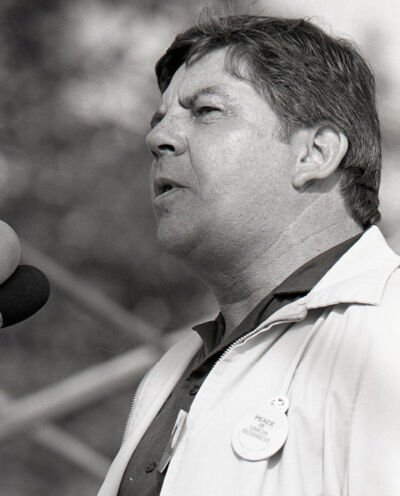
Mike Kramer speaks at rally following Walk for Peace, 1983. Pacific Tribune photo MSC160-823_28.
In this interview, Mike Kramer discusses the 1983 Operation Solidarity movement in British Columbia. Kramer recalls the initial lack of a cohesive plan following the Social Credit government’s introduction of restraint legislation. When the July 1983 budget was tabled, diverse interest groups emerged and the Federation moved to centralize the response to maintain control.
Kramer details the logistical success of massive rallies, particularly at Empire Stadium, which he felt carried more hope than later demonstrations. A central theme is the internal friction between Federation affiliates, non-affiliates and community organizations. Kramer argues that only the Federation had the ability to lead because its members bore the financial burden of strikes. He justifies the decision to end the action—culminating in the “Kelowna Accord”—by citing the exhaustion of public sector workers, the threat of legal injunctions against teachers, and the realization that the newly elected Bennett government would not be toppled by protests alone. He dismisses calls for a general strike as rhetorical “lunacy” by leaders who didn’t have to deliver.
Contains strong language.
Related Resources
Joy Langan Interview: Union trailblazer, NDP politician
Joy Langan (1943-2009) trained as the first woman apprentice compositor at Pacific Press in Vancouver. As a member of the International Typographical Union (ITU), Joy was elected in 1972 to the union’...
Art Kube Interview Pt. 2: Summer of Solidarity
This interview covers the intense period in 1983 when Operation Solidarity and the Solidarity Coalition brought the province to the brink of a general strike. This interview was conducted by Jum Sincl...
Art Kube Fonds
The Art Kube fonds includes newspaper clippings, flyers, leaflets, research papers, legislation, briefs, speaking notes, press releases, personal notes, photographs, and documents pertaining to Operat...
Mike Dumler Interview: CUPE Leadership, Operation Solidarity, and Activism
Mike Dumler’s union career in the Canadian Union of Public Employees (CUPE) included many elected and staff positions. After coming to Canada from the United States as a Vietnam War veteran, Brother D...
Art Kube Interview Pt. 1: Socialism, Steelwork, and the BC Fed
Art Kube was born in Poland where he attended a socialist kindergarten. He joined the Metalworkers Union in 1949 and became a member of the socialist faction of the Metalworkers Union. This interview ...
Fred Wilson Interview, New Unions and Union Renewal
Fred Wilson recounts his life and work in the labour movement, including his early involvement with the Young Communist League, his time as a labour reporter at the Pacific Tribune, his role in the Op...