
Norm Richards Interview: BCGEU, Operation Solidarity
Norman T. Richards (1922-2000) joined the BC Government Employees’ Association (BCGEA) in the early 1950s, becoming active after a public service strike. He was president from 1968-1995 and saw the association became a full-fledged union. Tom McGrath recorded this interview in 1989. It covers Richards’ early union experience and explores in greater depth Richards’ involvement during the Operation Solidarity movement of 1983.
Under Richards’ leadership, the union grew to 50,000 members and achieved collective bargaining rights under BC’s first NDP government in 1973 — the largest certification ever granted in BC at the time.
Tom McGrath Fonds, UBC Special Collections
Norm Richards, May 25, 1989
Transcribed by Donna Sacuta, June 2026
[00:00:00.340] – Tom McGrath
This is an interview with Norm Richards, former president of the BCGEU. The interview is on May 25th, 1989. Norm, how did you become the president of the BCGEU? How did you get involved with the unionization of the organization itself?
[00:00:24.400] – Norm Richards
Well, you’re going back to the early 1950s. I joined the then BC Government Employees’ Association, I think the day I started work for the government, and I had really no intention of getting involved as far as being active in the union or holding any position in the union. Shortly afterwards, we had a strike in the public service in British Columbia and I was asked to help out, and I reluctantly agreed to become involved during that period, thinking that I would then slip into the background.
[00:01:07.440] – Tom McGrath
Mm-hmm.
[00:01:12.780] – Norm Richards
Shortly afterwards, I was approached to run for an office of the local in Victoria, and I did accept, and then I was elected shortly after that to the provincial executive of the BC Government Employees’ Association. It wasn’t too long after that that I was elected president. I was elected every year or every two years in the latter part of my term till I retired. So that’s briefly the history of how I became involved.
[00:01:49.380] – Tom McGrath
During the term of the NDP, this is when you actually became a union, and because of the decision of the NDP to give bargaining, collective bargaining rights to their employees at that time. Was this in part due as well to the initiative of the BCGEU, the Association at that time?
[00:02:15.670] – Norm Richards
Oh, I don’t think there’s any doubt. We hired a new general secretary in the early part of 1969, I guess, one year after I’d been president. We became a union prior to the NDP taking office. We changed our name to the BC Government Employees’ Union. We were very active and very forceful prior to having collective bargaining. In fact, in some instances, maybe we would walk off the job then when we didn’t have any rights than we did after we had rights and grievance procedure to cover disputes. So I think it would have happened whether the NDP were elected or not, but the NDP did approach industrial relations with a better attitude, and I think they were committed to giving us bargaining rights. But what they did, they appointed a commission to look into collective bargaining in the public sector, and we traveled Canada-wide looking at provinces that did have collective bargaining, such as Saskatchewan that had collective bargaining for years under an NDP government. When we obtained collective bargaining, and I can remember appearing before the Labour Relations Board when we were—our application for certification and all the work we had to do and re-sign all our members. We were granted certification, and at that time, that was the largest certification that had ever been granted in the province of British Columbia.
[00:03:59.330] – Tom McGrath
Because of the numbers involved.
[00:04:00.640] – Norm Richards
Because of the numbers, the size of our membership. We did reach a peak at one time in our union of 50,000 members, which is a very large union.
[00:04:11.960] – Tom McGrath
Yes, that’s true, that’s true. During the the period of growth, and that really is the period of growth of unionization in the 1970s, and then it starts to tail off in the early 1980s because of the recession/depression that hits. There is an almost a pronounced attempt on the part of Bennett to try and control, minimize, cut back on the employees, cut down on collective bargaining rights. That even precedes the restraint program that he introduces in 1983, because the restraint program really does begin in 1982, sort of thing. Was t hat restraint, the six and five of 1982— was that a premonition of what was going to happen in 1983, would you think?
[00:05:07.180] – Norm Richards
Well, I think the government of the day, and I’m speaking now of Premier Bennett the younger rather than Premier W.A.C. Bennett. In my term of office, we’ve dealt with not only W.A.C. Bennett but Premier Bill Bennett. And yes, they really did figure that they probably would—I don’t think there’s any doubt that they were out to break the union. We had become a very powerful union, although we were, I think, a very democratic and social conscious union. I don’t think we were by any means radical in the sense, but at the same time, we were no patsies either. We would stand up for our rights and our membership. I don’t think that there’s any doubt that it went beyond government. I think business in general were blaming public sector unions for maybe leading the way. One could go back to— and you won’t have to go back too many years when you could hardly live on a government salary. We had clerks taking home very little money, and it took some drastic means to bring them up to salaries they could live on. Even today, I don’t think government salaries are that great in comparison with other salaries.
[00:06:45.350] – Norm Richards
In fact, in many occupations, they’re lagging badly. But one thing in the early days, in the early 1950s and maybe up into the 1960s even, fringe benefits in the government sector maybe were a little better than the private sector, and pension plans. But in saying that, I should point out that in the government and the public sector, we pay for our pension plans and we’re forbidden by law to negotiate pension plans. But we contributed an awful lot of money into pensions, billions of dollars, and where in the private sector it’s fair game to bargain pensions, and usually the government puts some—or the employer with so much money in an hour. So there’s a terrific difference in pensions. Now even the private sector has pretty well caught up on pensions. They don’t—public sector pensions are not that much better now than the private sector. Now when I’m talking about the private sector, I’m talking about the unionized private sector. I think some of the problems we’re facing is this $5 an hour wages or less that they’re paying in the province now, and it makes anyone’s salary that’s organized look good in comparison.
[00:08:01.730] – Norm Richards
But you either have to be out on pension or a young child living at home in order to live on that type of money. What’s going to happen after they spend a few years working at McDonald’s or some such operation like McDonald’s? And one can look at the whole service industry. There’s a little bit of it unionized that probably is keeping up, but there’s so many employees in the service industries that aren’t organized, and they’re all working for that type of salary. You cannot live on those salaries. So there was a great attempt by Bill Bennett, Premier of our province at that time, to try and curtail the growth of clerical work, and the women especially in the public sector, and that’s what brought on the battle. Every time our contracts expired, we had difficulty keeping up. Now, this privatization is a new thing, really. That’s really— well, it started just at the end of my term of office. It’s really expanded since. Anywhere they do privatize, it isn’t too long if it’s not unionized, that you find the wages are starting to slip badly, or else government in funding those operations are not giving them sufficient money to meet a payroll.
[00:09:29.110] – Norm Richards
That’s exactly what happens in these private hospitals that look after the elderly in this province. There’s usually a lag, no matter what type of work you’re doing in those hospitals, with the general hospitals. Yet they get their money from the government too. So it’s to the government’s advantage to keep wages back in the public sector. But I don’t know what you gain. You probably make employers richer by all this privatization, but you certainly don’t make workers as well off as they were.
[00:09:59.850] – Tom McGrath
No, that’s very true. A lot of the workers actually then have to have two jobs in order to subsist.
[00:10:05.130] – Norm Richards
Or they have to be single living at home, and I don’t mean single family parents, which is another thing that we’re faced with today. Single women especially trying to bring up families and do it on their own income and not receiving adequate salaries. It’s a terrible situation to be in.
[00:10:24.730] – Tom McGrath
With the victory of Bennett in 1982, the electoral victory, and after the battle—I’m sorry, in 1983—and after the battle that he had had with you people in 1982, finally negotiating an agreement in 1982, in August, sort of thing, and suggesting that the way to guarantee employment was to vote for his government, and really then falling back on the whole question of restraint and but never defining what that restraint was. When the budget was brought down, when the various pieces of legislation on July 7th, in 1983 was brought down, had you people started to prepare because you were in a bargaining position because your contract was expiring? Had you people started to prepare for the eventuality of the possibility of a strike because of what Bennett had been talking about?
[00:11:38.440] – Norm Richards
Oh, we certainly did. We were preparing and planning all the time. We have a very fine structure in our union. Financially, we had the money and we had the will to battle if we had to in order to maintain salaries in the public sector.
[00:11:57.460] – Tom McGrath
Norm, when that legislation was first introduced on July 7th, on that Thursday, and then there was really almost an immediate response on the part of the various unions the following week. Operation Solidarity was formed, the Lower Mainland Budget Solidarity Coalition was formed as well. Had the BCGEU worked in concert with the Fed, with people like Art Kube and Jack Adams as well, to respond to that government?
[00:12:40.250] – Norm Richards
Well, certainly. I was not only president of the BC Government Employees’ Union, I was a vice president of the BC Federation of Labour. As well as vice president of our national union. So not only in BC, but even at the national level, we were prepared to stand up to the government of British Columbia, and I think we did. Solidarity grew, I guess, beyond all expectations. It wasn’t only trade unions affiliated to the Fed, I think all trade unions in the province supported Solidarity, such as the Teamsters, which are a very large, strong organization and not affiliated to the family of labour in BC or Canada. So we were prepared for a battle. Then we also recruited teachers, for example, very strong supporters. They were outside of the labour movement, their own union, in their own right. Pensioners groups, just about every organization that you can think of supported Solidarity. In our first rally, I think in Empire Stadium, was an indication of how successful we were, almost too successful really.
[00:14:08.360] – Tom McGrath
With the 40,000.
[00:14:10.630] – Norm Richards
Yeah, and then in Victoria, it was just as great, really. I’ve never seen so many people in my life. Well, I would think that was an underestimate, anyone that was there.
[00:14:20.790] – Norm Richards
You couldn’t see Government Street or all the lawns all the way back to the water and then the parade down to the buildings. It was just fantastic. It was really moving support, really.
[00:14:37.360] – Tom McGrath
Did you have any close contacts with any of the seniors’ groups as they were functioning?
[00:14:43.780] – Norm Richards
Yeah, we used to meet on a regular basis. You mentioned Jack Adams. Jack Adams worked for our union, not for the Fed. He was a senior administrative officer in our union, and Jack did take part in a lot of the planning that had to do with the Fed because every union had representatives at all those meetings.
[00:15:16.710] – Tom McGrath
Yeah, okay, Jack was the Secretary-Treasurer of the Fed at that point.
[00:15:22.080] – Norm Richards
No, no, the Secretary-Treasurer at that point was Mike Kramer.
[00:15:27.350] – Tom McGrath
Oh, I’m sorry, you’re right.
[00:15:29.410] – Norm Richards
Cliff Andstein worked for our union. He’s now the Secretary-Treasurer of the Fed, has been now for quite a number of years. Art Kube was the president of the Federation at that time.
[00:15:42.810] – Tom McGrath
And Jack was the connecting link basically between the BCGEU and the Fed.
[00:15:52.210] – Norm Richards
Yes, that’s a fair statement. Well, there was so much going on at that time that we had to have different people attending different meetings. Jack played a tremendous role in representing our union at a lot of these different meetings, including meetings of the Federation.
[00:16:14.520] – Tom McGrath
Why did you—in July 25th, you sent out a memo saying that the government couldn’t be trusted and we had to be very, very careful in our negotiations and dealings with them.
[00:16:28.460] – Norm Richards
Did that memo go out from me?
[00:16:29.760] – Tom McGrath
Yeah, I didn’t know whether it went out from you. It has your signature on it.
[00:16:33.560] – Norm Richards
Yeah, it did then. Yeah. That was the government that proved that you couldn’t trust them and that they were becoming unpredictable, even as they are today. The government in British Columbia is very unpredictable. I don’t know where they’re heading today, having retired, but when one reads the newspapers, there’s one thing after another being privatized. I’m sure, as I’m sitting here, that it’s at greater cost than when the government was performing the service themselves.
[00:17:11.070] – Tom McGrath
And so it basically then, just because of what had happened in the past and what they were projecting through the legislation that made you apprehensive about what they were projecting through the privatization, through the Bills 2 and 3, which simply took away the union rights, seniority question?
[00:17:32.960] – Norm Richards
Yeah, I think the big thing was the controlling of wages to try and lower all government employees’ salaries, or hold them still while everyone else was moving ahead. The privatization really hadn’t got underway at that time. That came a little bit later, as I recall. But, oh, there was legislation proposed in British Columbia to fire without just cause, for example, just go through the service and they didn’t like the colour of your hair to tell you to go down the street. Well, we weren’t going to stand for that.
[00:18:09.200] – Tom McGrath
Matter of fact, John Shields was one of the people who was fired.
[00:18:12.770] – Norm Richards
That’s true, yeah, and Diane Wood.
[00:18:15.770] – Tom McGrath
Diane Wood as well, yes. Both of them fired.Well, there were hundreds fired, really. You’d go to work and they’d give you your notice, whether you’d been there 10, 15 years and somebody else there maybe only a short term.
[00:18:31.990] – Tom McGrath
Right.
[00:18:32.680] – Norm Richards
There was no justification at all. We had that legislation changed, to fire without just cause, but only because of the union. If our union hadn’t stood up to government, that would have passed.
[00:18:47.800] – Tom McGrath
But they did, in fact, then make amendments with new legislation that almost permitted them to do— they just simply changed the wording.
[00:18:57.830] – Norm Richards
Not really, and we bargained the terms of termination. They had to offer other jobs on a seniority basis. It was a vast improvement over what they intended to do.
[00:19:15.250] – Tom McGrath
Right. You had mentioned that Jack had done a lot of work in looking after your interests with the Fed, this sort of thing.
[00:19:25.590] – Norm Richards
And other groups. And unions.
[00:19:29.540] – Tom McGrath
With both the groups and the unions, because he was the chairperson actually of the Trade Union Steering Committee, and in that position was very, very important for the Operation Solidarity activity. Did he keep then in close touch with you as well?
[00:19:48.210] – Norm Richards
Oh, absolutely. He was working here, working—he was an employee of our union. Yeah, we played a tremendous role actually in the organization of Solidarity, and I don’t say this in the bragging sense. We have the halls and everything for meetings. As I said before, we had the finances in order to do it. A lot of these groups were short of money. So I think probably the public sector played as large a role as anyone in organizing solidarity.
[00:20:24.580] – Tom McGrath
In the context of just the funding or through the assisting with—
[00:20:30.590] – Norm Richards
No, through our work and I think, probably our ability to contribute and to organize. We’ve had a long history. For instance, one looks back when W.A.C. Bennett, Bill Bennett’s father, took away payroll deduction of dues from our organization when we were BC Government Employees’ Association because of our affiliation at that time to the BC Federation of Labour. We had to go around this huge province collecting every month from all our members a $2 membership fee is what our dues were at that time. It was a terrific job and at that time, our union had withdrawn from the Federation. That’s before my time. They withdrew because of the lack of funds to pay any extra affiliation dues, and they had a mammoth job of trying to collect them every month. So there’s no doubt about it, the government was ruthless and never did care for unions all the 17 years that I was president of the union, and things haven’t changed a bit today.
[00:21:43.450] – Tom McGrath
With that connection, did you participate in any of the steering committee discussions that took place.
[00:21:53.920] – Norm Richards
Oh yeah. I was a vice president of the Fed.
[00:21:55.830] – Tom McGrath
Right.
[00:21:56.720] – Norm Richards
So I was very active at the Federation level. I traveled around the province on behalf of the Fed to different areas.
[00:22:03.370] – Tom McGrath
And gave speeches.
[00:22:04.350] – Norm Richards
Gave speeches, yes, and marched in parades and whatever.
[00:22:08.440] – Tom McGrath
Okay, in those parades, because there’s a marked escalation that takes place. From the very first one, which is put on by the Lower Mainland Budget Coalition on the 23rd of July.
[00:22:23.440] – Norm Richards
No, that was put on by the Federation.
[00:22:25.670] – Tom McGrath
Well, they eventually then supported it, the Fed. The Fed was—Kube didn’t want them to have it.
[00:22:31.120] – Norm Richards
Well, I remember what you’re—that’s not really quite factual that we didn’t want them to have it, but we didn’t want them going off on a tangent by themselves. But I can’t remember whether I think we picked the dates. I’m not—I can’t recollect how it came about, but we knew we had to keep control, that we couldn’t have little groups going off in their own direction, and we certainly would have had a failure. So the Federation got control of it, and they organized and did everything for the rally that was held at the Empire Stadium and every other rally.
[00:23:05.960] – Tom McGrath
Okay, so that’s the one, you see, and this is why I’m talking about the escalation. The first one, which is about 25,000, is the march from the downtown station over to BC Place. This is put on by the Lower Mainland Budget Coalition that was formed.
[00:23:22.810] – Norm Richards
That would have been, alright. I wouldn’t have anything to do with that.
[00:23:25.200] – Tom McGrath
Yeah. And then on the 19th, there was a rally which was a spontaneous thing over in Victoria, about 6,000 people.
[00:23:33.250] – Norm Richards
No, that was not a spontaneous thing. These things were all organized.
[00:23:37.770] – Tom McGrath
Yeah, that’s a poor term on my part. It was made to look as if it was spontaneous because on the 27th, then you had that massive rally, which, you know, there was 27,000 people there and you say probably more. And I think that it, you know, because there was the estimations are from 25,000 to 35,000 actually there. And then the Empire Stadium one, which is 40,000 plus, and again, that varies between 30,000 and 50,000 numerically. But was this—because you talked about the control situation—was this to make sure that you people knew precisely how you would be able to negotiate with the government?
[00:24:22.890] – Norm Richards
No, I don’t know if the control is the right word to use, but to organize on such a scale, one had to have a procedure to go through and prepare for a tremendous undertaking to put on these rallies. It just didn’t happen. For instance, the march where we marched downtown Vancouver, I can’t recollect now just how many was in that parade, but I’ve never seen a parade like that.
[00:24:58.200] – Tom McGrath
70,000 at least.
[00:25:00.680] – Norm Richards
Absolutely, and we almost caught up to people still in the parade when we were at the finish line. It was just fantastic, really.
[00:25:11.470] – Tom McGrath
Yeah, it took two hours. Two hours, yeah, to pass any given point.
[00:25:15.760] – Norm Richards
Yeah, but all this took planning. I mean, they don’t, that didn’t just happen. I mean, that was a concern. Like, we—I think we came so powerful that one had to be careful, otherwise you really would be taking on creating anarchy, I guess, and maybe overthrowing government. I’m not sure. At the same time, you had to stand up to them because they’d have ran roughshod all over us if we hadn’t.
[00:25:55.200] – Tom McGrath
When the first— people first started to talk about strike activity, and that really happens in July, you see people mentioning it, and job action is talked about repeatedly. This is obviously just part of the tactics that were being employed.
[00:26:15.180] – Norm Richards
Well, a lot of it was contracts too. We’re all coming to some planning went into as well ahead of time. But we, after Bennett’s speech on television, I just forget the dates now, but It was obvious that we were going to have a battle at the bargaining table. I guess our union was the first union to strike. But it was probably a foregone conclusion that it was going to take some drastic action in order to get an agreement.
[00:26:56.970] – Tom McGrath
How did you feel about the steps that were taken by the people at Tranquille?
[00:27:03.560] – Norm Richards
Well, that was our union as well.
[00:27:05.080] – Tom McGrath
Yeah, of course it was. Sure. The occupation that began on the 15th of July.
[00:27:09.420] – Norm Richards
Well, I think there’s an indication today in what’s happening in society where they’re closing mental hospitals. You see people wandering around the streets, maybe American cities that were the first ones, I think, that I know of to start closing mental institutions and releasing people. It’s kind of a sad case, really. We were not opposed to closing the institutions if there’s a better way, when government’s responsible for funding and you start off with group homes and everything’s fine for a year or so, and then there’s not sufficient funds or no increase in funds to carry on, pretty soon the whole system falls apart. And I think there’s no doubt today that’s exactly what’s happened. It’s slowed down a little bit. I think they had plans to, and probably still have, to close one in Victoria, Glendale. And another one on the Lower Mainland. Actually, I don’t think anyone likes to see people in hospital, but when you have such a highly trained group of workers to look after these people, and anyone that went through places like Tranquille and had the stomach to even go through and see the type of patients that were there. One had to have a very strong stomach to stand it, really.
[00:28:37.180] – Norm Richards
To work there every day, it’s just beyond one’s imagination, really, what you put up with.
[00:28:46.120] – Tom McGrath
No, because it was—the occupation, I think, was as a tactical move just a superb, but it also reflected their commitment to working with those people. And I saw some of the rough cuts as they were making the ‘Common Cause’, and quite moving.
[00:29:09.640] – Norm Richards
Yeah, it’s very moving. One only has to spend a few hours in one of those hospitals.
[00:29:17.410] – Tom McGrath
And when—because you had mentioned your involvement too with the rallies and so on. Which one of those rallies struck you as being the most significant, the most imposing, as a reflection of what in fact was transpiring?
[00:29:42.390] – Norm Richards
Well, I think the Victoria rally. Where Victoria becomes so important, Victoria is the capital of British Columbia, that’s where the legislative buildings are located. It was the seat of government, so everything that happens in Victoria is very important. If one put on a show in Victoria and it wasn’t a success, then I think probably it would be the start of the downfall. So I think Victoria is very important. Naturally, the Lower Mainland area being so large and containing the bulk of the population of British Columbia, it’s also very important, those two areas. But we had other rallies throughout the province, and they were all, in my estimation, very successful. I attended several of them and was really pleased on the turnout and the support.
[00:30:36.610] – Tom McGrath
In the local areas, like in Kelowna or Kamloops, this sort of thing?
[00:30:40.860] – Norm Richards
Well, in Kamloops, we couldn’t get everyone in the hall. Had the largest hall we could find. There was as many people outside as inside. I spoke at that rally and I think it was very successful. Everyone had walked off the job to come to the meeting. That in itself is an indication of support. People go without a day’s pay, even with the wages what they were. You can tell by the expression of the members at the meetings that they were really behind the leadership.
[00:31:23.970] – Tom McGrath
As the thing progressed, Norm, would you say that the membership of the GEU, that they were favourably disposed to the possibility of eventually a general strike as it escalated, or would you think that they would have been opposed? I raise this question because the poll that was taken by the province in the week of the 14th—yeah, the 12th to the 15th—indicated that there was, you know, 60% of the people polled were opposed to what the government was doing and thought that they should rescind the legislation, the budget.
[00:32:14.620] – Norm Richards
Well, start out by saying we didn’t want a general strike because it would have been disruption. One can only stand so much disruption on a scale like that and keep any sanity at all. So we were opposed to having to go that far. Had we gone for a general strike, there’s no doubt in my mind it would have been successful. But I want to emphasize again that would have been the last thing, the last straw, a general strike. We may have looked at other means of tying up the province, which we found there are many ways. Economically, we could ruin cities, we could ruin businesses when we were so united. For instance, if we decided we weren’t going to shop in the Woodward’s in the city of Victoria, when probably the vast number of customers in those stores were public employees in that particular city, we had a tweremendous clout. In fact, we were realizing as we went on, just how strong we were as a group, how much power we had. So we had to act responsible. I think we did. I think we were very responsible. Otherwise, there probably would have been chaos.
[00:33:36.250] – Tom McGrath
So that in the negotiations that Cliff was involved with in late—and they broke down a number of times, and we mentioned the fact that in the first part, prior to the 15th, the negotiations broke down, and then Bill comes on with this fireside chat on the 20th, 5 days after the massive march passed. And, you know, then on the 24th, negotiations open again. Is that a reflection of your flexibility and—
[00:34:13.640] – Norm Richards
I think the opening, reopening of negotiations was a suggestion from us that we made through the media at that time, and the government picked up on it. We started bargaining in the Labour Relations Board offices. Cliff and I were co-chairpersons of the bargaining committee, and I guess it’s history what happened there. We eventually reached an agreement, all right, but we only reached an agreement with approval of all the organizations that were in Solidarity. If there hadn’t been an agreement, then I suppose we would not have signed the agreement with the government.
[00:34:55.280] – Tom McGrath
In the negotiations that took place, was this part of the plan to protect the public sector unions? Because the escalation, as it was set up was specifically, you people were already on strike as of November 1st. Then on the 8th, the teachers went out. And then on the 10th, the ferry workers and so on were supposed to go out, but they then signed an agreement on the 10th and didn’t go out. Transit workers were supposed to go out on the 14th. This sort of thing. So there is a—
[00:35:33.200] – Norm Richards
Well, we had—that was planned. We would have accelerated that way, all right. But I just forget the point you mentioned there before you got into each one accelerating.
[00:35:47.790] – Tom McGrath
Well, I was specifically asking about the negotiations and the agreement that you came to was primarily to look after the public sector unions.
[00:35:58.920] – Norm Richards
Well, we were bargaining the BC Government Employees’ Union contract at that time. But we had to get approval of all the other unions before we accepted. We would not have accepted had we not had approval of the Canadian Union of Public Employees and the teachers and everyone else.
[00:36:16.590] – Tom McGrath
Oh, right. So this is— but this was the individual
[00:36:18.900] – Norm Richards
Bargaining for the BC Government Employees’ Union.
[00:36:21.310] – Tom McGrath
Yes, that’s right.
[00:36:23.030] – Tom McGrath
But when you and Cliff were doing this bargaining that week from the 10th, sorry, from the 7th on, when this was taking place in the Labour Relations Board. Then I guess there was pressure that was put on you from what, Jack Munro and Mike Kramer to come to an agreement?
[00:36:52.970] – Norm Richards
Oh, not really. No.
[00:36:54.240] – Tom McGrath
There wasn’t eh?
[00:36:56.760] – Norm Richards
No, we wouldn’t have stood for any pressure.
[00:37:03.720] – Tom McGrath
Why not?
[00:37:04.990] – Norm Richards
Because that was our bargaining. But there was no pressure on us.
[00:37:09.720] – Tom McGrath
None at all from Jack after he had made—because see, your agreement is made after he makes his agreement with Spector on the 11th or 12th.
[00:37:19.190] – Norm Richards
Well, that’s—he really didn’t make an agreement with Spector. I mean, that was a committee decision. I didn’t sit on that committee because I was at the Labour Relations Board. Well, I could have been there and not at the Labour Relations Board, I guess, but that’s where our union was bargaining. They made a decision to go to Kelowna, if that’s the meeting you’re referring to.
[00:37:45.910] – Tom McGrath
Yeah, that’s when he goes to eventually on the 13th. And your agreement is made on the 12th, but he, on the 11th, the night of the 11th and 12th, makes his agreement with Spector and Kelleher, and that’s when they have to—but the real problem is, see, you people are the ones on strike, and so his agreement really is irrelevant.
[00:38:04.410] – Norm Richards
No. If he did make an agreement, I’m not aware of it. There was no interference on our union.
[00:38:10.740] – Tom McGrath
From him?
[00:38:11.450] – Norm Richards
From him.
[00:38:13.840] – Tom McGrath
That’s really interesting because I had thought that because of the tentative agreement they had made with Spector.
[00:38:25.170] – Norm Richards
I know nothing about that. We were the ones—Spector was at the bargaining table with us.
[00:38:31.750] – Tom McGrath
Well, he had two hats, it seems to me, because he was bargaining with you people, but he was also negotiating with Munro. Munro had been talking with Jim Matkin and Jim Kellaher and got involved on the 10th.
[00:38:47.880] – Norm Richards
Well, it wouldn’t have bothered us, our bargaining. We were the ones at the bargaining table. I hope you don’t think that I was going to agree with something negotiated, not on the table.
[00:39:03.290] – Tom McGrath
No, in this regard, I’m still unclear about this, and I talked to Cliff about it as well, because it seemed to me—
[00:39:09.620] – Norm Richards
What did Cliff say?
[00:39:09.740] – Tom McGrath
Well, Cliff said that he was working totally independently of Munro, and he said he didn’t even know that Munro had made the agreement. He only learned that after the fact that he had made the agreement.
[00:39:28.250] – Norm Richards
Well, if I didn’t know about it and we reached an agreement, I don’t see how they had reached an agreement without telling us, how we could have agreed on the same.
[00:39:45.090] – Tom McGrath
Well, see, this is where I’m really having some problems because I spoke to Jack Adams about it as well because I was trying to piece together the various connecting links on the thing. And Jack said, “Well, Munro contacted us,” and phoned all the various members of the Trade Union Steering Committee and said, “This is a tentative thing, but it looks like it’s going to fly. Now what we have to do is BCGEU has to make their agreement.”
[00:40:21.790] – Norm Richards
Yeah, well, see, we were operating as one large organization. Like you said that the teachers were going on strike and CUPE was going on strike and somebody else was going on strike, which is true. What I said to you, we were bargaining individually, we would never interfere. But at the same time, we weren’t going to go out and reach an agreement without approval of the other ones.
[00:40:44.030] – Tom McGrath
Right.
[00:40:45.170] – Norm Richards
And there’s no doubt about it that Art Kube as president of the Fed played an overall role as well as we kept all the unions informed. Even Jeff Rose came out here and met with the Labour Relations Board and marched on our picket lines and everything else. So no doubt that we were together and there were numerous meetings taking place, all right, but certainly no one told us what we were going to accept at the bargaining table. We’d have refused what we finally came up with in the way of layoffs and everything in the public sector and money. We’d have still been out.
[00:41:35.730] – Tom McGrath
Well, then, Norm, because you see, Munro is negotiating in the Labour Relations Board building. You people are negotiating in the Labour Relations Board building as well, at the same time, on different floors.
[00:41:54.490] – Norm Richards
But not on our contract.
[00:41:56.330] – Tom McGrath
No, no, no. He’s talking about the overall picture through Operation Solidarity because, you know, as you remember, Art got sick and so Munro and Kramer took over. Because Kramer was the Secretary-Treasurer and as First Vice President then Jack moved in as well. Then Jack virtually did most of the agreeing, but he got Mike to accept it as the CUPE representative of the agreement. Again, the term agreement is almost— doesn’t make any sense because it’s a verbal agreement.
[00:42:37.470] – Norm Richards
Who was the agreement with?
[00:42:39.550] – Tom McGrath
Well, it’s with Spector at this point to try and satisfy, to keep the $18 million in with the education to be spent there so that the teachers would go back.
[00:42:56.130] – Norm Richards
Not being there, I really can’t comment on anything that went on outside of the bargaining table that I was at.
[00:43:06.780] – Tom McGrath
And so you—
[00:43:08.650] – Norm Richards
No one interfered with our bargaining. If they did, I’d know. It was unknown to me and had nothing to do with the recommendation of acceptance of our contract to our members.
[00:43:24.740] – Tom McGrath
Well, then see, I guess the person who seems to be almost a linchpin in the connecting link is Spector because he’s doing bargaining with you and he’s doing bargaining with—
[00:43:37.140] – Norm Richards
That’s possible. I can remember one time telling him on television that if he’d stay in the bargaining room and stop going out talking to the press that we’d probably have an agreement. He moved around all right, Spector, and there’s no doubt about it, he was in the government at times, I think. He had a very close relationship with the Premier of the day.
[00:44:08.090] – Tom McGrath
No, that’s very true. When that agreement was made, Cliff made reference to it being a no concessions agreement.
[00:44:19.000] – Norm Richards
Yes. His words.
[00:44:20.110] – Tom McGrath
Yeah, and I questioned him on that because I wondered whether in fact it couldn’t possibly have been an even better agreement because of the potential that you had for pressuring the government to yield even more. And in relation to the actual numbers that were involved, because you had all those people out and then CUPE and those people were going on Monday along with the transit workers, so that you virtually had, you know, you were moving towards a real close down of the province. Interestingly enough, Cliff said, well, he hadn’t thought of it in that sense, because he was more concerned just of getting an agreement for the BCGEU.
[00:45:12.680] – Norm Richards
Well, I have thought of that, all right, but I thought we did very well, and I really believe it was a no-concessions agreement. I think we moved ahead in just about every area, including money. I don’t know whether one is ever satisfied. You always think you could do better. I guess hindsight is a wonderful thing. I was pleased, otherwise I wouldn’t have recommended it. And in our union, if we didn’t recommend it, it probably wouldn’t have passed.
[00:45:53.060] – Norm Richards
But we never, never went out to our membership without a recommendation. If we hadn’t thought as an executive that it was—if we’ve done properly the best we can do, we would have not recommended it.
[00:46:13.590] – Tom McGrath
Would it have been possible to take a vote before sending them back on the agreement?
[00:46:17.780] – Norm Richards
Oh, we did take a vote.
[00:46:18.560] – Tom McGrath
Oh, you took a vote, but not before sending them back?
[00:46:22.510] – Norm Richards
Uh, I’ll have to stop and think here.
[00:46:26.260] – Tom McGrath
No, because I asked—
[00:46:26.990] – Norm Richards
Yeah, I think you’re right. We went back to work.
[00:46:31.340] – Norm Richards
Yeah, we made that decision that we would return to work. Mind you, our members were losing pay all the time they were off. Our strike pay hadn’t yet kicked in, and a lot of people feeling the pinch, as supportive as everyone was. And we thought we’d done very well if we sent them back. If it hadn’t passed, we’d have them back out on strike. It might have been unusual, but at the same time, I think you always have to keep in touch with the membership on their financial situation. We do pay fairly good strike pay, but we don’t pay anything for the first week.
[00:47:16.230] – Tom McGrath
Oh yeah, and so once it kicks in, so that was, that would have been the beginning of the second week.
[00:47:23.090] – Norm Richards
That’s right, yeah. But that wasn’t the reason why we made that decision, although I have difficulty remembering all the dates now. It seems so long ago, but we definitely as an executive, that’s a 21-person executive, made that decision, returned to work.
[00:47:49.030] – Norm Richards
So I think that in itself shows that we thought we had done well. (approx. 60 seconds of blank tape)
[00:48:32.610] – Norm Richards
I can’t recall now the approval in the vote by the membership, but it seems to me it was quite a good percentage. Maybe you have those figures, I don’t know.
[00:48:44.730] – Tom McGrath
The only thing that— and I asked Cliff about this and Jack, you know, because it— and they both said that, well, it wasn’t a normal procedure, but the same sort of the negotiations that were taking place, but they both said that it was an abnormal situation because of the other strikes that were—and the teacher strike specifically that was in progress— and the others that were planned. So that does really make it different. There’s no question of that.
[00:49:16.280] – Norm Richards
Well, there’s no doubt about it. It was a unique situation. You have so many unions, and not only unions, but we had groups in society such as pensioners and even small business people were supporting it.
[00:49:36.240] – Tom McGrath
In that regard, would it have been possible, do you think—and again, this is hindsight telescoping here—would it have been possible to have brought some of those issues to the bargaining table with the government?
[00:49:51.590] – Norm Richards
Issues of other groups?
[00:49:52.780] – Tom McGrath
Yeah.
[00:49:55.280] – Norm Richards
It would have been impossible, I think, under the laws, as I mentioned earlier, that we’re even forbidden to bargain pensions, etcetera, in this province. So one is pretty well restricted to working conditions and grievance procedures. Money.
[00:50:24.180] – Tom McGrath
But would it have been possible to have, really, to have, I guess, transcended the legal boundaries that were set up?
[00:50:38.610] – Norm Richards
Well, we pretty well had limited the bargaining to things that affect our own membership under the contract. But the way we supported the other groups, that the other groups hadn’t thought that government was moving and making commitments at other levels of our committees, we wouldn’t have accepted either because we said we won’t—we told the government that unless we got approval of all the groups and unions involved, that we wouldn’t be taking our contract out for a vote.
[00:51:08.700] – Tom McGrath
Yeah, but if you consider, for instance, the Human Rights Commission, which the government said they were going to keep around, and then they virtually emasculated it so much three months later by March.
[00:51:24.200] – Norm Richards
Well, hindsight is a wonderful thing. I guess the labour movement— I’m speaking of the labour movement, all of it in British Columbia— probably accepted the Premier’s word that that he would move in these different directions. Plus the groups in giving us approval to go back to work probably thought the same. It’s an awful thing. I don’t think there’s any doubt that the Premier, if he’d have stayed in office, would have been kicked out of office too by the people of British Columbia. Those are the type of things I think when one is not honest, time it shows, you’ll trip up.
[00:52:09.910] – Tom McGrath
How did you feel in working with the private sector unions, the IWA?
[00:52:15.350] – Norm Richards
We had a fine relationship, fine relationship with all unions. I think our union for years played a tremendous role in the labor movement in this province. One time we were about on par with the IWA for size. Eventually, I think we exceeded the IWA because of a lot of cutbacks in the forest industry. There’s another example with your privatization. At one time, all the inspection services used to be in government. For instance, the government had all the scalers, not just a few supervisory ones and our scalers would scale the wood, know how much the companies were taking. Now they have all the scalars. And the same with other inspections.
[00:53:03.310] – Tom McGrath
Yes, that’s true.
[00:53:04.460] – Norm Richards
It’s just unbelievable what’s happened in this province.
[00:53:08.120] – Tom McGrath
No, it really is. In the non-affiliates, how did you feel the relationship was with them? And I’m thinking specifically of the Hospital Employees’ Union or the CCU.
[00:53:23.650] – Norm Richards
Very good. I don’t know of any that we didn’t have a great relationship with. It did more to bring the union movement, even Teamsters. We had a wonderful relationship with Teamsters all during Solidarity. They had people in all our meetings.
[00:53:39.750] – Tom McGrath
Well, what happened then on November 3rd when the CCU, because of the Operation Solidarity Steering Committee, they decided to turf out the CCU representatives. You see, this is just when negotiations are getting back on track with the BCGEU.
[00:54:02.790] – Norm Richards
I can’t recollect that myself. I’m not saying it didn’t happen, but I probably was involved at the bargaining table at that time. It was through our negotiations that someone would have been there. Jack probably was there and could answer that question.
[00:54:20.660] – Tom McGrath
Yeah. Well, no, I did ask Jack about it and I asked Art and so on. And basically what, because there seems to be confusion. Joy Langan said, ‘Well, it was a very nice excuse because the relationship was very difficult at the best of times.’ As an example, Mike Kramer said in September that they didn’t have to pay the $5 per capita fee, and on the 3rd of November, Kube makes a statement and says that they’re kicked out because they haven’t paid the per capita contribution. Joy said, ‘Well, you know, Jack didn’t get along very well with the Pulp and Paper Workers’ people.’
[00:55:08.640] – Norm Richards
Oh, yes, we did get along very well with Art Gruntman.
[00:55:11.650] – Tom McGrath
No, no, no, this was the Canada— that’s Canadian. The other Pulp and Paper. You had the really curious situation where the Pulp and Paper Workers are locked out in October and Art supports them. Art Gruntman supports them. The IWA people are crossing lines, and Jack Munro is really having a problem trying to—so it’s a—
[00:55:42.710] – Norm Richards
Well, I can remember faintly, not being involved in those situations, it’s very hard for me now at this date to recollect just what did go on there, but oh, there’s no doubt about it, you had problems. You can’t organize such a massive thing without problems. I can remember the railway workers was coming down to the Labour Relations Board and they wanted to meet, and we met with them and they said, “Oh, don’t bother us with all the details. Just tell us when you want us to go on strike. We’re very supportive and we’ll be there.” That was the type of support we had. Farley, I think, was the head of the railway workers, although I’d never met him before in my life. He said, “Don’t you worry. We’ll be there.”
[00:56:32.460] – Tom McGrath
You see, that kind of— if there’s that kind of support, Norm, like, I’m wondering why the pressure then wasn’t applied even stronger on the government.
[00:56:43.700] – Norm Richards
Well, I guess we took the government at its word. We had bargained our contract subject to approval of the other organizations, which we got approval. There were indications that once one settled, things will all fall in line. You mentioned human rights issues, and there were indications that they were going to do something there. I can’t remember exactly what they said at the time, but it was something that they’ll meet with them and bring something. It was all indications that everything was going to fall into line. We took the government probably at its word and when I say we, I’m speaking of the larger group now.
[00:57:32.750] – Tom McGrath
Yeah, we see this is, because one of the first questions I asked you before had to do with you said we shouldn’t, we can’t trust the government. That to me seems so perceptive. Yeah, so perceptive on your part. Then suddenly, it’s not just you that does it, because Jack Munro does the same thing.
[00:57:56.110] – Norm Richards
Well, I think that was a fine statement that we can’t trust them. I don’t think we could. We didn’t know what they were doing. But there’s a difference in saying that, I think, than then reaching an agreement and shaking hands and saying you’ve got an agreement or whatever. Indications. When I’m saying you can’t trust the government, I think I was probably referring to knowing what they were going to do. For instance, they may have decided to do away with the government service for all I knew. I don’t think you could trust the government to come and have any discussions and have any dialog, that you know their plans, that you think they would do.
[00:58:41.300] – Tom McGrath
No, because this is precisely what they do with the investigation. Not investigation, but the checking of the motor vehicles. They privatized. They got rid of those things.
[00:58:56.510] – Norm Richards
Well, they didn’t privatize, they’d done away with the motor vehicle testing. They just closed the station. But that, under our agreement, the majority of those people were placed in other jobs. I can’t recollect if some took early retirement. We had early retirement provisions. We did negotiate a pretty fair agreement, and then we said, ‘No concessions.’ Those that didn’t take early retirement, I think, were given options, several options. I’m not saying some of them didn’t quit. Maybe they did. I don’t know. But it was a little bit different than just going through and firing them all, and many of them work with government today, that worked for Motor Vehicle Testing Stations.
[00:59:45.790] – Tom McGrath
With the following spring, there are changes made to the Labour Code, which had to do with secondary picketing, which is a means of taking, well emasculating, union rights once again. But there was no upsurge of opposition to it. Was it because they didn’t think it was sufficiently important, or what would you think? I mean, see, you people had signed the three-year contract.
[01:00:25.090] – Norm Richards
I recollect all that. I can’t remember just what action the labour movement did take. Did you ask Art?
[01:00:30.470] – Tom McGrath
Yeah, they didn’t do anything. Art threatened that there was going to be job action and they didn’t do it. But see, he, like to me, and I brought this back to Art a number of times, he kept using that term, you know, the strike and the job action and so on. The government just didn’t pay any attention. Because in January, he did the same thing about the teachers and nothing happened, over that $18 million that was supposed to go back and, you know, then two months later, same thing.
[01:01:11.170] – Norm Richards
Well, probably we may have made some mistakes, no doubt about that. I can’t recollect everything. I can remember, I know you’re right in what you’re saying, but we had indications that that wouldn’t happen in education. I think the teachers were satisfied. They were the ones that had to give the approval, and they thought that things were moving in the right direction. About the secondary picketing, I can recollect that, all right, but I can’t remember what action the labour movement took in that regard at this time. Maybe we didn’t do anything. If Art Kube says we didn’t because Art was president of the Federation, there must have been a reason. There wasn’t support to do anything.
[01:01:55.060] – Tom McGrath
Well, what was happening at that time too, there was a bit of a schism between the IWA and Art Gruntman because Jack was actually suggesting to his members to virtually cross picket lines. As you know, in BC, that just isn’t done. So there was a definite split that was happening there. So that weakened Art’s position appreciably, I think, as to what could be done.
[01:02:26.100] – Norm Richards
I remember that story. I wasn’t involved with that. I think one thing is safe to say, I don’t think unions interfere with other unions. Probably that’s one of our problems, that we have too many unions. I think we have far too many small unions in Canada. They’re not financially or membership-wise strong enough to fight business the way it’s organized today.
[01:03:03.100] – Tom McGrath
When the Solidarity dies out in 1986 as the whole organization, there’s a host of things that take place in between, in the interval. But Norm, in the period, there’s also some changes that take place between— Well, I think that as you mentioned, and I’m talking about some of the exacerbations that take place, the conflicts between Jack Munro and Art Kube. Does that come about, do you think, because of the differences that developed over or during the Solidarity movement? Or is that intimating too much to that?
[01:03:58.930] – Norm Richards
I think so. I think Jack was probably falsely accused of doing something wrong in Kelowna, which he had approval and was sent there. I retired in 1985, so you may be moving on into a period that I wasn’t around longer.
[01:04:18.870] – Tom McGrath
Well, see, the period, 1984, for instance, at the BC Fed Convention, as an example, there’s the battle between Art and Frank Kennedy and Joy Langan for the presidency. Joy is put up specifically by Jack Munro to stop Frank Kennedy. More specifically to give Art more than a scare and hopefully defeat him. That doesn’t come about, and he only wins; Art comes back in in 1984 primarily because they don’t want Frank Kennedy to come in.
[01:05:02.740] – Norm Richards
Well, that would be a matter of opinion. Every real democratic organization, when you open nominations for election, you never know who’s going to be nominated.
[01:05:19.170] – Tom McGrath
Okay, now I’m gonna— because Jack Adams said that, ‘Yeah, that’s right. If it wasn’t for me, that Art wouldn’t have won that election in 1984.
[01:05:29.680] – Norm Richards
Well, there are large blocks of votes at Fed or Congress conventions. Any disciplined organization pretty well votes in a block, and different unions support different candidates. There’s no doubt about that. I don’t know what to say beyond that. You’re always going to get battles. You’re always going to get people supporting and working, and people that always take credit when you’re elected. I think it’s true, what I’m saying is that I don’t know how you stop that type of thing if you’re a democratic organization, which I think the labour movement in this country really is.
[01:06:17.190] – Tom McGrath
Oh, no question of it. It’s the most democratic one that’s around and functioning, as I keep telling people. I’m on TV and radio frequently, and the thing that I keep impressing on people is that if we had governments that were even close to being as democratic as the unions— and there are some bad unions, I always admit that as well— but there’s certainly, in terms of a comparison—
[01:06:45.030] – Norm Richards
Actually, when you check people that hold office in labour unions in Canada, you really have difficulty finding any wrongdoings. I’m not saying there aren’t. There’s bound to be, but basically I think they’re really honorable people. I’ve met an awful lot of people in my lifetime, but I don’t think I’ve met finer people than those that are in the labour movement.
[01:07:13.040] – Tom McGrath
Here I’m going to ask you a question which comes after you have retired. Bills 19 and 20 come on scene in 1987, and there’s that massive one-day strike, general strike as they call it, 300,000 people who go out. I see that as a reflection of the Solidarity movement of 1983, both in the legislation and in the reaction response of the people. The teachers go out, as an example, on a one-day strike on their own in April. How would you perceive the introduction of that legislation in Bills 19 and 20 in 1987?
[01:08:08.000] – Norm Richards
Well, you’re right, I am retired and was out of the picture [laughter]. Yeah, I think it was terrible legislation. Naturally, I support the stand the labour movement took in opposing those Bills 19 and 20.
[01:08:25.560] – Tom McGrath
But would you think that it is then just a continuation on the part of the government? Now, this is Van Der Zalm, and Van Der Zalm who would—
[01:08:34.580] – Norm Richards
I don’t know. I honestly don’t know. It’s surprising once you— when you’re so involved and you get away from it, you kind of pick up pieces here and there, but you lose touch. Like I’m having great difficulty remembering everything, dates especially.
[01:08:58.400] – Tom McGrath
I know you’re just trying to imitate me, Norm.
[01:09:00.740] – Norm Richards
No, I do, I really do.
[01:09:03.180] – Tom McGrath
Yeah, oh no, no, I do too. I do too. My kids always— we have a great joke, and I keep telling my kids I must be getting young like them because they always forget everything. And it’s not just a question of getting old, it’s simply that the young do it as well, and they forget that.
[01:09:21.250] – Norm Richards
It’s nice to think that.
[01:09:24.360] – Tom McGrath
But would you think then, if I can go back to that Solidarity activity, that it was a positive development as you perceived it?
[01:09:37.330] – Norm Richards
I certainly do. Yes, and it was a great experience in bringing people together. When one looks back, I suppose we had the power to make greater advances. If there was any doubt, it certainly crossed my mind that we could maybe do better than we did normally. But at the same time, as I also said before, there’s an awful lot of responsibility in these positions. There’s an awful lot of people’s jobs and their income at stake. It’s not something you would go to bed and sleep at nights and not have the problem there in the morning. Accept the responsibility that you have and you’re right with your decisions.
[01:10:36.150] – Tom McGrath
Why the opposition to the prospect of the general strike? Simply because of that responsibility?
[01:10:42.340] – Norm Richards
Well, I think one realizes that you’re not very far away from chaos with a general strike. We certainly had no plans to bring down government. What we did have is plans to make government take a good look at what they were doing and to make changes. To that extent, we did our best to bring that about, but we certainly had no plans to overthrow the government. There is always the fear there as you take steps to make your points that eventually you reach the point where you’re at— you’ve created a revolution or something in the country. We knew we had to come on strong to make changes to get anywhere. We thought we were quite successful, actually. There’s no doubt about it. With hindsight, maybe there’s other things we should have had in black-and-white prior to returning to work. We should have had all the human rights issues solved and every other issue. But this was something that grew and grew and grew in a very short period of time,and to bring all these groups and all these people together. Thousands of meetings that were held not only in the Lower Mainland area but all over the province.
[01:12:17.550] – Norm Richards
It’s really unbelievable the number of people that were involved, not only planning but then carrying out the instructions to make it a success.
[01:12:29.080] – Tom McGrath
No, I agree with you completely in that, and in the research that I’ve done, when I see the activity that took place up in Campbell River or Nanaimo or Powell River.
[01:12:38.060] – Norm Richards
I went to Campbell River too, Courtenay and those places, Prince George.
[01:12:42.710] – Norm Richards
I marched in Prince George. I have pictures today of our march there and our meetings. Fabulous meetings. I don’t think there was ever a hall that we didn’t have overflowing at all our meetings. It was standing ovations at every meeting. So I know that I felt the support was there, and I think I’ve been around long enough to know when you have support. You can walk into halls and hear people cheering when you just walk in. You know you’re doing something right.
[01:13:24.750] – Tom McGrath
No, it’s really true. Another question which has to do with the collective bargaining. Did you keep in contact with John back in Ottawa? And now John was down here frequently during the thing, letting him know what you were doing.
[01:13:43.660] – Norm Richards
Yeah, he knew what was going on.
[01:13:46.350] – Norm Richards
Up to date, and our national union pledged support too.
[01:13:56.550] – Tom McGrath
They contributed, were prepared to provide all kinds of financial support.
[01:13:59.930] – Norm Richards
And they did. I can remember Gary Doer coming out here and there was a cheque. I can’t remember how much it was. Well, we had the support. It wasn’t lacking. Even the teachers, I think, had support of their national—
[01:14:19.250] – Tom McGrath
Yes. Yeah. The Canadian Teachers’ Federation.
[01:14:22.330] – Norm Richards
They did a very good job, the teachers, actually. I think they’ve grown into a strong organization today.
[01:14:28.680] – Tom McGrath
Much, much stronger than they had been.
[01:14:31.180] – Norm Richards
They’ve done very well, I think, in their bargaining. I think probably they’ve set rates higher than any other union.
[01:14:38.550] – Tom McGrath
Do you think that the BCGEU— now this is a difficult question, Norm, because you’ve been outside of it for a bit— do you think that the BCGEU has become a stronger union because of that activity back in 1983, 1984, 1985?
[01:14:58.330] – Norm Richards
Well, I’m not really in a position to answer that question, I don’t think. Because I have been away. I’m here today, but I only came over to meet with you, really. I really have got away from it. Well, I have done a little bit of work. Worked with Health Science Association for a while. They had some internal problems and I was asked if I would chair a committee to see if we could bring—
[01:15:26.130] – Tom McGrath
Sure, use your expertise. Great stuff.
[01:15:29.250] – Norm Richards
Outside of that, I’ve been really isolated from the labour movement. Not to— one reason I haven’t been enjoying real good health since I retired.
[01:15:42.220] – Tom McGrath
I’m sorry to hear that. I had heard that you had been ill and actually, this is one of the reasons why I thought it’d be much easier for me to go over to Victoria.
[01:15:54.400] – Norm Richards
Well, I was going to kill two birds with one stone and meet with you here, and I thought it may be more convenient for you. I was coming over. They were going to have some videotapes prepared for a history of the BC Government Employees’ Union. First on their own movie. We used to do a lot of that type of work. We have produced a history on our own union. I suppose you’ve read it.
[01:16:25.010] – Tom McGrath
Yes, that’s right.
[01:16:25.810] – Norm Richards
Well, you’ll know when we were certified as a union then.
[01:16:29.450] – Tom McGrath
Yeah, yeah, yeah. Oh, no, no, it’s a nice—
[01:16:33.980] – Norm Richards
I guess you have the Higgins Report too then? So you know about the Higgins Committee and who was on it? I don’t know what else I can tell you. I’ve tried to be quite factual.
[01:16:49.640] – Tom McGrath
No, Norm, you’ve been just fine, and you certainly answered the questions that I posed, and I thoroughly enjoyed it, and I thank you very much.
[01:16:56.680] – Norm Richards
I hope I haven’t wasted your time.
[01:16:58.770] – Tom McGrath
Not at all, not at all. I’m absolutely delighted to have had the occasion because you have been very, very helpful in providing the material and the recollection is there. You had been apprehensive about it, but no.
[01:17:14.630] – Norm Richards
Well, I’m very proud of the BC Government Employees’ Union. I think, yeah, and John Fryer, I think, played a big role in our union. No doubt about it. He came in 1969. He was with us and still is a member of our union. He’ll be out here at the convention on the 12th. Maybe you should come out and do that.
[01:17:37.110] – Tom McGrath
Yeah, no, that would be an interesting thing. I should consider that.
[01:17:42.200] – Norm Richards
It’s not a bad idea to sit in on some of these conventions and you hear all the reports and see how democratic unions are and the elections and the
[01:17:55.450] – Tom McGrath
That’s true. I did a study on CUPE and really interesting because I was at the CUPE convention in 1983 when this was all taking place and I remember very vividly them sending out, reading out the telegram of support to you people in October. I find going to the conventions really quite useful. I’ve been to the CLC a number of times, and I was at the BC Fed just in November, December of last year, 1988. No, no, no. But this one here is on the 12th.
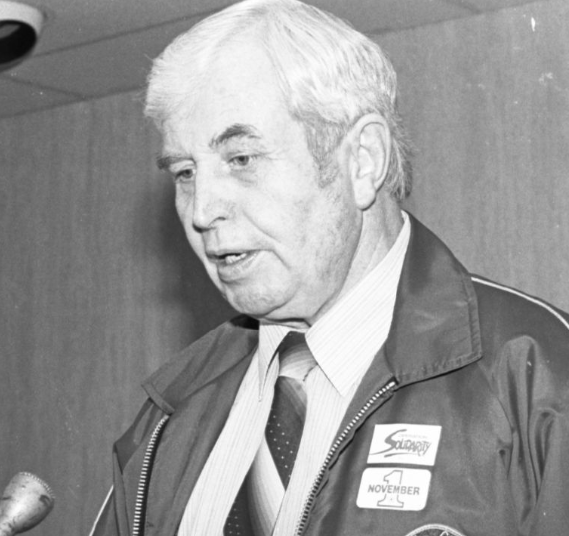
Norm Richards speaking at a news conference announcing the National Union of Provincial Government Employees would donate $3 million to the BCGEU strike fund during Operation Solidarity. Pacific Tribune Photo Collection, Simon Fraser University, MSC160-905_07.
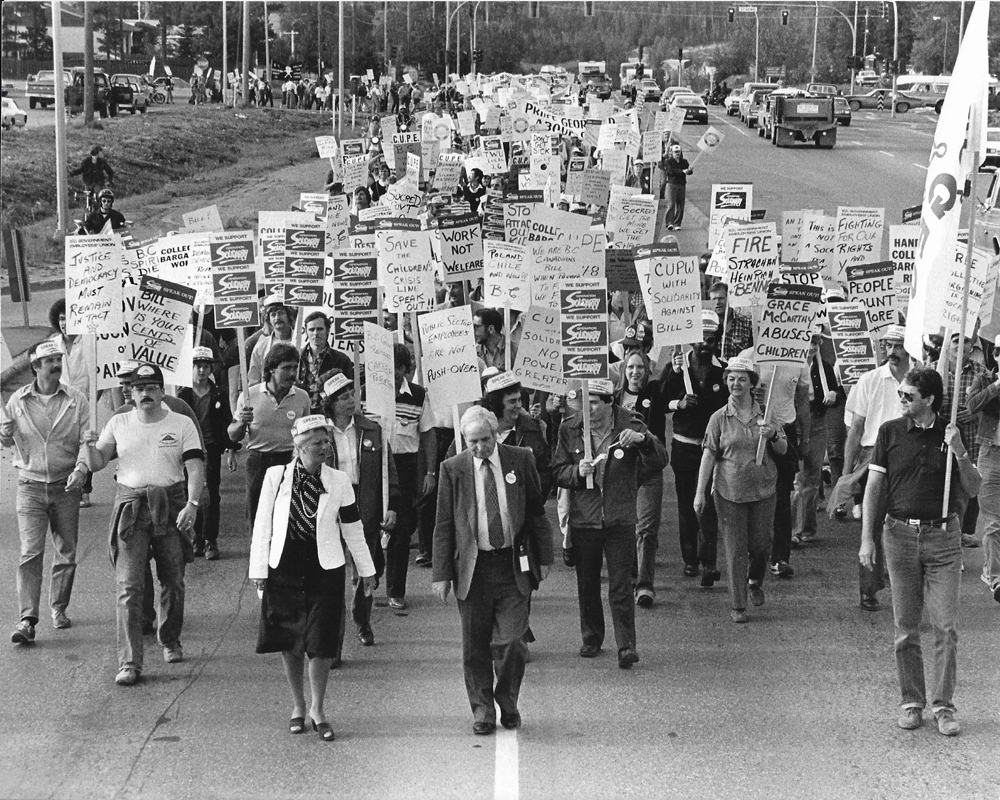
Richards characterizes Bill Bennett’s Social Credit government of the early 1980’s as intent on breaking the union, blaming public sector unions for wage growth across the economy. The 1982 “six-and-five” wage restraint program and the subsequent 1983 legislation (Bills 2 and 3) were seen as direct attacks on wages, seniority, and job security. The July 1983 budget triggered a massive coalition of teachers, Teamsters, pensioners, and community groups under the umbrella of Operation Solidarity. Rallies in Victoria and Vancouver drew tens of thousands; Richards viewed the Victoria rally on July 27, 1983 as the most strategically significant.
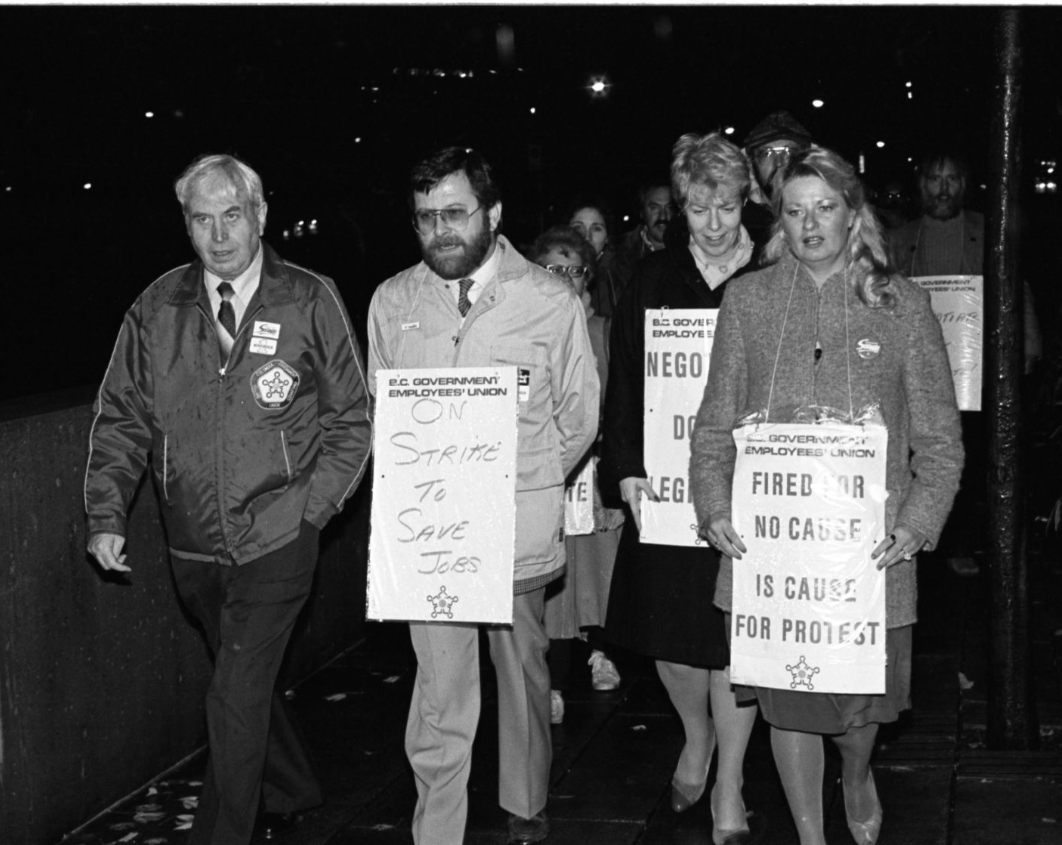
A general strike was deliberately avoided out of concern for the social chaos that would result, though Richards believed it would have succeeded. He co-chaired BCGEU bargaining at the time, reaching a “no concessions” agreement he considered a genuine win on wages, layoffs, and job protections. The BCGEU executive voted to return members to work before ratification, factoring in financial strain after one week without strike pay.
Richards expresses pride in the BCGEU’s democratic culture and its central role funding and organizing Solidarity. He acknowledges in hindsight that more concessions — particularly on human rights issues — should have been secured from government in writing before returning to work.
Related Resources
Russ Leech Interview: The People and Moments that Shaped BCGEU
Russ Leech is from a family of strong trade unionists. His parents organized the Machinists’ Fitters & Helpers Industrial Union local in Victoria during World War II. Given his family’s history, i...
Prince George, BC's Operation Solidarity Experience
The weather forecast for Thursday, July 7, 1983 in Prince George, BC was for heavy thunderstorms in the evening. No one expected a political tornado would be unleashed earlier that day when the newly ...
Cliff Andstein Interview: 30 Years in the Labour Movement
Cliff Andstein is a seasoned activist with over 30 years’ experience in the trade union movement. He moved to BC as a young man, leaving his home province of New Brunswick where he had encountered the...
George Heyman Interview: From Log Scaler to the Legislature
George Heyman was born in Vancouver to parents who were survivors of the Holocaust. They were assisted by the Japanese Consul in Lithuania, Chiune Sugihara, to escape Poland. George attended high scho...
Stephanie Smith Interview: BCGEU President 2014-2024
Stephanie Smith was the first elected woman president of the BC General Employees Union (BCGEU) in its over 100-year history, holding the post from from 2014 to 2024. Born in Canada and educated in Ne...
Patrice Pratt Interview: Women’s Leadership in Unions & Politics
Patrice Pratt was born in Ohio in 1948 and grew up in Arizona in a staunchly Catholic family with five children. She attended Catholic schools and moved to San Francisco to attend the University of Sa...